Table of Contents
- Why Old Pet Urine Odors Linger in Your Carpet
- Step 1: How to Locate Pet Urine Stains With a Blacklight
- Step 2: Test for Colorfastness Before Cleaning
- Step 3: The Best Enzymatic Cleaner for Pet Urine and How to Use It
- Step 4: Home Remedies: Vinegar, Baking Soda, and Hydrogen Peroxide
- Why Carpet Smells Worse After Cleaning and How to Fix It
- When to Call a Professional for Sub-Pad Saturation
- Conclusion
- Frequently Asked Questions
Last Updated: September 6, 2026
Why Old Pet Urine Odors Linger in Your Carpet
Old pet urine odors are not a surface problem, and that is why wiping and spraying rarely fix them. When urine soaks into a carpet, it carries uric acid crystals and odor-causing bacteria deep into the fibers, the carpet padding, and sometimes the subfloor below. This is why the smell returns days after a standard clean, and it is the reason most pet owners feel like they are fighting a losing battle.
Your goal is not just to mask the smell but to achieve actual odor neutralization. That requires breaking down the biological compounds at the source rather than covering them with fragrance. The method below works for fresh accidents, but it is specifically built for old, dried-in pet urine odors that have had months to crystallize.
Below, we will show you exactly how to remove old pet urine odors from carpet, step by step.
American Kennel Club’s guide on removing pet stains notes that the key to eliminating odors lies in neutralizing the uric acid rather than simply cleaning the visible spot.
Step 1: How to Locate Pet Urine Stains With a Blacklight
A blacklight is the single most effective tool for finding old pet urine stains that are invisible to the naked eye. Dried urine residue fluoresces under ultraviolet light, appearing as a yellow-green or pale blue glow against the carpet (peer-reviewed research). This step is critical because cleaning only the spot you can see leaves the rest of the contamination to keep smelling.
Turn off the room lights and close curtains for best results. Move the blacklight slowly across the carpet, marking every glowing area with small pieces of tape or a chalk pencil. Check baseboards, corners, and areas near pet beds, as these are common spots for repeat accidents.
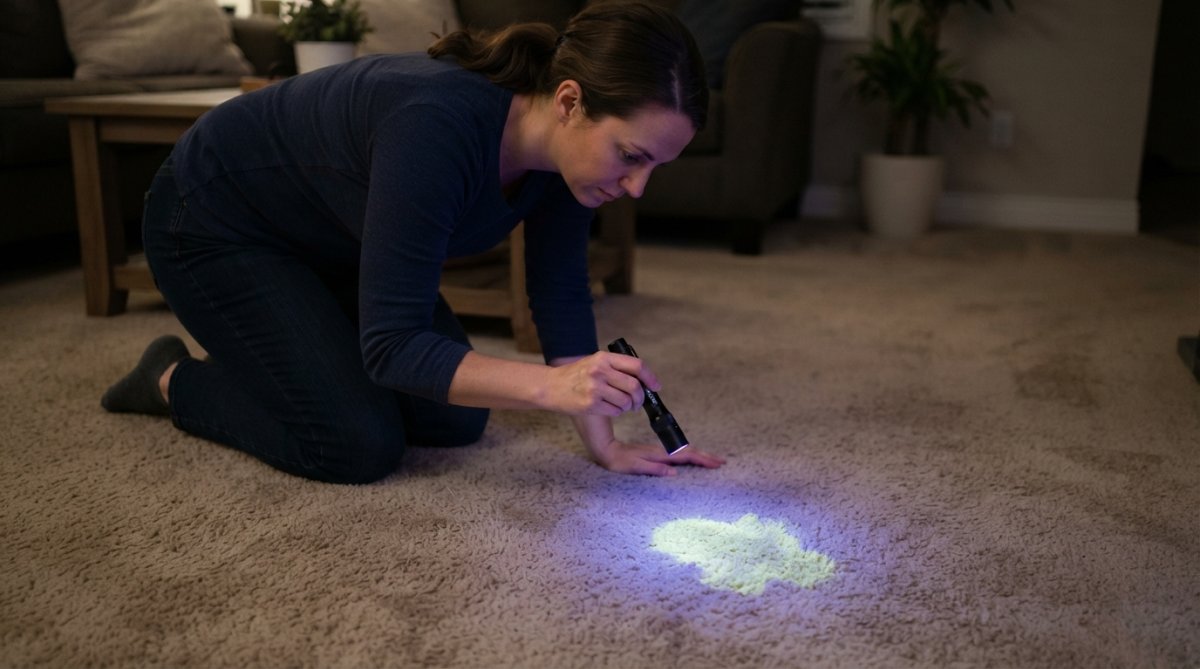
A common mistake is assuming one pass reveals everything. Older stains that have soaked into the carpet padding may only show a faint outline. If you are dealing with a heavy or long-term problem, the contamination may extend well beyond what the blacklight reveals on the surface.
Step 2: Test for Colorfastness Before Cleaning
Before applying any cleaning solution, you must test your carpet for colorfastness to avoid permanent discoloration. Many synthetic fibers handle cleaning products well, but natural fibers like wool can react poorly to vinegar, baking soda, or enzymatic cleaners.
Mix a small amount of your chosen cleaning solution and apply it to a hidden area of the carpet, such as inside a closet or under a piece of furniture. Blot the area with a white cloth and wait 10 to 15 minutes. If the color transfers to the cloth or the carpet fibers appear dulled or faded, do not use that solution on the visible areas.
Skipping the colorfastness test is the fastest way to turn a urine stain into a bleach spot or a dull patch. Once carpet fibers are damaged by the wrong cleaning agent, the discoloration is permanent and often requires professional repair or replacement.
This test also tells you something important about your carpet’s fiber type. Synthetic fibers like nylon and polyester are generally more forgiving, while wool and silk require gentler, pH-balanced products. When in doubt, dilute your solution further or consult a professional before proceeding.
Step 3: The Best Enzymatic Cleaner for Pet Urine and How to Use It
The best enzymatic cleaner for pet urine is one that contains live enzymes specifically formulated to break down uric acid crystals and odor-causing bacteria. Unlike general-purpose cleaners that only remove surface dirt, enzymatic cleaners work through biological breakdown, digesting the organic compounds that cause the smell.
To use an enzymatic cleaner effectively:
- Blot the area with a dry cloth to remove any loose residue.
- Saturate the stain thoroughly with the enzymatic cleaner, reaching down into the carpet padding if possible.
- Allow the solution to sit for the time specified on the label, typically 10 to 15 minutes. Do not rush this step.
- Blot the area again to absorb excess moisture, then allow it to air dry completely.
The most common failure point is using too little product or wiping it up too quickly. The enzymes need time to work. For old, deeply set stains, you may need to apply the cleaner two or three times over several days.
University of Illinois Extension’s guidance on carpet stain removal emphasizes that enzyme-based products are the most effective choice for organic stains like urine because they digest the proteins and uric acid rather than just bleaching or masking them.
Step 4: Home Remedies: Vinegar, Baking Soda, and Hydrogen Peroxide
If you prefer a DIY approach, a white vinegar solution is a reliable first step for neutralizing ammonia-based odors. Mix one part white vinegar with one part water and blot the solution into the stain. Vinegar helps balance the pH and break down some of the uric acid crystals, but it is not a substitute for a true enzymatic cleaner on old, set-in stains.
After the vinegar solution has dried, sprinkle a generous layer of baking soda over the area. Baking soda acts as a moisture absorption agent and helps deodorize the carpet fibers. Let it sit for several hours or overnight, then vacuum thoroughly.
For stubborn stains on colorfast, synthetic carpets, a hydrogen peroxide solution can provide extra oxidation power. Mix one part 3% hydrogen peroxide with two parts water and add a drop of dish soap. Apply sparingly and blot, never scrub, as scrubbing can damage carpet fibers and push the stain deeper.
Do not combine hydrogen peroxide with vinegar in the same application. The mixture creates a weak acid that is ineffective for cleaning and can damage carpet fibers. Apply each solution separately and allow the carpet to dry between treatments.
These home remedies work best on fresh or lightly set stains. For old pet urine odors that have penetrated the padding, they often provide only temporary relief.
Why Carpet Smells Worse After Cleaning and How to Fix It
Many homeowners report that their carpet smells worse after shampooing, and there is a clear reason for this. When you use a carpet shampooer or steam cleaner on a urine stain without first neutralizing it, the moisture reactivates the dried uric acid crystals and draws them back to the surface. The heat and water can also push the contamination deeper into the carpet padding, spreading the odor rather than eliminating it.
Another culprit is residue. Many cleaning products leave a soapy film behind that attracts dirt and provides a food source for odor-causing bacteria. This is why carpets cleaned with the wrong method often look worse and smell stronger within days.
To fix this, you must switch from surface cleaning to deep cleaning. This means using an enzymatic cleaner to break down the biological material first, then using an extraction method that removes both the dissolved waste and the cleaning solution. A wet-dry vacuum or a professional-grade carpet extractor is far more effective than a standard shampooer because it pulls water and contaminants out of the carpet rather than leaving them to dry in place.
If the smell returns after a proper enzymatic treatment and extraction, the urine has likely saturated the carpet padding beneath. Surface treatments cannot fix this, and continuing to shampoo will only drive the odor deeper.
When to Call a Professional for Sub-Pad Saturation
Sub-pad saturation is the point where DIY methods stop working, and it is the most common reason pet owners call us after months of frustration. Here is what is actually happening, how to confirm it, and what professional intervention involves.
What Sub-Pad Saturation Means Physically
Your carpet is not a single layer. It is a face fiber, a primary backing, a secondary backing, and a padding layer (usually polyurethane foam or rubber) sitting on top of a subfloor (plywood or concrete). When urine is old and heavy, it does not stop at the face fiber. It wicks down through the backing and into the padding. The padding is porous and absorbent, it acts like a sponge. Once saturated, it holds the uric acid crystals and bacteria indefinitely. Every time the room gets humid or you clean the surface, the moisture reactivates those crystals, and the odor is released back into the air.
How to Confirm You Have Sub-Pad Saturation
Before you call anyone, do this diagnostic test:
- The smell test: Press your nose directly against the carpet surface. If you smell ammonia at the surface, the contamination is in the face fiber. If you smell nothing at the surface but the room smells when you walk in, the odor is coming from below.
- The touch test: Press your palm firmly into the carpet. If the padding feels damp or spongy, it is holding moisture.
- The lift test: Pull up a corner of the carpet at the edge of a wall or in a closet. Look at the back of the carpet and the top of the padding. If you see yellow-brown staining or dark spots, the urine has penetrated through.
- The blacklight test from underneath: If you can access a basement or crawlspace below the affected area, shine a blacklight on the subfloor. A glowing area indicates the urine has soaked all the way through the padding and is now on the wood or concrete.
If any of these tests are positive, surface cleaning is done. You are now dealing with a structural problem.
The Two Professional Solutions
There are two approaches, and they are not interchangeable.
Option 1: Professional Hot Water Extraction (if the padding is salvageable)
This is not the same as renting a Rug Doctor from the grocery store. A professional truck-mounted unit operates at 200°F or higher and uses high-pressure injection followed by powerful vacuum extraction. The heat helps dissolve uric acid crystals, and the vacuum pulls the dissolved waste out of the padding. A rental machine typically operates at lower temperatures and has weaker suction, which is why it often leaves the padding wet and the odor worse. Professional extraction can resolve sub-pad saturation if the padding has not been saturated for months or if the urine volume was moderate.
Option 2: Padding Replacement (if the padding is beyond saving)
If the padding has been saturated for months, it is almost always beyond saving. The uric acid crystals have bonded to the foam, and no cleaning solution can fully remove them. In this case, the professional will:
- Cut and pull back the carpet from the affected area.
- Remove the contaminated padding.
- Treat the subfloor with an enzyme-based cleaner and seal it with a shellac-based primer (like B-I-N) to lock in any residual odor.
- Install new padding.
- Re-stretch and re-attach the carpet.
This is a labor-intensive process, but it is the only way to permanently eliminate the odor when the padding is saturated. The cost varies depending on the room size and carpet type, but it is almost always less expensive than full carpet replacement.
Why You Should Not Wait
The longer you wait, the worse the problem gets. Urine that sits in padding for months can soak through to the subfloor. On plywood subfloors, this can cause delamination and structural damage. On concrete slabs, it can seep into cracks and create a persistent odor that requires sealing. Trapped moisture promotes biological growth, which is a health concern beyond just the smell.
What to Ask a Professional Before Hiring
Not all carpet cleaners are equipped to handle sub-pad saturation. Before you hire anyone, ask these three questions:
- Do you use a truck-mounted extraction unit? If they say yes, they have the suction power needed. If they use a portable unit, ask about its suction rating.
- Do you treat the padding and subfloor, or just the carpet surface? If they only clean the surface, they are not solving your problem.
- Will you dry the carpet within 4 to 6 hours? Professional low-water methods should dry carpets in hours, not days. If they say 24 hours or more, they are using too much water, which risks mold.
At PowerPro Carpet Cleaning, our technicians are trained to IICRC standards and use low-water extraction that dries carpets in 2 to 4 hours. We also offer padding replacement services for cases where extraction alone will not suffice. If you have confirmed sub-pad saturation, do not waste time with another surface clean, address the source.
Conclusion
Old pet urine odors are stubborn because they live below the surface of your carpet, in the padding and fibers where standard cleaners cannot reach. The steps above, from locating stains with a blacklight to applying a true enzymatic cleaner, will resolve most cases. When the padding is saturated, professional deep cleaning is the only method that delivers lasting results.
If you are in New Jersey and struggling with pet urine odors that will not go away, PowerPro Carpet Cleaning offers a deeper clean that dries faster and promotes a healthier home environment. Our organic solutions and trained technicians are backed by a 100% satisfaction guarantee. Call us at 848 347 3201 to get started.
Frequently Asked Questions
Why does the urine smell get worse after shampooing the carpet?
Shampooing adds moisture and detergent, which reactivates the uric acid crystals and raises the pH of the carpet. This makes the odor more volatile and easier for you to smell. Furthermore, a standard shampooer does not extract deeply enough to remove the salts from the carpet padding. The moisture leaves the salts in a state where they can be detected by your nose, proving why a simple shampoo is often not enough for old pet urine odors.
Can professional cleaning remove years of pet urine odors?
Yes, but only if the urine hasn’t soaked through to the subfloor. Professional technicians use low-water extraction methods, which allow them to flush the padding thoroughly without over-saturating it. If the padding is saturated, the affected section must be removed and replaced. Professionals also use commercial-grade enzymatic treatments that are much stronger than retail products, ensuring the biological breakdown of uric acid crystals is complete.
What kills the smell of pet urine permanently?
Enzymatic cleaners are the only products that actually break down the uric acid crystals responsible for the odor, rather than just masking the smell. For the best results, you must saturate the area down to the padding and allow it to air dry slowly. This gives the enzymes time to work. In severe cases of sub-pad saturation, no cleaner will work, and the carpet padding must be replaced to permanently remove the pet urine odors.