Table of Contents
- What Counts as Emergency Carpet Cleaning for Water Damage
- The First 30 Minutes: Immediate Steps Before Help Arrives
- What You’ll Need for Emergency Water Removal
- Step-by-Step: The Water Damage Carpet Drying Process
- How to Prevent Mold in Wet Carpet
- When to Call Emergency Water Extraction Services
- DIY vs. Professional Emergency Carpet Cleaning for Water Damage
- Common Mistakes That Make Water Damage Worse
- Frequently Asked Questions
Last Updated: September 17, 2026
What Counts as Emergency Carpet Cleaning for Water Damage
Emergency carpet cleaning for water damage is the urgent removal of standing water and moisture from carpeted floors, usually within the first 24 hours of a leak, flood, or burst pipe. At PowerPro Carpet Cleaning, we treat any wet carpet that has been soaked for more than an hour as a time-sensitive job, because the clock on mold growth starts almost immediately.
Not every spill needs a same-day call. A knocked-over glass of water is a towel problem. These situations are true emergencies:
- Burst or leaking pipe soaking a carpeted room
- Washing machine or dishwasher overflow
- Toilet or supply line failure upstairs
- Storm water or sump pump backup
- Roof leak dripping onto carpet overnight
The difference comes down to volume and time. A small spill dries with fans in a few hours. A soaked carpet pad holds water for days and needs extraction equipment to dry properly.
Water damage also falls into categories based on how contaminated the water is. Clean water from a supply line is the easiest to handle. Gray water from a washing machine or toilet bowl carries bacteria. Black water from sewage or flooding is a health hazard that requires protective gear and disposal, not a shop vac.
Knowing which category you’re dealing with tells you whether you can handle it yourself or need to call for help right away.
The First 30 Minutes: Immediate Steps Before Help Arrives
The first 30 minutes decide how much of your carpet survives. Act quickly and you can often save both the carpet and the pad. Wait, and you may be replacing flooring.
Here’s what to do the moment you spot the water:
- Shut off the water source. If a pipe or appliance is leaking, close the nearest shutoff valve. If you can’t find it, call a plumber before you call anyone else.
- Cut the power to the affected room. Water and electricity don’t mix. Flip the breaker for that area if you can reach it safely.
- Move furniture off the wet carpet. Wood and metal legs can stain or rust. Lift items onto plastic sheeting or dry flooring.
- Pull up the carpet edges. If the carpet is loose, lift a corner to let air reach the pad underneath.
- Blot, don’t scrub. Press towels into the wet area to soak up surface water. Scrubbing pushes moisture deeper into the fibers.
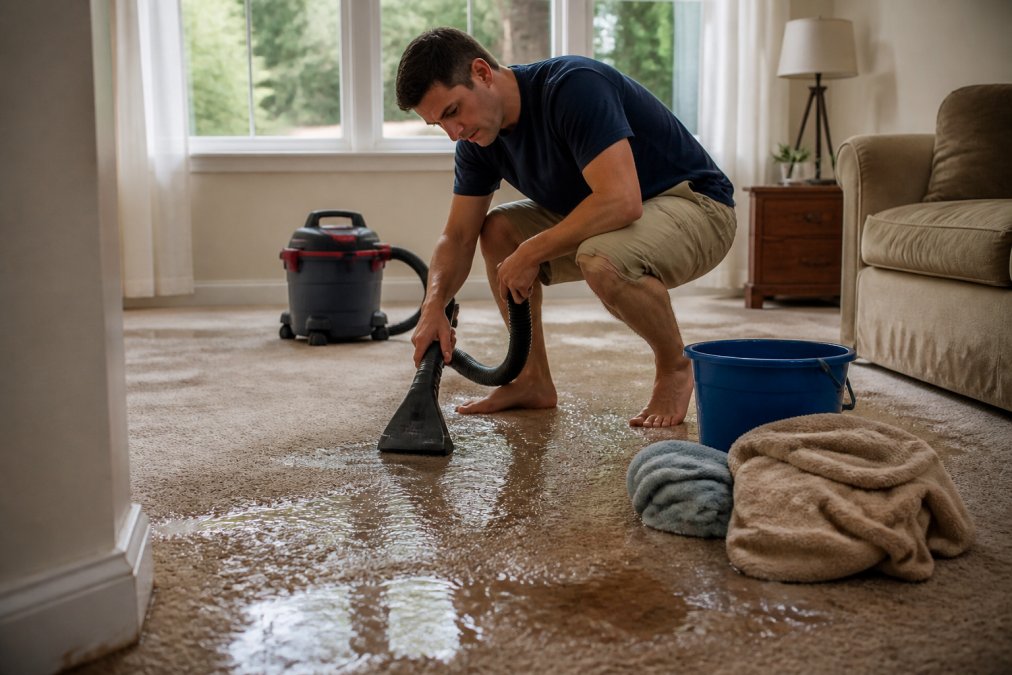
One mistake people make is waiting for a professional before doing anything. Every minute of standing water gives mold a head start. Your quick action buys time for the pros to finish the job.
What You’ll Need for Emergency Water Removal
The right tools turn a two-day disaster into a manageable afternoon. You don’t need commercial-grade equipment, but household basics only go so far.
Gather these before you start:
- Wet/dry shop vacuum (the single most useful tool)
- Clean towels and old sheets
- Buckets or large plastic bins
- Rubber gloves and boots
- Box fans and a dehumidifier
- Plastic sheeting or trash bags
- A moisture meter if you have one
A wet/dry vacuum pulls water out of carpet fibers and the pad surface. It won’t dry the pad completely, but it removes the bulk of the water fast. Box fans and a dehumidifier handle the rest by moving air and pulling moisture out of the room.
What most guides skip: a dehumidifier matters more than a fan. Fans move water into the air. A dehumidifier removes it from the air. Without one, you’re just circulating damp air around the room.
Point box fans toward the wet area, not away from it. Aiming them at a window pushes moisture across the room instead of drying the carpet. Set the dehumidifier in the center of the room and empty its tank every few hours.
If the water came from a sewage backup or outdoor flooding, stop. Don’t use household tools on contaminated water. Call a professional team trained to handle hazardous materials.
Step-by-Step: The Water Damage Carpet Drying Process
The water damage carpet drying process follows a clear sequence: extract, lift, air, dehumidify, and monitor. Skipping a step leaves hidden moisture that causes problems weeks later.
Step 1: Extract the standing water. Use a wet/dry vacuum to pull up as much water as possible. Work in overlapping passes across the whole wet area.
Step 2: Lift the carpet and pad. If the pad is soaked, it usually needs to come up. Carpet pad acts like a sponge and holds water long after the surface feels dry. Many pads can’t be saved once saturated.
Step 3: Set up airflow. Place box fans around the room, angled toward the carpet. Open windows if the weather allows, but keep the dehumidifier running.
Step 4: Run the dehumidifier. This pulls moisture out of the air so the carpet can keep releasing water. Empty the tank or run a drain hose.
Step 5: Monitor moisture daily. Press a paper towel into the carpet and pad. If it comes up damp, keep drying. A moisture meter gives you a real reading instead of a guess.
Step 6: Check for odor. A musty smell means moisture is still trapped somewhere. If the smell lingers after three days of drying, the pad or subfloor is still wet.
Most carpets dry in 24 to 48 hours with proper airflow and dehumidification. Thick carpet or a soaked pad can take longer.
How to Prevent Mold in Wet Carpet
Mold in wet carpet starts growing within 24 to 48 hours, which is why drying speed matters more than anything else. Once mold takes hold in the pad or subfloor, cleaning the surface won’t fix it.
To prevent mold, you need to do three things well:
- Dry fast. Every hour you cut off the drying time reduces mold risk. Aim to have the carpet dry within two days.
- Dry deep. Surface-dry carpet can hide wet pad underneath. Lift the carpet and check the pad and subfloor.
- Control the room. Keep humidity low with a dehumidifier and keep air moving with fans.
Watch for these signs that mold is already forming:
- A musty, earthy smell that won’t go away
- Dark spots or discoloration on the carpet or pad
- Visible fuzz or growth along the baseboards
- Allergy symptoms that flare up in one room
If you see or smell mold, surface cleaning won’t solve it. Mold in the pad or subfloor usually means the affected materials need to come out. For small, clean-water spills caught early, fast drying is often enough. For anything larger or older than two days, bring in a professional.
Never paint over or cover a musty carpet with a rug or furniture. Trapped moisture keeps feeding the mold, and the problem spreads to the subfloor. What looks like a quick fix turns into a full flooring replacement.
::: Understanding the rapid progression of mold growth timeline is essential for recognizing when a minor dampness issue has already escalated into a structural hazard.
When to Call Emergency Water Extraction Services
Emergency water extraction services are the right call when the water volume, source, or timing is beyond what household tools can handle. Extraction equipment pulls water from deep in the carpet and pad far faster than a shop vac.
Call a professional team when:
- The wet area is larger than one small room
- Water has been sitting for more than 24 hours
- The source is a sewage line, toilet, or outdoor flooding
- The carpet pad is soaked through
- You smell mold or see discoloration
- Water reached the subfloor, walls, or baseboards
The reason timing matters: mold, warped subfloor, and delaminated carpet backing all get worse with every passing hour. Extraction services use truck-mounted or high-powered units that remove water fast and measure moisture to confirm the job is done. That matters when you can’t see what’s happening under the carpet.
PowerPro Carpet Cleaning handles emergency calls around the clock, so a 2 a.m. burst pipe doesn’t have to wait until morning. Our technicians are trained to Inspection Institution of Cleaning and Restoration standards and use low-water methods that get carpets dry within hours.
DIY vs. Professional Emergency Carpet Cleaning for Water Damage
DIY works for small, clean-water spills caught within the first hour. Professional emergency carpet cleaning for water damage is the safer choice for anything larger, dirtier, or older.
Here’s how the two compare:
| Situation | DIY Approach | Professional Approach |
|---|---|---|
| Small clean-water spill | Towels, fan, quick dry | Usually not needed |
| Soaked pad | Hard to dry fully | Extraction and pad handling |
| Water sitting 24+ hours | High mold risk | Fast extraction and drying |
| Sewage or flood water | Not safe to handle | Hazardous-material trained crew |
| Water under subfloor | Can’t reach it | Moisture meters and deep drying |
| Lingering odor | Often returns | Source removal and treatment |
The honest trade-off: DIY saves money on small jobs but risks hidden moisture on bigger ones. Professional service costs more upfront but catches what you can’t see. For a spill you caught in the first hour, grab the towels. For a soaked room or anything contaminated, make the call.
What most people miss is that a carpet can feel dry on top while the pad and subfloor stay wet for days. That hidden moisture is what causes the mold and the smell three weeks later.
Common Mistakes That Make Water Damage Worse
The wrong move in the first hour can turn a saveable carpet into a replacement job. These are the mistakes we see most often.
Scrubbing instead of blotting. Scrubbing grinds moisture and dirt deeper into the fibers and can fray the carpet. Blot with pressure and let the towels do the work.
Skipping the pad. A wet pad under dry-feeling carpet is the most common cause of returning mold and odor. If the pad is soaked, it has to be addressed.
Using a household vacuum. A standard vacuum pulls water into the motor and ruins the machine. Only a wet/dry shop vacuum is safe for water.
Turning up the heat. Heat feels like it helps, but it can bake moisture into the pad and warp the subfloor. Air movement and dehumidification do the real work.
Waiting to call. Every hour of standing water increases mold risk and the chance the pad and subfloor are damaged beyond saving.
Ignoring the smell. A musty odor is a signal, not a minor annoyance. It usually means moisture is still trapped somewhere you can’t see.
Speed beats every other factor. The faster you extract water and dry the carpet, the lower your risk of mold, odor, and replacement. When in doubt, call for help early rather than late.
Water damage never waits for a convenient moment, and the difference between a saved carpet and a replaced one often comes down to how fast you act. PowerPro Carpet Cleaning has handled emergency water damage since 1989, using organic, green-certified solutions and a low-water method that dries carpets within hours. Our team is available 24/7, trained to Inspection Institution of Cleaning and Restoration standards, and backed by a 100% satisfaction guarantee. If your carpet is soaked, don’t wait it out. Call PowerPro Carpet Cleaning at 848 347 3201 and get your home dry, safe, and back to normal.
Frequently Asked Questions
Can carpet be saved after water damage?
Yes, in many cases carpet can be saved if you act within 24 to 48 hours. Clean water from a burst pipe or supply line is the most salvageable. Category 2 (gray water) and Category 3 (black water) losses often require removal and replacement. The deciding factors are how long the carpet stayed wet, the water source, and whether mold has started. Fast extraction and proper drying give the best chance of saving the carpet and pad.
How long do I have before mold grows on wet carpet?
Mold can begin growing within 24 to 48 hours on wet carpet and padding. Humidity, temperature, and the water source all affect the timeline. That is why the water damage carpet drying process needs to start the same day, not the next morning. If the carpet still feels damp after 48 hours, call a professional for moisture readings and additional drying equipment.
What is the difference between carpet cleaning and water damage restoration?
Routine carpet cleaning removes dirt and stains from a dry or lightly damp carpet. Water damage restoration is a different scope: it involves extracting standing water, measuring moisture in the carpet, pad, and subfloor, running commercial air movers and dehumidifiers, and checking for mold. Restoration also documents the loss for insurance. If you have standing water or a soaked pad, you need restoration, not a standard cleaning.
Does homeowners insurance cover emergency water extraction services?
Most homeowners policies cover sudden and accidental water damage, such as a burst pipe or appliance failure, including emergency water extraction services and drying. Flood damage from outside the home is typically excluded and requires separate flood coverage. Document everything with photos before work begins, keep receipts, and call your insurer early. A restoration company can provide moisture readings and a written scope to support the claim.