Table of Contents
- Why Your Carpet Traps Allergens (And Why It Matters)
- What You’ll Need to Remove Allergens from Carpets Naturally
- Step 1: Vacuum with the Best Vacuum for Allergy Sufferers
- Step 2: Apply Natural Carpet Deodorizer Recipes
- Step 3: How Often to Steam Clean Carpets for Allergies
- Step 4: Dry Your Carpet Properly to Prevent Mold and Mildew
- Natural DIY Cleaning Solutions Beyond Baking Soda
- Carpet Material-Specific Advice for Allergen Removal
- When to Call a Professional for Deep Allergen Removal
- Frequently Asked Questions
Last Updated: September 19, 2026
Why Your Carpet Traps Allergens (And Why It Matters)
Your carpet is a filter, and like any filter, it fills up. Every day it catches pollen, pet dander, dust mites, and microscopic particles that drift through your home. The problem starts when those particles stay put.
Carpet fibers have a lot of surface area. That surface area grabs airborne allergens and holds them tight. Every time someone walks across the room, some of that material lifts back into the air. For allergy sufferers, that cycle repeats all day long.
This guide walks through how to remove allergens from carpets naturally, step by step, without harsh chemicals. PowerPro Carpet Cleaning has cleaned carpets across Monmouth County and central New Jersey since 1989.
The Role of Carpet in Indoor Air Quality
Indoor air quality is a measure of how clean the air inside your home is, based on the pollutants and particles it carries. Carpet affects that number more than most people realize.
A carpet in good shape traps allergens and keeps them out of the air you breathe. A carpet that’s overdue for cleaning does the opposite. It becomes a reservoir, releasing dust mites, pet dander, and mold spores with every step.
The U.S. Environmental Protection Agency’s indoor air quality guidance notes that indoor pollutant levels can run higher than outdoor levels. Carpets are one reason why. They collect particulate matter that would otherwise settle and get wiped away.
So the goal isn’t to rip out your carpet. It’s to keep it clean enough that it keeps working as a trap, not a source.
What You’ll Need to Remove Allergens from Carpets Naturally
Gather your supplies first so you’re not running to the store mid-job. Here’s the short list:
- A vacuum with a HEPA filter and strong suction power
- Baking soda (plain, unscented)
- Essential oils
- A spray bottle
- White vinegar
- Clean microfiber cloths
- A fan or dehumidifier for drying
Skip anything with heavy fragrance or harsh solvents. Those add volatile organic compounds to your air instead of removing them.
Test any DIY solution on a hidden corner of carpet first. Some natural ingredients, especially vinegar and citrus oils, can affect certain dye lots. Wait 24 hours before treating the full room.
Step 1: Vacuum with the Best Vacuum for Allergy Sufferers
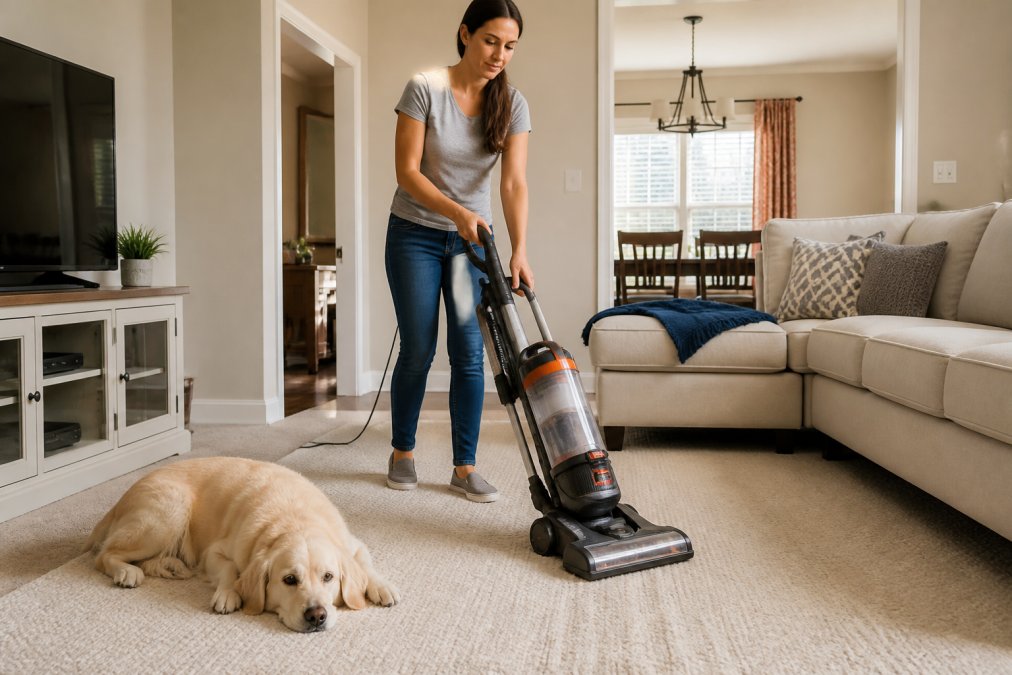
The best vacuum for allergy sufferers uses a sealed HEPA filter system and strong suction. Without both, you’re just stirring allergens into the air instead of capturing them.
Vacuuming is the foundation of allergen removal. Everything else builds on it. If you skip this step or rush it, the rest of the process won’t get you far.
Go slow. One pass over a section isn’t enough. Use overlapping strokes and cover each area two or three times. This lifts embedded dust mites and pet dander from the base of the carpet pile.
Key Features: HEPA Filter and Suction Power
A HEPA filter is a high-efficiency particulate air filter that captures microscopic particles down to 0.3 microns. That includes dust mite waste, pollen, and most pet dander.
Suction power matters just as much as filtration. A weak vacuum leaves allergens behind no matter how good the filter is. Look for a model with adjustable height settings so the brush reaches deep into the carpet pile without damaging fibers.
One more thing: empty or change your filter often. A clogged HEPA filter loses suction and stops trapping particles. Check it every few uses if you have pets.
Step 2: Apply Natural Carpet Deodorizer Recipes
A natural carpet deodorizer lifts odors and loosens allergens at the same time. The most common recipe uses baking soda as a base, with essential oils added for scent and antibacterial action.
Here’s the basic method:
- Sprinkle a thin layer of baking soda across the carpet
- Let it sit for 15 to 30 minutes
- Vacuum it up with slow, overlapping passes
The baking soda absorbs odors and helps pull moisture and particles from the fibers. The vacuum then removes both.
Baking Soda and Essential Oil Blend
For a scented version, mix one cup of baking soda with 10 to 15 drops of essential oil. Lavender and tea tree both work well. Tea tree has natural antimicrobial properties, which helps with mildew and mold spores.
Stir the mixture well and let it sit in a sealed jar overnight. This gives the oil time to spread through the powder. Then sprinkle and vacuum as usual.
Never apply baking soda to a damp carpet. It clumps, packs into the fibers, and becomes very hard to remove. It can also feed mold growth if moisture stays trapped underneath.
Step 3: How Often to Steam Clean Carpets for Allergies
Steam clean your carpets every 6 to 12 months if allergies are a concern. Homes with pets, kids, or heavy foot traffic should lean toward the 6-month mark.
Steam cleaning uses hot water and suction to reach deep into the carpet pile. It kills dust mites, removes embedded dander, and flushes out residue that vacuuming can’t touch. Unlike dry soil extraction, which lifts surface debris, steam cleaning penetrates the backing where allergens collect.
Timing matters too. Steam clean before allergy season starts, not during the worst of it. That way your carpet is at its cleanest when pollen counts climb.
Step 4: Dry Your Carpet Properly to Prevent Mold and Mildew
Drying is the step most people rush, and it’s the one that causes the most problems. Mold and mildew need three things to grow: moisture, warmth, and organic material. A damp carpet supplies all three. Most mold species begin colonizing within 24 to 48 hours of sustained dampness, which is why drying speed matters more than any single cleaning product you use.
Here’s the drying protocol that actually works:
- Start drying immediately after cleaning, not after a break
- Run box fans and a dehumidifier in the same room, pointed across the carpet surface
- Keep interior doors open so humid air has somewhere to go
- Turn the thermostat up a few degrees to speed evaporation
- Blot any standing water with clean microfiber cloths right away
- Keep foot traffic off the carpet until it’s fully dry to the touch and no longer cool or clammy
How Long Should a Carpet Take to Dry?
Drying time depends on the method, the carpet pile, and the humidity in your home. Here’s a realistic benchmark:
| Cleaning Method | Typical Dry Time | What Affects It |
|---|---|---|
| Low-water methods | 2 to 4 hours | Airflow, humidity |
| Dry methods | 1 to 2 hours | Pile density |
| Hot water extraction | 6 to 24 hours | Pile depth, pad thickness, airflow |
| DIY methods | 1 to 3 hours | How much liquid soaked in |
If your carpet still feels damp after 24 hours, something went wrong. Either too much water was applied, airflow is insufficient, or the pad underneath is holding moisture. A wet pad is the hardest part to dry and the most common cause of recurring mildew smell.
The Pad Problem Most Guides Skip
Carpet pad is a sponge. When liquid reaches the pad, surface drying won’t fix it. You can dry the carpet fibers completely and still have a damp pad feeding mold growth underneath. Signs the pad is still wet include a musty smell that returns within a day, a cool feeling underfoot, and discoloration near the base of the fibers.
If you suspect the pad is soaked, the fix is more aggressive: run a dehumidifier continuously, place a fan blowing directly at the carpet, and give it a full 48 hours. If the smell persists after that, the pad may need to be replaced. This is one reason low-water methods are preferred for allergy sufferers, especially in humid months.
Humidity Control by Season
Indoor relative humidity should stay between 30% and 50% for allergen control. Above 50%, dust mites thrive and mold risk climbs. Below 30%, you may see static and cracking in some fibers. A hygrometer is inexpensive and takes the guesswork out of when to run the dehumidifier versus when to open windows.
In humid summer months, opening windows can make drying slower, not faster. Run the air conditioning or a dehumidifier instead. In dry winter months, cracking a window can help, but watch for outdoor pollen if allergies are the reason you’re cleaning in the first place.
Fast drying isn’t a bonus, it’s part of the cleaning. A damp carpet undoes the allergen removal you just did by inviting mold spores and mildew to grow. Dry within hours, not days, and check the pad, not just the surface.
Natural DIY Cleaning Solutions Beyond Baking Soda
Baking soda gets all the attention, but it isn’t the only natural option. Vinegar, hydrogen peroxide, and certain plant-based compounds all help with allergen removal.
White vinegar is a natural deodorizer and mild disinfectant. Mix one part vinegar with two parts water in a spray bottle. Lightly mist the carpet, let it sit for a few minutes, then blot with a clean cloth. Don’t soak the fibers.
Hydrogen peroxide works on pet stains and odors. Use a 3% solution, dab it on the spot, and let it bubble for a few minutes before blotting. Test it first on dark carpets, since it can lighten some dyes.
University of Nebraska-Lincoln Extension’s home cleaning research offers guidance on safe DIY cleaning ratios for household use.
Carpet Material-Specific Advice for Allergen Removal
Not all carpets handle the same treatment. Synthetic fibers, wool, and natural plant fibers each react differently to moisture, heat, and cleaning agents. Using the wrong method can shrink, stain, or permanently damage a carpet, and it can also leave moisture behind that feeds mold. This is the part most natural-cleaning guides skip.
Here’s a quick reference, followed by what each entry actually means in practice:
| Carpet Type | Moisture Tolerance | Best Method | Watch Out For |
|---|---|---|---|
| Nylon | High | Steam clean or low-water | Heat damage over time; matting |
| Polyester | Moderate | Low-water clean | Crushing under furniture; oil affinity |
| Synthetic fibers | Moderate to high | Low-water clean | Staining from oil-based products |
| Synthetic fibers | High | Steam clean | Oil-based stains; heat sensitivity |
| Wool | Low | Dry clean or low-water | Shrinking, dye bleed, browning |
| Natural plant fibers | Very low | Dry methods only | Water damage, mold in the weave |
Synthetic Carpets: Nylon, Polyester, Triexta, Olefin
Synthetic fibers are the most forgiving. Synthetic fibers tolerate low-water cleaning but can mat or crush under heavy furniture, and they attract oil-based soils, so avoid oil-heavy DIY mixtures like castile soap at full strength.
For allergy control, synthetic carpets respond best to a two-step routine: a slow HEPA vacuum pass, then a low-water clean with a mild natural solution.
Wool: The High-Risk Natural Fiber
Wool is a protein fiber, and it behaves more like hair than plastic. Too much water causes shrinking, and agitation can felt the surface. Wool also bleeds dye more readily than synthetics, and it can brown if it stays wet too long. That browning is a chemical reaction, not dirt, and it’s hard to reverse.
For wool, stick to dry methods or a professional low-water clean. If you’re doing it yourself, mist a natural solution lightly, blot with a clean cloth, and dry immediately with airflow.
Plant Fibers: Sisal, Jute, Coir, Seagrass
Plant-based carpets are the least moisture-tolerant. These fibers absorb water, swell, and can grow mold deep in the weave where you can’t see it. Once mold establishes in a natural fiber backing, the carpet is usually a loss.
For plant fibers, use dry cleaning methods only. Vacuum with HEPA filtration, use dry compound cleaners, and spot-treat with a barely damp cloth. Never steam clean these fibers. Never apply a wet DIY spray. If a spill happens, blot immediately and run a fan on the area for hours, not minutes.
How to Identify Your Carpet Fiber
If you’re not sure what your carpet is made of, check three places: the original installation paperwork, a manufacturer tag under a corner of the carpet near the wall, or the backing visible at a transition strip. If none of those are available, a carpet retailer can usually identify the fiber by feel and burn test. Knowing the fiber changes which method you should use, and it’s the single most useful piece of information before you start any natural cleaning routine.
When in doubt, treat the carpet as if it’s wool or a plant fiber. Dry methods and low moisture are always safer than over-wetting, and the downside of being too cautious is far smaller than the downside of shrinking or molding a carpet.
When to Call a Professional for Deep Allergen Removal
DIY cleaning handles routine maintenance well. But some situations call for professional equipment and training.
Call a pro when:
- Allergies persist after regular cleaning
- You’ve had water damage or flooding
- Pet stains have soaked into the pad
- The carpet hasn’t been deep cleaned in over a year
- You’re moving in or out and need a full reset
PowerPro Carpet Cleaning uses organic, green-certified solutions and a low-water method that dries within hours. Our technicians are trained to Inspection Institution of Cleaning and Restoration standards, and we handle carpets, area rugs, tile, grout, and air ducts in one visit. We’ve served homeowners across Monmouth County and central New Jersey since 1989, and we’re available 24/7 for emergencies.
Frequently Asked Questions
What kills allergens in carpet?
Steam cleaning can kill dust mites and denature pet dander proteins. HEPA vacuuming removes microscopic particles. For natural removal, combine baking soda, essential oils, and thorough drying. Professional cleaning methods reach deeper into carpet fibers than DIY methods, eliminating allergens that regular vacuuming misses.
How often should carpets be cleaned to minimize indoor allergy triggers?
Regular vacuuming and professional cleaning help minimize indoor allergy triggers. Regular maintenance prevents allergen buildup in carpet pile and keeps indoor air quality healthy.
Can baking soda effectively remove dust mites and dander from carpet fibers?
Baking soda absorbs moisture and neutralizes odors, creating an environment where dust mites struggle to survive. It also helps lift dander particles for easier vacuuming. For best results, sprinkle generously, let sit 15-30 minutes, then vacuum with a HEPA filter. Combine with steam cleaning for complete removal.
What is the difference between surface cleaning and deep cleaning for allergen removal?
Surface cleaning removes visible debris and loose allergens from carpet fibers. Deep cleaning, like steam extraction or professional low-water methods, penetrates the carpet backing to eliminate embedded dust mites, pet dander, and mold spores. For allergy relief, deep cleaning every 6-12 months is essential to remove what surface cleaning leaves behind.
Allergens build up faster than most people expect, especially in homes with pets or heavy foot traffic. Regular vacuuming, natural deodorizers, and steam cleaning on a schedule keep your carpet working for you instead of against you. When DIY isn’t enough, PowerPro Carpet Cleaning brings organic solutions, fast drying times, and a healthier result for your home. Call us at 848 347 3201 to schedule your deep clean.