Table of Contents
- The Golden Rule: Blot, Don’t Scrub
- Immediate Action Steps for Fresh Spills
- Best Tools for Spot Cleaning Carpets
- Safe Carpet Stain Removal for Kids and Pets
- Step-by-Step Carpet Stain Removal Process
- Working From the Outside In to Stop Spreading
- How Carpet Type Affects Your Approach
- When to Call Professional Carpet Cleaners
- Preventing Stains Without Turning Your Home Into a No-Go Zone
- Frequently Asked Questions
Last Updated: September 25, 2026
The Golden Rule: Blot, Don’t Scrub
Every parent who has watched a cup of grape juice hit a cream-colored carpet makes the same instinctive move: grab a rag and scrub hard. That instinct is the single biggest reason a small spill becomes a permanent mark. A carpet stain removal guide for busy parents has to start here, because the technique matters more than the product.
This guide from PowerPro Carpet Cleaning covers what actually works when you have thirty seconds and a crying toddler. Below, we’ll show you exactly how to lift fresh spills, what belongs in a grab-and-go kit, and when a stain has moved past DIY territory. The five-step process we cover handles almost every household spill, from milk to pet accidents.
Here’s what most guides get wrong: they treat all stains the same. They don’t. Liquid, semi-solid, and old set-in marks each need a different first move.
Why Scrub and Wipe Both Push Stains Deeper
Scrubbing grinds the spill into the carpet fibers instead of lifting it out. It also distorts the pile, which leaves a fuzzy patch that shows even after the stain is gone.
Wiping has the opposite problem. A back-and-forth wipe drags the liquid sideways across clean fibers, spreading the stain into a bigger area.
Blotting is the fix. You press straight down and let the cloth pull the liquid up through wicking action. No sideways motion, no grinding.
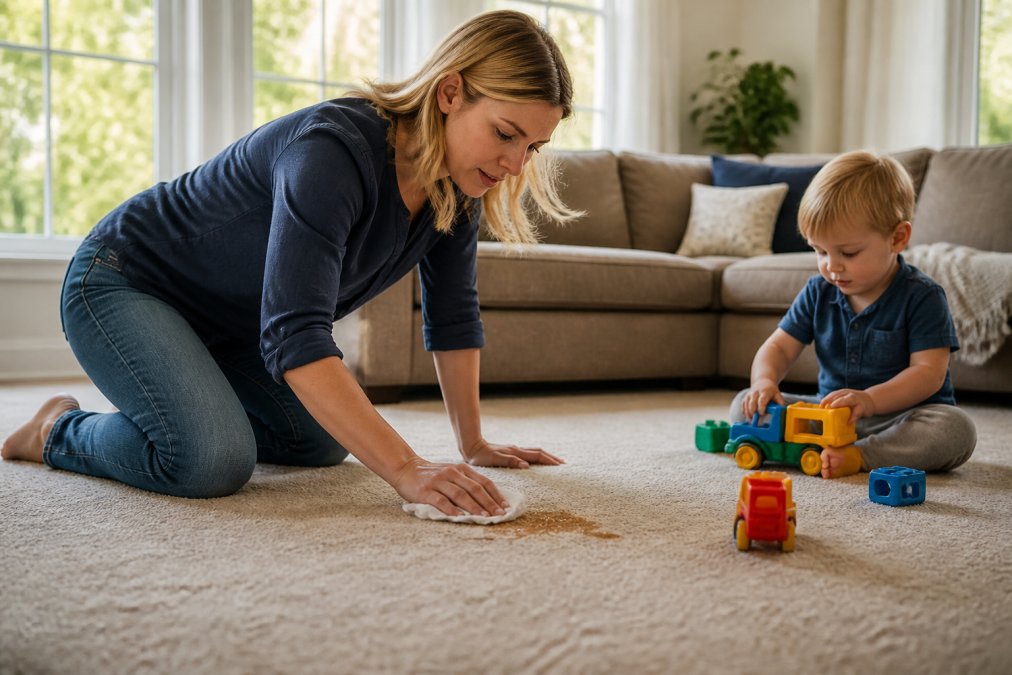
How to Blot Properly (Even With a Toddler on Your Hip)
Blotting is simple, but the details matter:
- Use a clean, white, absorbent cloth. Dyes from a colored towel can transfer to the carpet.
- Press straight down with your palm or knee. Hold for 10 to 15 seconds.
- Work from the edge of the spill toward the center.
- Switch to a clean part of the cloth after each press.
- Never rub. If you catch yourself scrubbing, stop.
One hand free is enough. Kneel beside the spill, keep the child on your hip or in a nearby seat, and press. You don’t need both hands to blot correctly.
Keep a stack of white cotton shop towels, not paper towels, in your spotting kit. Paper towels shred under pressure and leave lint trapped in the pile, which makes the stain look worse once it dries.
Immediate Action Steps for Fresh Spills
Speed beats strength. The first two minutes matter more than any cleaner you own, because fresh spills sit on top of the fibers instead of bonding to them.
The clock is your real enemy here. A spill addressed in the first minute needs far less work than one left for an hour.
Liquid Spills: Milk, Juice, and Medicine
Liquids soak down fast. Milk and juice will reach the backing pad within seconds on a low-pile carpet.
- Blot up as much liquid as possible with a dry cloth.
- Mix one teaspoon of mild dish soap with two cups of cool water.
- Dampen a clean cloth with the mix and blot the area.
- Rinse with a cloth dampened with plain water.
- Blot dry and weigh the spot down with a stack of towels.
Medicine stains, especially those with red dye, need cool water only. Hot water sets dye into synthetic fibers.
Semi-Solids: Yogurt, Peanut Butter, and Pet Accidents
Semi-solids need a different first move. Scoop before you blot.
- Use a plastic spoon or a dull knife to lift the solid off the surface.
- Scrape toward the center so you don’t spread the mess.
- Blot the remaining residue with a damp cloth.
- Follow with a spot treatment suited to the stain type.
Pet accidents need one extra step: an enzyme-based cleaner. More on that below.
Best Tools for Spot Cleaning Carpets
You don’t need a closet full of products. A small, well-chosen kit handles nearly every spill a family will face, but the kit only works if it’s reachable in the ten seconds you actually have while a toddler is mid-meltdown.
The best tools for spot cleaning carpets are the ones you can grab in ten seconds. If your supplies are buried in a garage cabinet, you’ll reach for a paper towel instead, and the stain wins. Most parents don’t lose the stain because they lack the right cleaner; they lose it because the cleaner is three rooms away.
Build the Kit Around the Ten-Second Rule
Build one caddy and keep it under the kitchen sink or in a hall closet, somewhere on the main floor, not the basement. Here’s what belongs in it:
- Six white cotton cloths or microfiber towels, folded so you can grab one without unfolding the stack
- A spray bottle of mild dish soap and cool water (one teaspoon of soap to two cups of water)
- A bottle of enzyme-based cleaner for pet and organic stains
- A small bottle of white vinegar
- A plastic scraper or dull knife
- A spray bottle of plain water for rinsing
- A stack of clean dry towels for blotting
That’s it. No need for a shelf of specialty products. Everything on this list is either non-toxic at the dilution used or gets rinsed out in the final step, which matters when a crawler is on the same floor an hour later.
| Tool | What It Handles | Why It Belongs |
|---|---|---|
| White cotton cloths | All spills | Absorb without dye transfer |
| Dish soap and water | Greasy and food stains | Lifts residue safely at low dilution |
| Enzyme cleaner | Pet accidents, milk, protein | Breaks down organic matter |
| White vinegar | Odors, light residue | Neutralizes and cuts film |
| Plastic scraper | Semi-solids | Lifts without damaging pile |
| Plain-water spray bottle | Rinsing | Removes soap film that reattracts dirt |
Two Kits, Not One
The single-caddy approach fails the moment a spill happens upstairs or in the car. A common pattern among parents who stay ahead of stains is a second, smaller kit:
- Upstairs kit: three cloths, a pre-mixed spray bottle of soap and water, and one enzyme bottle. Keep it in the bathroom linen closet.
- Car kit: a folded white cloth and a spray bottle of plain water. Curbing a spill on the way in the door is far easier than treating a stain that’s already set into the carpet by the entry.
You don’t need to duplicate the scraper or the vinegar. The two things you can’t improvise are an absorbent white cloth and water, those are the duplicates that earn their space.
What to Leave Out
A few items show up in generic cleaning lists but don’t belong in a parent’s kit:
- Paper towels. They shred under pressure and leave lint trapped in the pile, which makes the stain look worse once it dries.
- Colored towels or rags. Dye can transfer to the carpet, especially on light fibers, and you’ve now traded a juice stain for a pink one.
- Bleach and ammonia-based products. They leave residue that attracts dirt, can irritate skin and airways, and shouldn’t be stored where a child can reach them.
- Stiff brushes. On loop-pile carpet like Berber, a brush can pull a loop and leave a permanent run.
Never mix vinegar and ammonia-based cleaners in the same bottle. The combination creates a harmful gas. Use one or the other, and rinse between applications.
Keep a stack of white cotton shop towels, not paper towels, in your spotting kit. Paper towels shred under pressure and leave lint trapped in the pile, which makes the stain look worse once it dries.
Safe Carpet Stain Removal for Kids and Pets
Safe carpet stain removal for kids and pets comes down to one rule: if you wouldn’t want it on a crawling baby’s hands, don’t put it in your carpet.
Crawlers touch the floor, then their mouths. Pets lick their paws. Whatever you spray on the carpet ends up on them. That’s the whole argument for choosing your cleaning agent carefully.
DIY Mixtures That Are Safe for Crawlers and Paws
You can handle most stains with items already in your kitchen:
- Dish soap and water: One teaspoon of mild soap to two cups of cool water. Good for food and grease.
- White vinegar and water: Equal parts, for odors and light residue. Rinse well after.
- Baking soda: Sprinkle on fresh spills to absorb liquid, then vacuum once dry.
Skip bleach, and skip anything with a strong solvent smell. These leave residue that attracts dirt and can irritate skin and airways.
Enzyme Cleaners for Pet Odors and Organic Stains
Enzyme-based cleaners use live enzymes to break down the proteins and fats in organic stains. That’s why they work on pet accidents when soap alone won’t.
The key is dwell time. Enzymes need to sit and work, often 10 to 15 minutes, before you blot. Rushing this step is the most common mistake pet owners make.
For old urine odors, the stain has usually soaked into the pad beneath the carpet. Surface cleaning won’t reach it. That’s a job for a low-water extraction method, which reaches deeper into the carpet and pad and removes the source of the smell.
Step-by-Step Carpet Stain Removal Process
The full process takes about 15 minutes for a fresh spill. Follow these steps in order and you’ll handle almost any household stain without damaging the carpet.
Step 1: Remove Solids and Prep the Area
Scoop up any solid material first with a plastic scraper or spoon. Work toward the center so you don’t push the mess outward.
Blot up as much liquid as you can with a dry cloth. The more you remove now, the less the cleaner has to do.
Step 2: Test for Colorfastness
Test your cleaning solution on a hidden spot before you touch the stain. Pick a corner behind furniture or inside a closet.
Apply a small amount, wait five minutes, then blot with a white cloth. If no color transfers to the cloth, you’re safe to proceed. If you see dye, stop and use plain water only.
Step 3: Apply, Dwell, Blot, Rinse, and Dry
Now apply your chosen cleaning solution to the stain. Don’t soak the carpet. A damp cloth or a light spray is enough.
Let it dwell for the time the product recommends. Then blot with a clean cloth, working from the outside in.
Rinse with a cloth dampened with plain water. This step removes leftover cleaning agent, which otherwise leaves a sticky residue that pulls in new dirt.
Finally, blot dry and place a stack of towels over the spot. Weigh it down with a book or a heavy pot for an hour. Air movement from a fan speeds the dry time.
Rinsing is the step parents skip most often, and it’s the one that decides whether the spot stays clean. Leftover soap residue attracts dirt and makes the spot reappear within days.
Working From the Outside In to Stop Spreading
The outside-in technique keeps a stain from growing. You start at the outer edge and work toward the middle, which stops the cleaning solution from pushing the stain into clean carpet.
Here’s why it works. If you start in the center, each press pushes liquid outward into untouched fibers. Start at the edge, and every pass moves the stain inward, toward the part you’re already treating.
The same logic applies to your cloth. Fold it into quarters and use a fresh section for each pass. Once a section is dirty, switch. Pressing a loaded cloth back onto the carpet just redeposits what you lifted.
For larger spills, work in small sections around the edge, then move inward in rings. It takes an extra minute and saves you from a stain that doubles in size.
How Carpet Type Affects Your Approach
Carpet type changes how much water you can use and how hard you can press. Getting this wrong is how people damage a carpet while trying to clean it, and in a house with kids and pets, the damage usually comes from too much moisture, not too little cleaner.
The fiber content decides your water budget. The pile style decides how much pressure you can apply. Check both before you start.
Synthetic Carpet: Nylon, Polyester, Olefin
Synthetic carpet handles water and mild cleaners well. It’s the most forgiving type and covers most homes.
- Nylon is the most common and the most resilient. It takes water, mild soap, and enzyme cleaners without complaint.
- Polyester is softer but more prone to matting. Blot rather than scrub so you don’t crush the pile.
- Olefin (polypropylene) is moisture-resistant, which sounds like a win until you realize it also resists water-based cleaners. Give the solution a longer dwell time before you blot.
For all three, cool water is the default. Hot water can set dye-based stains like juice and medicine into synthetic fibers, which is the opposite of what you want.
Wool and Natural Fibers: Less Water, More Patience
Wool and other natural fibers need a gentler touch. Too much water can cause shrinkage, and harsh cleaners can dull the color. Use less moisture and blot more.
A practical rule: dampen the cloth, not the carpet. Wring it out until it’s barely wet, then press. If you can see a dark wet ring spreading past the stain, you’ve used too much.
Natural fibers also dry more slowly than synthetics. In a house where a toddler is back on the floor within the hour, that matters. Run a fan over the spot and keep kids and pets off it until the pile feels dry to the touch, not just dry on the surface.
Loop Pile vs. Cut Pile
Pile style is the part most guides skip, and it’s where busy households get into trouble.
- Loop-pile carpets, like Berber, snag easily. A stiff brush or hard scrubbing can pull a loop and leave a permanent run. Small toys with wheels, pet claws, and even a plastic scraper dragged at the wrong angle can do the same. Stick to blotting and a soft cloth.
- Cut-pile carpets hide blotting marks better but show pile distortion if you scrub. Always press straight down. If you’ve already scrubbed and left a fuzzy patch, a light pass with a soft brush after the spot is fully dry can sometimes lift the fibers back into line.
How to Find Out What You Have
If you’re unsure what you have, check the manufacturer’s label or a leftover piece from installation. It usually lists the fiber content and cleaning codes, a letter code that tells you whether water-based or solvent-based cleaners are safe.
If you can’t find the label, pull a single fiber from a hidden corner and look at it. A synthetic fiber springs back when stretched. Wool feels rougher and doesn’t snap back the same way.
Match your moisture to the fiber, not the stain. Synthetics tolerate a damp cloth; wool and natural fibers want a barely-damp one. When you can’t tell what you have, clean it like it’s wool.
When to Call Professional Carpet Cleaners
Call a professional when a stain has soaked into the pad, when it covers a large area, or when it’s been set for more than a day or two. DIY methods work on the surface, but they can’t reach what’s underneath.
Other signs it’s time to bring in help:
- The stain reappears after it dries
- You can still smell pet odor after cleaning
- The spot is larger than a dinner plate
- The carpet has been cleaned several times with no result
- You’re preparing to sell your home and need the carpet to look its best
Preventing Stains Without Turning Your Home Into a No-Go Zone
Prevention doesn’t mean banning juice boxes and locking up the dog. It means making small changes that cut down on the messes you have to chase.
A few habits that help:
- Place washable mats at every entry and under high chairs
- Keep the spotting kit where you’ll actually reach it
- Treat spills the same day, even if it’s just a quick blot
- Vacuum weekly to lift grit that grinds into fibers
- Schedule a professional deep clean once a year to reset the carpet
Keep a small spray bottle of plain water and a folded white cloth in the car. Curbing a spill on the way in the door is far easier than treating a stain that’s already set.
Frequently Asked Questions
How do you get 10-year-old stains out of carpet?
Ten-year-old stains have had years to bond with carpet fibers, so DIY carpet stain removal may not fully work. Start by vacuuming loose debris, then apply a small amount of enzyme-based cleaner for organic stains or a solvent for oil-based ones. Always test for colorfastness on a hidden spot first, blot with a clean absorbent cloth, and avoid over-wetting. If the stain persists after two or three attempts, call a professional carpet cleaner who has stain extraction tools and spotting kits.
What household items are safe for removing carpet stains around kids and pets?
For safe carpet stain removal for kids and pets, keep it simple: mild liquid dish soap mixed with warm water, white vinegar diluted 1:1 with water, and baking soda for odor absorption. Avoid bleach, ammonia solution on urine (it can set the stain and attract pets back), and any cleaner with strong fumes. Always test on a hidden area first, blot rather than scrub, and rinse with a damp cloth so no residue is left behind for small hands and paws.
How quickly should you treat a carpet stain?
The faster, the better. Fresh spills treated within a few minutes usually lift with blotting and a light cleaning solution, while stains left for hours or days can wick back to the surface and set. Keep a small spotting kit with an absorbent cloth, enzyme-based cleaner, and a spray bottle of diluted dish soap in a handy closet. If you cannot get to it right away, blot up what you can and cover the area with a damp cloth until you have time.
How do you know when it’s time to call professional carpet cleaners?
Call professional carpet cleaners when a stain covers a large area, returns after drying (a sign of wicking), involves pet urine that still smells after enzyme treatment, or has been set for weeks. Also call if your carpet has pile distortion from scrubbing, if you see mold or mildew, or if your child or pet has asthma and you want a deeper allergen removal. A trained technician can use heat transfer, low-water extraction, and pH balance to lift what DIY methods cannot.