Table of Contents
- Emergency Rug Cleaning Services Near Me Now: What to Expect
- Emergency Water Damage Cleanup for Homes: First 60 Minutes
- How to Dry a Wet Area Rug Quickly (Without Causing Damage)
- Same-Day and 24/7 Emergency Response: How Fast Can a Team Arrive?
- Pet Stain and Odor Removal: Saving Rugs After Accidents
- Rug Material-Specific Emergency Protocols
- Rug Cleaning Services Monmouth County NJ: Local Coverage
- Cost Transparency and Pricing Factors for Urgent Cleaning
- Safety and Chemical Standards in Emergency Rug Cleaning
- Frequently Asked Questions
Last Updated: September 11, 2026
Emergency Rug Cleaning Services Near Me Now: What to Expect
When a pipe bursts or a pet accident saturates an area rug, the clock starts ticking. Emergency rug cleaning services near me now searches spike during exactly these moments, and PowerPro Carpet Cleaning has answered those calls across New Jersey since 1989. Here is what a professional response actually looks like, from the first phone call to the final walkthrough.
Emergency rug cleaning is the rapid extraction, treatment, and drying of a rug that has been exposed to water, pet waste, or another contaminant before permanent damage sets in. The window matters: mold can begin colonizing a damp rug within a day or two, and dye bleeding can start even sooner (the CDC).
A typical emergency visit follows a predictable sequence:
- On-site assessment and moisture reading
- Fiber identification and colorfastness testing
- Water extraction with professional-grade equipment
- Spot treatment and odor neutralization
- Controlled drying with air movers and dehumidifiers
Most homeowners are surprised by how much of the job happens before any cleaning solution touches the rug. IICRC rug cleaning standards overview outlines why fiber identification comes first: the wrong method on wool can shrink or felt a rug beyond repair.
Emergency Water Damage Cleanup for Homes: First 60 Minutes
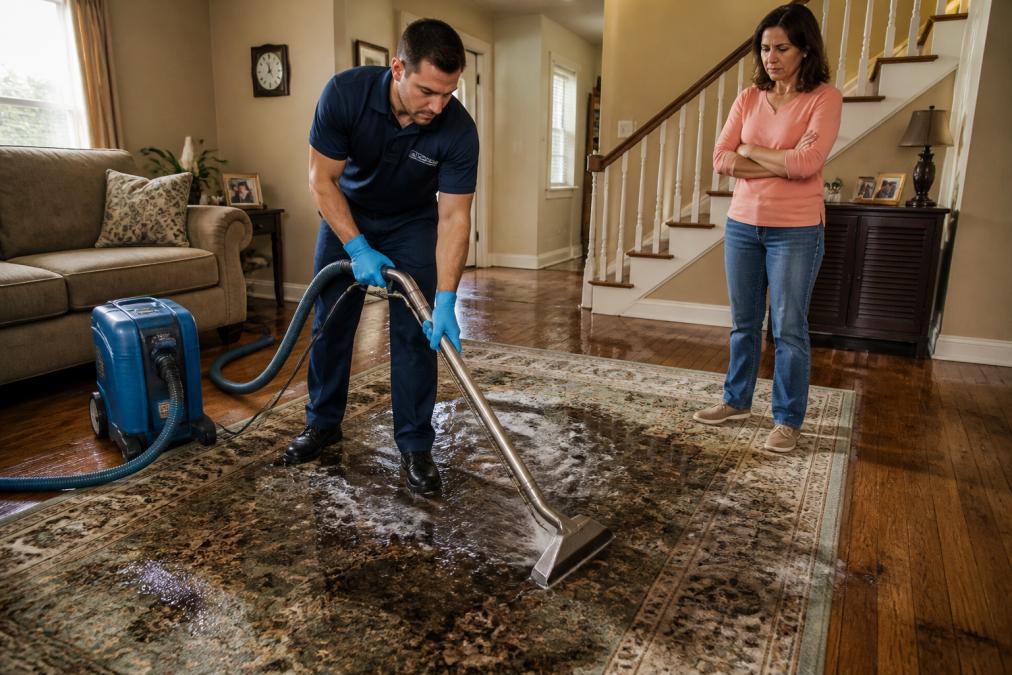
The first hour after a water leak decides whether a rug is salvageable. Emergency water damage cleanup for homes begins with stopping the source, lifting the rug off wet flooring, and calling a restoration team that can arrive the same day.
Start with these steps:
- Shut off the water supply or move the rug away from the leak.
- Blot, do not rub, standing water with clean white towels.
- Lift the rug off the floor so moisture does not wick back in.
- Keep pets and children off the wet surface.
- Call for professional extraction before the day ends.
A common mistake is dragging a soaked rug outside to “dry in the sun.” Direct sun can fade dyes and warp a rug’s backing while the padding underneath stays wet.
DIY Emergency Rug First-Aid Before Help Arrives
What you do in the first fifteen minutes can save a rug. Blot spills from the edges inward, never scrub, and avoid heat or harsh household chemicals that set stains instead of lifting them.
For pet accidents, scoop solids first, then blot with a diluted mild detergent. Skip vinegar-and-baking-soda internet remedies on wool or silk, they can strip dyes. If the rug is antique, hand-knotted, or silk, stop and wait for a technician.
How to Dry a Wet Area Rug Quickly (Without Causing Damage)
Fast drying is about airflow and moisture control, not heat. A wet area rug dries fastest when air moves across both sides while a dehumidifier pulls moisture out of the room.
Technicians use air movers positioned at low angles and industrial dehumidifiers to dry a rug in hours rather than days. At home, you can help by:
- Running ceiling fans and a dehumidifier in the room
- Flipping the rug periodically if it is small and colorfast
- Avoiding direct sunlight and space heaters
- Checking the floor underneath for trapped moisture
A rug that feels dry on top can still hold moisture in the backing or pad, which is where mildew starts. PowerPro Carpet Cleaning uses a low-water method that leaves carpets and rugs dry within hours, which matters when kids and pets need the floor back.
Same-Day and 24/7 Emergency Response: How Fast Can a Team Arrive?
Response time depends on your location and the time of day, but same-day service is standard for most urgent calls. PowerPro Carpet Cleaning answers emergency calls around the clock, including overnight water damage.
Dispatch works like this: you call, describe the situation, and a technician is routed to your address. For severe flooding, ask whether water extraction equipment is on the truck, since not every cleaner carries it.
When you call, have three things ready: the rug’s approximate size, what caused the damage, and how long it has been wet. That information lets dispatch send the right equipment on the first trip instead of scheduling a second visit.
Pet Stain and Odor Removal: Saving Rugs After Accidents
Old pet stains are often recoverable, but the odor source is usually deeper than the visible spot. Urine soaks through the rug into the pad and subfloor, so surface cleaning alone leaves the smell behind.
Effective pet stain and odor removal targets three layers: the fiber, the backing, and the pad underneath. Enzyme-based treatments break down uric acid crystals that cause the odor, while sub-surface extraction pulls contaminated liquid out of the pad.
What most guides miss is the re-soiling problem. If urine residue stays in the fibers, the spot attracts dirt and darkens again within weeks. A technician with a UV light can map old accident sites you cannot see.
Rug Material-Specific Emergency Protocols
Not every rug tolerates the same emergency treatment. Wool, silk, cotton, and synthetic rugs each react differently to water, heat, agitation, and cleaning agents, and the wrong first move can turn a salvageable rug into a permanent loss. This is the gap most emergency cleaning pages skip: they list fiber types but never explain the mechanism behind the risk.
| Rug Material | Water Tolerance | Key Risk | Emergency Approach |
|---|---|---|---|
| Wool | Moderate | Shrinking, felting | Cool water, controlled drying, no agitation |
| Silk | Low | Dye bleed, distortion | Dry or low-moisture methods only, no wet extraction |
| Cotton | High | Shrinkage, backing separation | Gentle extraction, flat drying under weight |
| Synthetic (polypropylene, polyester, nylon) | High | Little fiber risk | Standard hot water extraction |
| Viscose / art silk | Very low | Fiber loss, pile crush | Dry methods only, immediate pro referral |
Why Wool Fails Under the Wrong Method
Wool fibers are covered in microscopic scales. When wool gets wet and is then agitated or exposed to heat, those scales lock together and the fiber matts into felt. The rug does not just shrink, it loses pile height and texture permanently. That is why the emergency protocol for wool is cool water, minimal agitation, and controlled airflow rather than heat. A wool rug that is soaked through should be lifted, blotted, and dried flat with air movers at room temperature, never propped in front of a space heater.
Why Silk and Viscose Are the Highest-Risk Fibers
Silk and viscose (often sold as art silk or bamboo silk) bleed dye the moment they get wet, and the dyes in these rugs are frequently unstable even in cold water. Viscose also loses up to half its tensile strength when wet, so a soaked viscose rug can tear under its own weight if lifted carelessly. The emergency protocol is counterintuitive: do not wet-clean, do not blot aggressively, and do not attempt home drying. Cover the affected area with a clean white towel, keep traffic off it, and get a technician who works with fine rugs on site.
Cotton, Jute, and Natural Fiber Rugs
Cotton rugs tolerate water well but shrink unevenly, which warps the shape and can pull the backing apart. Jute and sisal are the opposite problem: they absorb water fast, brown out from the inside, and can grow mold in the core of the fiber where surface drying never reaches. Flat drying under gentle weight helps cotton hold its shape, while jute and sisal usually need professional drying with dehumidification because home airflow cannot reach the interior of the weave.
Synthetic Rugs: The Forgiving Category
Polypropylene, polyester, and solution-dyed nylon rugs are the most forgiving in an emergency. They tolerate hot water extraction, most cleaning agents, and faster drying. The main risk is not the fiber but the backing: many synthetic rugs use a latex or glue backing that can delaminate if the rug stays wet too long or is dried with too much heat. Even with synthetics, the goal is fast extraction and airflow, not heat. water damage restoration.
Why Material Identification Comes First
A rug that survives a spill can still be ruined by the wrong drying method. That is why material identification and a colorfastness test come before any treatment, not after. PowerPro Carpet Cleaning technicians are trained to Inspection Institution of Cleaning and Restoration standards, so fiber testing is part of every emergency visit, and antique, hand-knotted, or silk rugs are flagged for specialized handling before any solution touches the pile.
If you are not sure what your rug is made of, check the back. A hand-knotted rug will show an uneven, knotted foundation, while a machine-made rug shows a uniform grid or a glued backing. When in doubt, treat it as silk and wait for a technician.
Rug Cleaning Services Monmouth County NJ: Local Coverage
Local coverage matters because emergency response is a proximity business. Rug cleaning services Monmouth County NJ residents rely on need to reach Manalapan, Monroe, Eatontown, Howell, and the surrounding central New Jersey towns quickly.
PowerPro Carpet Cleaning serves homeowners and businesses across Monmouth County and central New Jersey, handling area rugs, wall-to-wall carpet, upholstery, tile, grout, and air ducts. A single visit can cover a flooded rug, the carpet around it, and the upholstery that caught splash damage.
For residents comparing providers, ask two questions: How far is the technician from your address, and does the company carry extraction equipment on every emergency call? A nearby team with the right truck beats a distant one with a lower quote.
Cost Transparency and Pricing Factors for Urgent Cleaning
Emergency rug cleaning costs more than a routine appointment, and the reasons are worth understanding before you book. Most emergency cleaning pages hide pricing entirely or bury it behind a phone call. This section breaks down what actually drives the number so you can compare providers on the same terms.
What Makes Emergency Cleaning Different From Routine Cleaning
A routine rug cleaning is scheduled, batched with other jobs, and dried on a standard timeline. An emergency call is none of those things. The provider is pulling a technician off a route, sending equipment that may sit idle on a normal day, and accepting the risk that the job runs long. Those three factors, dispatch disruption, equipment commitment, and open-ended drying time, are what separate an emergency rate from a standard rate.
The Factors That Move the Number
- Rug dimensions and material. A 9×12 wool rug takes more water, more drying time, and more care than a 5×8 synthetic runner. Silk and viscose add handling time because they cannot be wet-cleaned.
- Type of contamination. Clean water from a supply line is the simplest. Pet waste adds enzyme treatment and sub-surface extraction. Sewage or gray water from a drain backup requires disinfection and often pad replacement, which is a different scope entirely.
- Whether the pad or subfloor needs treatment. A rug pad that has absorbed urine or flood water usually cannot be saved and must be replaced. Subfloor treatment adds drying equipment and sometimes a separate visit.
- On-site drying time and equipment. Air movers and dehumidifiers are typically billed by the day or included in a drying package. Ask which model applies before work starts.
- After-hours or weekend scheduling. Overnight and holiday calls carry a premium because the provider is staffing outside normal hours.
- Access and setup. A rug on a third-floor walk-up or under heavy furniture takes longer to extract and dry than one in an open room.
How to Reduce the Bill Without Cutting Corners
Three moves reliably lower the cost of an emergency call. First, call before the rug has been wet for more than 24 hours, since mold remediation adds a separate scope. Second, lift the rug off the floor and start airflow immediately, which shortens drying time and equipment rental. Third, photograph the damage before anything is moved, which helps the provider scope the job accurately and avoids add-on charges later.
What a Written Estimate Should Include
A written estimate for emergency rug cleaning should list the rug size and fiber, the contamination type, whether pad replacement is included, the drying equipment and duration, and any after-hours surcharge. If a provider will not put the scope in writing, that is a signal to call someone else. PowerPro Carpet Cleaning offers free estimates so you know the scope before anyone starts, and the written scope covers extraction, treatment, and drying as separate line items.
Never accept a verbal quote for water damage work. Without a written scope, add-on charges for drying equipment, odor treatment, or pad replacement can appear after the job is done. Ask for the estimate in writing before the technician unloads equipment.
Questions to Ask Before You Book
- Is the estimate based on the rug size and fiber, or a flat emergency rate?
- Is drying equipment included, or billed per day?
- Is pad replacement included if the pad is contaminated?
- Is there an after-hours surcharge, and does it apply to the current call?
- Will the written scope change if the technician finds hidden damage?
Getting answers to those five questions before the truck arrives is the difference between a predictable bill and a surprise at the end.
Safety and Chemical Standards in Emergency Rug Cleaning
Safety standards protect both your family and the rug. Professional cleaners use EPA-registered disinfectants and green-certified solutions, and they follow label directions for dwell time and ventilation.
EPA guidance on choosing safer cleaning products explains why “organic” and “green-certified” are not marketing words but regulated categories. For households with allergies, asthma, or young children, the residue left behind matters as much as the cleaning itself.
PowerPro Carpet Cleaning uses organic, green-certified solutions that leave no dirt-attracting residue, which keeps rugs cleaner longer and reduces exposure to harsh chemicals. If anyone in your home has chemical sensitivities, say so when you book so the technician can adjust products and ventilation.
The safest emergency cleaning balances three things: the right product for the fiber, correct dwell time, and thorough extraction. Skipping any one of them leaves residue or moisture behind.
Frequently Asked Questions
How quickly does professional rug cleaning need to happen to prevent mold?
Mold can begin growing on damp rugs within 24 to 48 hours, so emergency rug cleaning services should start as soon as possible. If you call immediately, a team can extract water, apply antimicrobial treatments, and dry the rug within hours. Waiting longer increases the risk of permanent fiber damage, odor, and mold spores spreading to your subfloor. Same-day response is critical for the best outcome.
Can professional cleaning remove pet stains from area rugs?
Yes, professional pet stain and odor removal can eliminate even old urine stains when technicians use enzyme-based treatments and hot water extraction. The process neutralizes odor at the source rather than masking it. For set-in stains, multiple passes may be needed. Emergency rug cleaning services often include pet damage as a standard service, especially when you book within 24 hours of the accident.
What should I do immediately after a rug spill or flood?
First, remove the rug from the wet area if possible and blot excess liquid with clean towels. Avoid rubbing, which can spread the stain. Then, prop the rug up to allow airflow on both sides. Call an emergency water damage cleanup for homes provider right away. Do not use a household vacuum on wet fibers, and avoid direct heat, which can set stains and shrink certain materials.
How do I find reliable emergency rug cleaning in Monmouth County?
Look for a local company with 24/7 availability, certified technicians, and transparent pricing. Ask about response times, drying methods, and whether they handle both water damage and pet stains. A family-owned business with decades of experience, like PowerPro Carpet Cleaning, offers free estimates and serves Monmouth County, Manalapan, Monroe, Eatontown, and Howell. Call to confirm availability before you have an emergency.
A flooded rug or a pet accident never waits for a convenient moment, and neither should your response. PowerPro Carpet Cleaning has handled emergency calls across New Jersey since 1989, with 24/7 availability, organic green-certified solutions, and a low-water method that dries rugs within hours instead of days. When you need emergency rug cleaning services near me now, call 848-347-3201 and get a team on-site the same day.