
Table of Contents
- Are You Legally Required to Professionally Clean Carpets Before Moving Out?
- Security Deposit Deduction Laws and Carpet Cleaning
- Normal Wear and Tear vs Damage: What Can a Landlord Charge For?
- Professional Carpet Cleaning Receipt Requirements: Your Proof
- Review Your Lease Agreement for Cleaning Clauses
- Your Move Out Cleaning Checklist for Carpets
- The Pre-Move-Out Inspection: Your Best Defense
- What to Do If Your Landlord Deducts for Carpet Cleaning
- Why Professional Steam Cleaning Beats DIY for Move-Outs
- Conclusion: Protect Your Deposit with the Right Approach
- Frequently Asked Questions
Last Updated: September 7, 2026
Are You Legally Required to Professionally Clean Carpets Before Moving Out?
The short answer is no, there is no blanket law requiring professional move out carpet cleaning in most states, but your lease agreement can create that obligation. Move out carpet cleaning becomes a legal requirement only when your rental contract includes a specific cleaning clause, or when the carpet’s condition exceeds normal wear and tear. Understanding the distinction between a contractual duty and a legal one is the first step to protecting your security deposit.
The most common source of conflict in move-out scenarios across New Jersey and the tri-state area is a misunderstanding of what the lease actually requires. Many tenants assume a landlord can demand professional cleaning regardless of the carpet’s condition. That assumption is often wrong. The legal baseline is that you must return the unit in the same condition it was in at move-in, minus ordinary wear and tear.
That baseline shifts when your lease contains a cleaning clause. Some leases explicitly state that carpets must be professionally steam cleaned and that a receipt must be provided at move-out. If you signed that agreement, you are contractually bound to follow it. This is why reviewing your lease before you schedule any service is essential, a point we will return to shortly.
Security Deposit Deduction Laws and Carpet Cleaning
Landlords cannot deduct from your security deposit for carpet cleaning simply because they want fresh carpets for the next tenant. Security deposit deduction laws generally allow charges only for damage that goes beyond normal wear and tear, and the burden of proof falls on the landlord (consumerfinance.gov). They must show itemized costs and, in most jurisdictions, provide written notice within a specific timeframe after you vacate.
State landlord-tenant law resources explain that deposit rules vary by state, but the common thread is that deductions must be for actual damages, not routine upkeep. A landlord who tries to charge for carpet shampooing as standard turnover maintenance is often overstepping their legal authority. Routine cleaning to prepare a unit for a new tenant is typically considered a cost of doing business, not a tenant responsibility.
State-by-State: What the Statutes Actually Say
Most online advice stops at “check your state law.” Here is what the statutes in several major states actually require, because the differences matter when you are disputing a deduction:
| State | Statutory Deadline for Itemized Deductions | Key Carpet-Cleaning Rule |
|---|---|---|
| California | 21 days after move-out | Deductions allowed only for “repair of damages” beyond ordinary wear and tear; cleaning charges require documented evidence the unit was dirtier than at move-in |
| New York | 14 days after move-out | Landlords must provide receipts for any deduction over $125; routine cleaning is generally not deductible unless the lease specifically requires professional cleaning |
| Texas | 30 days after move-out | Landlords must provide written notice and itemized list; cleaning deductions require documented “extraordinary” cleaning beyond normal turnover |
| Florida | 15 days after move-out (or 30 if disputed) | Landlords must provide written notice by certified mail; cleaning charges must be for damages, not standard preparation for the next tenant |
| Illinois | 30-45 days depending on municipality | Chicago requires itemized deductions within 30 days; cleaning fees must be tied to documented damage, not routine maintenance |
| New Jersey | 30 days after move-out | Landlords must provide an itemized list of damages; cleaning charges are only permitted if the unit was left in worse condition than at move-in, per the move-in checklist |
This table reflects general statutory patterns. Municipal ordinances in cities like Chicago, Los Angeles, and Philadelphia often impose stricter deadlines and higher documentation standards than state law. Always verify your specific jurisdiction’s current code before filing a dispute.
The “Non-Refundable Cleaning Fee” Trap
A growing pattern across the country is the “non-refundable cleaning fee” written into leases. Some states have ruled that non-refundable fees are legally unenforceable as a matter of public policy because they circumvent security deposit protections. Other states permit them if the lease explicitly labels the payment as a fee rather than a deposit.
If your lease contains a non-refundable cleaning fee, read the exact language. Does it state the fee covers “routine turnover cleaning” or does it require “professional carpet cleaning at move-out regardless of condition”? The first is likely unenforceable as a disguised deposit. The second may create a contractual obligation you must satisfy. When in doubt, ask your landlord in writing to identify the specific statutory authority for the fee. Most cannot, and the request alone often leads to a waiver.
The Burden of Proof Shifts With Documentation
The practical takeaway: if your carpet is clean and shows only normal foot traffic patterns, a security deposit deduction for carpet cleaning is likely improper. Document the condition thoroughly and know your local rules. If the carpet has pet odors, excessive stains, or damage you caused, a deduction may be legitimate, which is where understanding wear and tear becomes critical.
A common pattern in small claims courts is that judges presume routine carpet cleaning is a landlord’s business expense unless the landlord can produce two pieces of evidence: a move-in condition report showing the carpet was professionally cleaned before you arrived, and a move-out inspection report documenting specific damage beyond normal wear. Without both, courts often side with the tenant.
:::tip Keep a copy of your lease’s cleaning clause and your move-in condition report together in one folder. When a dispute arises, you will need both within days, not weeks.
Normal Wear and Tear vs Damage: What Can a Landlord Charge For?
Normal wear and tear is the gradual deterioration of a carpet from everyday use, such as lightly flattened fibers, faded areas in high-traffic paths, or a few small, barely visible spots. Damage, by contrast, includes carpet stains, burns, tears, or pet urine that requires carpet restoration or replacement. Landlords may charge for damage, but they cannot charge for normal wear and tear.
A common point of confusion is how landlords define “excessive soil.” Deeply embedded dirt that requires professional extraction may be classified as damage if it resulted from neglect, such as failing to vacuum regularly or leaving spills untreated. However, a carpet that simply looks tired after two years of normal living is wear and tear. The age of the carpet also matters, as most residential carpet has a useful life of roughly five to ten years, and depreciation reduces what a landlord can recover.
To protect yourself, compare the carpet’s current condition against your move-in condition report. That document is your strongest evidence. If you noted existing stains or worn areas when you moved in, you cannot be held responsible for them at move-out. If you did not receive a move-in report, request one in writing and take dated photos immediately.
Professional Carpet Cleaning Receipt Requirements: Your Proof
When your lease requires professional cleaning, the professional carpet cleaning receipt requirements usually demand more than a handwritten note from a friend. Landlords typically want an invoice from a licensed cleaning service that includes the date of service, the address cleaned, the method used such as steam cleaning, and the company’s contact information. A professional receipt establishes that the work was performed by someone with the proper equipment and expertise.
This is where tenants often get caught. A rented rug shampooer from the grocery store does not produce a professional receipt, and many leases explicitly reject DIY efforts. The distinction matters because professional hot water extraction reaches deep into the carpet pile and backing, removing allergens, pet dander, and residues that consumer machines leave behind.
Keep your receipt and a copy of the invoice with your move-out paperwork. Send a scanned copy to your landlord or property manager before the final inspection and retain the original for your records. If a dispute later lands in small claims court, that receipt is your evidence that you satisfied the contractual obligation.
Review Your Lease Agreement for Cleaning Clauses
Your lease agreement is the single most important document in this entire process, and most tenants never read the cleaning clause carefully. Before you assume what is required, locate the section on move-out obligations and read the exact wording. Look for phrases like “professionally cleaned,” “steam cleaned,” “carpet shampooing,” or “broom-swept condition,” as each carries a different standard.
The Five Cleaning Clause Patterns You Will Actually Encounter
Lease agreements across the country tend to fall into five distinct patterns when it comes to carpet cleaning. Identifying which pattern your lease uses determines your obligations precisely:
Pattern 1: The “Professionally Cleaned” Clause
Exact language often reads: “Tenant agrees to have all carpets professionally cleaned at move-out and provide receipt.” This is the strictest common clause. It requires a commercial service with verifiable invoicing. A rented machine from a grocery store does not satisfy this clause, regardless of how well you use it. Landlords who include this clause typically reject DIY efforts and will deduct for a professional service if you do not provide one.
Pattern 2: The “Steam Cleaned” Clause
This language specifies the method: “Carpets must be steam cleaned prior to vacating.” Steam cleaning in the rental industry almost always means hot water extraction, not dry cleaning or shampooing. If your lease uses this term, confirm with your landlord in writing whether a dry-cleaning method satisfies the requirement. Some landlords accept it; others do not. Getting clarification in writing protects you from a disputed deduction later.
Pattern 3: The “Broom-Swept Condition” Clause
This language appears in older or simpler leases: “Premises to be returned in broom-swept condition.” Technically, this standard requires only that you remove debris and loose dirt. However, landlords frequently interpret “broom-swept” more expansively when carpets are involved. A thorough vacuuming plus spot treatment of visible stains usually satisfies this standard, but a professional cleaning is often still wise to avoid arguments over what “clean” means.
Pattern 4: The “Clean Condition” Clause
This is the vaguest language: “Unit must be returned in clean condition.” What constitutes “clean” is subjective and frequently disputed. Most property managers interpret this as requiring professional carpet cleaning because that is what their turnover process uses. If your lease uses this language, request written clarification from your landlord at least 30 days before move-out. A one-sentence email asking whether professional carpet cleaning is required can prevent a costly misunderstanding.
Pattern 5: The Silent Lease
When the lease says nothing about carpet cleaning, state law governs, and the general standard is cleanliness without damage. In that case, professional cleaning is optional unless the carpet’s condition warrants it. However, even with a silent lease, landlords can still deduct if the carpet is genuinely damaged beyond normal wear. The absence of a cleaning clause does not immunize you from damage charges.
The “Certified Technician” Requirement
Some leases, particularly in professionally managed buildings, go further and require cleaning by a “certified technician” or an “IICRC-certified firm.” The Institute of Inspection, Cleaning and Restoration Certification (IICRC) is a recognized industry credentialing body. If your lease names this standard, verify that your cleaning provider employs IICRC-certified technicians before you book. Ask for the technician’s certification number and include it in your move-out documentation. A landlord who specified this requirement cannot reject a provider who meets it.
Negotiating the Cleaning Clause Before You Sign
Most tenants discover the cleaning clause after it is too late to negotiate. If you are still in the lease-signing phase, you have leverage you will never have again. Ask the landlord or property manager to strike or modify the professional cleaning requirement. Many will agree, particularly in a soft rental market or if you offer a slightly larger security deposit in exchange. Get any modification in writing as an addendum to the lease. Verbal promises from a leasing agent are not enforceable in most jurisdictions.
What to Do When the Lease Is Ambiguous
When the lease is silent on carpet cleaning, state law governs, and the general standard is cleanliness without damage. In that case, professional cleaning is optional unless the carpet’s condition warrants it. When in doubt, ask your landlord or property manager in writing for clarification before you schedule anything. A quick email can prevent a costly misunderstanding.
:::warning If your lease requires professional cleaning and you attempt a DIY job anyway, you are in breach of contract regardless of how clean the carpet looks. Landlords can reject the result and deduct the full cost of a professional service from your deposit.
Your Move Out Cleaning Checklist for Carpets
A structured move out cleaning checklist keeps you organized and gives you documented proof of your efforts. Start by reviewing your move-in condition report and lease requirements, then work through each room systematically. The goal is to leave the carpet in a condition that no reasonable landlord could dispute.
- Vacuum all carpeted areas thoroughly, including edges and corners where dust accumulates
- Treat visible spots and stains with an appropriate carpet spot cleaner
- Address pet odors at the source, as surface sprays rarely eliminate urine that has soaked into padding
- Schedule professional steam cleaning if your lease requires it or if heavy soiling is present
- Allow adequate drying time before the final walkthrough, typically several hours to a full day
- Take dated photos of every room after cleaning and before you hand over the keys
The order matters. Vacuuming before professional treatment removes loose soil that would otherwise turn to mud during extraction. Spot treatment prevents stains from setting during the cleaning process. And documentation at every stage ensures you have evidence if a dispute arises.
The Pre-Move-Out Inspection: Your Best Defense
A pre-move-out inspection is an informal walkthrough you request before the official final inspection, and it is the most effective tool tenants rarely use. During this walkthrough, you and your landlord or property manager tour the unit together, identify problem areas, and agree on what needs attention before you vacate. This meeting converts vague expectations into a concrete action list.
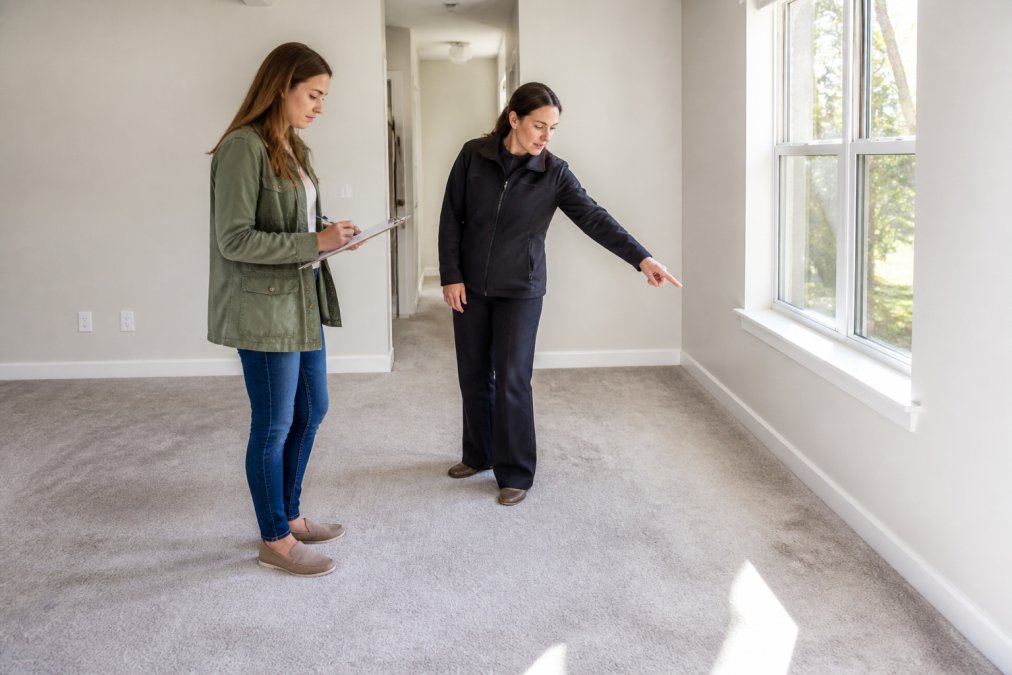
Request this inspection in writing at least two weeks before your move-out date. Come prepared with your move-in condition report, your lease, and a notepad. Walk every room, examine the carpet under good lighting, and ask directly whether the condition is acceptable. If the landlord flags an area, ask what specific cleaning or treatment they expect. Get any agreements in writing, even if it is a brief follow-up email summarizing what was discussed.
This inspection shifts the burden of proof. If the landlord approves the condition during the pre-move-out walkthrough and later tries to deduct for carpet cleaning, you have documentation that the issue was not raised when it could have been fixed. It also gives you time to address problems while you still have access to the property.
What to Do If Your Landlord Deducts for Carpet Cleaning
If your landlord deducts for carpet cleaning and you believe the charge is unfair, act quickly and methodically. Most states require landlords to provide an itemized list of deductions within a set period, often 30 days, along with any remaining deposit. Review that list against your lease, your move-in report, and your photos.
Your first step is a written dispute letter sent by certified mail. State clearly that you dispute the deduction, explain why based on your documentation, and request the return of the withheld amount. Reference your pre-move-out inspection if you had one. Many landlords reverse improper deductions when confronted with evidence because they know a tenant with documentation is likely to prevail.
If the landlord refuses, your next option is small claims court. Filing fees are modest, and you do not need an attorney for most cases. Bring your lease, move-in condition report, photos, professional receipt, and any written correspondence. Courts generally side with tenants who can document that they left the unit in proper condition. The process takes time, but the threat of a judgment often motivates a settlement.
Why Professional Steam Cleaning Beats DIY for Move-Outs
Professional steam cleaning, also called hot water extraction, remains the gold standard for move-out carpet preparation because it addresses what landlords and inspectors actually look for. Consumer rental machines operate at lower water temperatures and weaker suction, which means they leave behind detergent residue that attracts dirt and can leave carpets looking dull. Professional equipment extracts more water and soil, producing a visibly cleaner result.
The difference matters legally, not just aesthetically. If your lease requires professional cleaning, a DIY attempt does not satisfy the contract regardless of how well you executed it. Landlords can reject the result and still deduct for a professional service. Paying for professional cleaning once is almost always cheaper than paying for it twice or losing part of your deposit.
For tenants dealing with pet odors or heavy soiling, professional treatment is not optional. Standard cleaning removes surface dirt, but urine that has reached the carpet padding requires specialized rinsing and extraction. A professional service also dries carpets faster, which reduces the risk of mold and mildew before you hand over the keys. EPA guidance on indoor air quality and carpet care notes that proper moisture control during cleaning is essential to maintaining healthy indoor air.
Conclusion: Protect Your Deposit with the Right Approach
The path to a full security deposit return comes down to preparation, documentation, and understanding your lease. Review your agreement early, conduct a pre-move-out inspection, and keep records of every step you take. When your lease requires professional cleaning, or when the carpet’s condition demands it, hire a service that provides a verifiable receipt and uses equipment that actually restores the carpet.
PowerPro Carpet Cleaning has served homeowners across New Jersey since 1989, using organic, low-water steam cleaning that removes dirt, allergens, and pet odors while drying carpets within hours. Our technicians are trained to Inspection Institution of Cleaning and Restoration standards, and our methods leave no dirt-attracting residue behind. For move-out cleaning that satisfies even the strictest lease requirements, CALL US AT : 848 347 3201 and protect your deposit with a documented, professional result.
Frequently Asked Questions
Are tenants legally responsible for carpet cleaning when moving out?
Only if the carpet is damaged beyond normal wear and tear, or if your lease agreement includes a specific cleaning clause. Most states require landlords to prove the carpet needs professional cleaning due to excessive soil, stains, or pet odors. Routine vacuuming and a broom-swept condition typically satisfy basic requirements. Review your lease and your state’s landlord-tenant law before scheduling expensive professional services.
Can a landlord deduct carpet cleaning costs from a security deposit?
Yes, but only for damage that exceeds normal wear and tear. Landlords cannot charge for routine carpet aging or light matting. They must provide an itemized list of deductions and receipts within the timeframe your state requires, typically 14 to 30 days after move-out. If the carpet is clean and undamaged, a deduction for cleaning is unlawful under most security deposit deduction laws.
What is the difference between normal wear and tear and carpet damage?
Normal wear and tear includes light fading, minor flattening in high-traffic areas, and slightly worn fibers. Damage includes large stains, burns, tears, pet urine odors, or excessive soil that requires more than standard cleaning. Landlords can charge for damage but not for normal aging. Document the carpet’s condition with photos at move-in and move-out to support your case if a dispute arises.
How can I prove my carpets were professionally cleaned to my landlord?
Keep the professional carpet cleaning receipt requirements in mind: obtain an itemized invoice that includes the date, the cleaning company’s name, the method used (such as steam cleaning), and the specific rooms or areas serviced. A detailed receipt from a certified technician carries more weight than a handwritten note. Take timestamped photos after cleaning and before you vacate to complete your evidence package.