Table of Contents
- Quick Comparison: Eco Friendly Carpet Cleaning for Pet Stains
- How to Remove Pet Urine from Carpet Naturally
- Best Pet-Safe Carpet Cleaning Solutions for Fresh and Set-In Stains
- Carpet Cleaners and Machines Worth Buying
- Professional Dry-Steam Carpet Cleaning: When to Call a Pro
- Material-Specific Eco Cleaning for Wool, Nylon, and Upholstery
- Allergy and Sensitivity Testing Before You Clean
- Long-Term Carpet Health: Protecting Fibers After Pet Accidents
- Frequently Asked Questions
Last Updated: September 13, 2026
Quick Comparison: Eco Friendly Carpet Cleaning for Pet Stains
Pet owners searching for eco friendly carpet cleaning for pet stains face a crowded shelf of sprays, powders, and machines, and most labels blur the line between “natural” and “actually safe.” This guide from PowerPro Carpet Cleaning cuts through that. We have cleaned carpets and upholstery across New Jersey since 1989, and we have watched enzyme science replace harsh solvents in the products that genuinely work.
Here is the short version before the detail:
| Option | Best For | Method | Watch Out For |
|---|---|---|---|
| DIY vinegar + baking soda | Fresh accidents, mild odor | Acid neutralization, mild abrasion | Slow on set-in stains |
| Enzymatic spray | Urine odor removal at the source | Microbial action breaks down uric acid | Needs dwell time, often 10+ minutes |
| Oxygen-based cleaner | Visible stain lifting | Oxidation of organic matter | Not a true odor neutralizer |
| Home carpet machine | Maintenance between pro visits | Hot water extraction | Wet carpet for hours if overused |
| Professional dry-steam | Set-in stains, whole-room odor | Low-water extraction | Scheduling required |
The pattern is simple: match the tool to the age of the stain and the fiber underneath it.
Fresh accidents respond to almost anything. Set-in stains and lingering odor need enzymatic or professional treatment, because the uric acid crystals have already bonded to the carpet backing.
How to Remove Pet Urine from Carpet Naturally
Removing pet urine from carpet naturally comes down to three things: lift the liquid, neutralize the acid, and eliminate the odor source so the pet does not return. Skip any one of those and the stain comes back.
Start by blotting, never rubbing. Rubbing pushes urine deeper into the backing and spreads the stain sideways. Press a clean microfiber cloth down and hold it for 20 seconds, then repeat with a fresh section of cloth until no moisture transfers.
Once the surface is dry to the touch, the fiber still holds uric acid crystals. Those crystals are what your nose detects on humid days, and they are what tells your dog or cat this spot is still theirs. A ASPCA guide to pet stain and odor removal notes that pets re-mark areas where scent markers remain, which is why masking odor with fragrance backfires.
Next, apply your neutralizer. Distilled white vinegar diluted with water breaks down the alkaline compounds in urine. Let it sit, blot again, then follow with a thin layer of baking soda to pull residual moisture and odor from the fiber.
For anyone in Monmouth County dealing with a stain that has been there for weeks, the DIY route has limits. PowerPro Carpet Cleaning uses organic, green-certified solutions and a low-water method that reaches the backing where crystals hide.
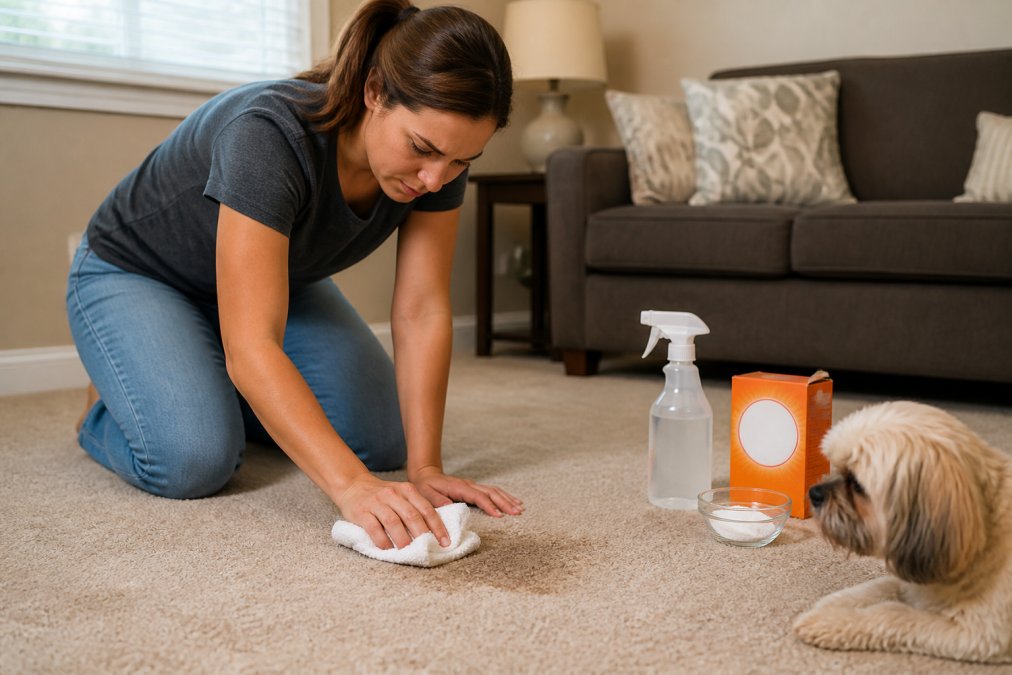
Step-by-Step DIY Process with Vinegar and Baking Soda
- Blot the fresh accident with a clean microfiber cloth, pressing rather than rubbing.
- Mix one part distilled white vinegar with two parts cool water in a spray bottle.
- Spray the area until damp, not soaked, and let it sit for 5 minutes.
- Blot again with a dry cloth to lift the loosened residue.
- Sprinkle baking soda over the damp patch in a thin, even layer.
- Let it dry completely, then vacuum thoroughly.
- Repeat on day two if odor returns when the room warms up.
Expected result: A fresh stain should disappear within one cycle. A stain older than a week usually needs two or three passes, and if odor persists after that, the urine has reached the pad.
Best Pet-Safe Carpet Cleaning Solutions for Fresh and Set-In Stains
Pet-safe carpet cleaning solutions fall into two families: enzymatic formulas that digest organic waste, and oxygen-based cleaners that lift visible discoloration. They solve different problems, and using the wrong one wastes money.
For fresh accidents and any lingering smell, enzymatic is the correct choice. Enzymatic cleaners are solutions containing live bacteria and enzymes that consume the proteins, fats, and uric acid in pet waste, converting them into harmless byproducts. Skout’s Honor Pet Stain and Odor Remover uses a plant-based, bio-enzymatic formula that is non-toxic and biodegradable, and it works on both carpet and upholstery. Nature’s Miracle Advanced Stain & Odor Eliminator takes a similar approach and is formulated to remove the pheromones that pull pets back to the same spot. My Pet Peed targets deep-set urine at the molecular level and needs no rinsing, which makes it a reasonable last resort before calling a professional.
Oxygen-based products handle a different job. OxiClean Carpet & Area Rug Stain Remover uses an oxygen formula to lift organic stains, and it is safe for most carpet types. The catch is that it brightens a stain without necessarily destroying the odor source underneath. Neutralizing these lingering scents requires a natural odor remover that targets the bacterial residue trapped deep within the carpet fibers.
| Product | Formula | Best For | Limitation |
|---|---|---|---|
| Skout’s Honor | Plant-based enzymatic | Fresh accidents, odor | Multiple passes on set-in stains |
| Nature’s Miracle | Enzymatic | Housebreaking, pheromone removal | Strong scent |
| My Pet Peed | Molecular elimination | Stubborn deep urine | Online purchase only |
| OxiClean | Oxygen-based | Visible stain lifting | Weak on odor |
Enzymatic Sprays vs. Oxygen-Based Cleaners
Enzymatic sprays win on odor, oxygen cleaners win on visible color. If your problem is smell, choose enzymatic. If your problem is a brown ring on a beige carpet with no odor, oxygen works faster.
One insider note: enzymatic products need contact time. Spraying and immediately blotting kills the microbial action before it starts. Give it 10 minutes minimum, and keep pets off the area until it dries.
Never combine vinegar and an oxygen-based cleaner in the same pass. The acid neutralizes the oxygen before it can lift the stain, and you end up scrubbing twice for half the result.
Carpet Cleaners and Machines Worth Buying
Home carpet machines make sense if you are managing recurring accidents, not a single event. They handle maintenance; they do not replace professional extraction for set-in damage. The mistake most buyers make is choosing on tank size or price alone, when the number that actually matters is how much water the machine leaves behind in the pad.
Here is how the three most common home units compare on the specs that affect eco-cleaning outcomes:
| Machine | Water Lift / Recovery | Heat | Pet-Specific Feature | Eco Consideration |
|---|---|---|---|---|
| Bissell Revolution HydroSteam Pet | High-lift recovery, fast-dry setting | Heated | Dedicated pet mode, HydroSteam | Heated water can set protein stains in wool, avoid on wool |
| Bissell TurboClean Pet | Moderate recovery | Ambient | Compact pet tool | Small tank means more passes and more residual moisture |
| Hoover SmartWash Pet | Auto push-pull extraction | Ambient | Auto-mix cleaning solution | Auto-mix can over-dose solution, leaving surfactant film |
What the specs mean in practice. Water lift is the suction force that pulls dirty water out of the backing. A machine with weak lift leaves the pad damp for 12-24 hours, which is the exact window when mold, mildew, and delamination begin. Fast-dry settings and air movers shorten that window to a few hours. If you cannot dry a section within four hours, you are trading a stain for a bigger problem.
Match the machine to the fiber, not just the pet. Wool and wool-blend rugs should never see a heated home extractor, heat plus agitation causes felting and shrinkage that no cleaner reverses. Nylon and polyester tolerate heated extraction and oxygen-based solutions well. For upholstery, skip the machine entirely and use a hand tool with a pH-balanced enzymatic spray, because cushion foam holds water far longer than carpet backing.
The eco angle most buyers miss. Every extra pass with a home machine deposits more cleaning residue in the fiber. That residue is a dirt magnet, it pulls new soil into the carpet and creates the surfactant film that bothers sensitive households. A single, thorough pass with a low-residue formula beats three passes with a strong one. Rinse-only passes with plain water after the cleaning pass strip most of that film.
When a home machine is the wrong tool. If the urine has reached the pad, a home unit dilutes the contamination and pushes it deeper rather than removing it. That is the specific reason PowerPro Carpet Cleaning uses a low-water method that flushes the backing and lets carpets dry within hours rather than overnight.
Never use a heated home extractor on wool, and never run a second cleaning pass “just to be sure.” Over-wetting is the leading cause of delamination, rippling, and the persistent odor that returns on humid days.
Professional Dry-Steam Carpet Cleaning: When to Call a Pro
Professional dry-steam carpet cleaning is the right call when odor survives your best DIY effort, when the stain covers a large area, or when the urine has soaked into the pad and subfloor. But “professional” is not one method, it is several, and they behave very differently on pet contamination.
The three professional methods, compared:
| Method | How It Works | Water Used | Dry Time | Best For |
|---|---|---|---|---|
| Hot-water extraction (steam cleaning) | Heated water + solution injected under pressure, immediately extracted | High | 6-12 hours | Heavily soiled synthetic carpet |
| Low-moisture / dry-steam | Fine mist at low volume, high-lift extraction | Low | 2-4 hours | Pet contamination, wool, quick re-occupancy |
| Dry compound | Absorbent compound worked into fiber, then vacuumed | None | Immediate | Delicate fibers, light soil, interim maintenance |
Why method choice matters for pet stains. Uric acid crystals bond to the carpet backing and the pad. Hot-water extraction can flush them out, but it also drives moisture deep into the pad, and a pad that stays wet for a full day becomes a mold reservoir. Low-moisture extraction reaches the backing with far less water, which is why it is the preferred method when odor is the problem rather than visible soil. Dry compound is excellent for maintenance but does not reach the backing, so it will not resolve set-in urine odor.
The three situations where calling a professional saves money:
- Recurring odor after multiple DIY attempts. You have spent more on sprays than a single service visit would cost, and the contamination is still in the pad.
- A large or multi-room affected area. Home machines cannot extract enough water from a big job, and the drying risk compounds with square footage.
- Preparing to sell or move. Buyers notice pet odor immediately, and it affects offers, a professional extraction with a fiber protector is a standard pre-listing step.
What to ask before you book. Ask which extraction method the technician will use, whether they treat the pad and subfloor or only the surface, and whether they apply a fiber protector after cleaning. A technician who only treats the surface will leave the odor source in place. Ask too whether the solutions are green-certified and residue-free, the residue left behind is what pulls new soil into the fiber and what bothers sensitive households.
Certification and standards. The relevant industry body is the Institute of Inspection, Cleaning and Restoration Certification (IICRC), which publishes the S100 standard for professional carpet cleaning. Technicians trained to that standard know how to identify fiber type, select the correct method, and set drying goals. Ask whether the company’s technicians hold IICRC credentials.
PowerPro Carpet Cleaning has handled these calls across central New Jersey since 1989, and our technicians are trained to IICRC standards. We are also available around the clock for emergencies, which matters when a water heater fails at 2 a.m. and the carpet is soaking.
EPA guidance on indoor air quality and carpet
Material-Specific Eco Cleaning for Wool, Nylon, and Upholstery
Eco cleaning is not one-size-fits-all, and this is where most guides fall short. Wool, nylon, and upholstery fabric each react differently to the same solution.
Wool is a protein fiber, which means enzymatic cleaners can attack the fiber itself if left too long. Wool also shrinks and felts with heat and agitation. Use cool water, minimal moisture, and a pH-balanced product, then dry fast.
Nylon and polyester are synthetic and far more forgiving. They tolerate oxygen-based cleaners and warmer water, and they respond well to enzymatic treatment for odor. This is where most DIY success stories come from.
Upholstery is the wildcard. A sofa cushion may be polyester, a cotton blend, or a rayon that water-spots permanently. Check the manufacturer tag before any liquid touches it. Codes starting with W accept water-based cleaners, S means solvent only, and WS accepts either.
Test any solution on a hidden area first, such as under a couch or inside a closet corner. Wait a full hour for it to dry. Some fibers only reveal discoloration after they are completely dry, and a hidden test costs you nothing.
Allergy and Sensitivity Testing Before You Clean
If anyone in the household has asthma or skin sensitivities, test before you clean the whole room. This step is skipped by nearly every guide, and it is the one that prevents a bad reaction.
The concern is not the “natural” label, it is residue. Volatile organic compounds and leftover surfactant film stay in carpet fibers after cleaning, and those residues are what trigger reactions in sensitive people. A product can be plant-based and still leave a film that bothers a child with asthma.
A simple protocol:
- Clean one small section, roughly one square meter, and let it dry fully.
- Keep the sensitive person out of the room for 24 hours, then have them spend 30 minutes in it.
- Watch for sneezing, itching, or breathing changes over the following day.
- If nothing appears, proceed with the rest of the room.
Hypoallergenic and residue-free formulas reduce this risk, but only a test on your own carpet confirms it. This is also why low-water extraction matters: less moisture means less residue left behind, and no dirt-attracting film to pull new soil into the fiber.
AAFA information on asthma triggers in the home
Long-Term Carpet Health: Protecting Fibers After Pet Accidents
Carpet health after a pet accident depends on what happens in the 48 hours after the mess, not the cleaning product you chose. Repeated wetting and slow drying is what actually destroys carpet.
Every time urine soaks through to the backing, the latex that holds the tufted fibers to the backing weakens. Do that a dozen times in the same corner and the carpet delaminates, which shows up as ripples and loose tufts that no cleaner can fix. The pad underneath degrades faster still, and a degraded pad holds odor permanently.
Protect the fiber with three habits:
- Dry fast, every time. Aim for a dry carpet within a few hours, not overnight. Air movers or a fan plus open windows do most of the work.
- Use a fiber protector. A stain guard applied after cleaning buys you reaction time on the next accident.
- Never over-wet. Multiple heavy soakings do more damage than the original stain.
For households in Manalapan, Monroe, Eatontown, or Howell Township dealing with a pet that has accidents regularly, a scheduled professional extraction a couple of times a year keeps the pad from reaching the point of no return. Prevention costs less than replacing carpet and pad.
The single best predictor of long-term carpet health is drying speed. Fast drying prevents mold, mildew, delamination, and the lingering odor that no spray can remove.
Pet accidents will happen, and the difference between a carpet that recovers and one that needs replacing comes down to how quickly and how thoroughly the mess is treated. When DIY sprays stop working and the odor keeps returning on humid days, that is your signal that the contamination has reached the pad. PowerPro Carpet Cleaning uses organic, green-certified solutions, a low-water dry-steam method that lets carpets dry within hours, and technicians trained to Inspection Institution of Cleaning and Restoration standards. We handle carpets, area rugs, upholstery, tile, grout, and air ducts in a single visit, and we back the work with a 100% satisfaction guarantee. Call 848 347 3201 to schedule service and get your home back to a healthier, odor-free state.
Frequently Asked Questions
What is the best homemade carpet cleaner for pet stains?
A mix of distilled white vinegar and water works for fresh accidents, then sprinkle baking soda to absorb odor as it dries. For set-in stains, a hydrogen peroxide solution tested on a hidden spot handles the discoloration. Enzyme-based cleaners do the heavy lifting on odor because they break down uric acid crystals that vinegar alone leaves behind. Blot, never rub, and give the area time to dry fully before judging results.
Are eco-friendly carpet cleaners effective against pet urine odors?
Yes, when the formula is enzyme-based. Plant-based enzymatic cleaners use microbial action to break down the uric acid crystals in urine, which is what actually causes the smell. Products that only mask odor with fragrance will fade within days, especially in humid rooms. Look for biodegradable, non-toxic formulas labeled for pet stain cleaning and follow the dwell time on the bottle.
How often should carpets be professionally cleaned if you have pets?
Most pet owners should schedule professional cleaning every 6 to 12 months, and more often if accidents are frequent or someone in the home has allergies. Deep cleaning with a low-water or dry-steam method reaches the backing and pad where DIY spot treatment cannot. In Monmouth County and central New Jersey homes with multiple pets, twice a year keeps odors from settling into the pad.
What is the best way to remove old pet stains from carpet?
Old stains need rehydration before treatment. Apply an enzyme cleaner generously, cover the area with plastic wrap, and let it sit for several hours so the formula reaches the pad. Follow with a steam or extraction pass to pull residue out of the fibers. If the odor returns after drying, the contamination has reached the pad and professional extraction is the practical next step.
What type of professional cleaning removes pet stains best?
Dry-steam and low-water methods are the strongest option for pet accidents because they reach deep into the backing without soaking the pad. Technicians trained to Inspection Institution of Cleaning and Restoration standards use pH-balanced, green-certified solutions that neutralize odor at the source rather than masking it. Carpets typically dry within hours, which matters when kids and pets share the floor.