Table of Contents
- Typical Carpet Drying Times by Cleaning Method
- What Affects How Long Carpet Takes to Dry After Cleaning
- Carpet Material and Fiber Drying Profiles
- How to Speed Up Carpet Drying
- Walking on Wet Carpet After Cleaning: Safety and Timing
- The Benefits of Low-Water Carpet Cleaning for Faster Drying
- Health Risks of Improper Drying: Mold and Mildew Prevention
- Post-Cleaning Maintenance Checklist
- Climate-Specific Drying Advice for Homeowners
- When to Call a Professional for Slow-Drying Carpets
- Frequently Asked Questions
Last Updated: September 8, 2026
If you have ever scheduled a professional carpet cleaning only to find your living room off-limits for an entire day, you know the frustration. The answer to how long does carpet take to dry after cleaning depends on several variables, but for most standard hot water extraction jobs, you are looking at 6 to 12 hours. At PowerPro Carpet Cleaning, we have spent decades refining a low-water approach that gets your carpets dry in just a few hours.
Most cleaning guides miss a critical point: the cleaning method you choose determines your drying timeline more than any other factor. Below, we break down typical drying times, the factors that slow things down, and the health risks of leaving your carpet damp for too long.
Typical Carpet Drying Times by Cleaning Method
Carpet drying time after cleaning ranges from 1 hour to 24 hours depending on the method used. Hot water extraction, often called steam cleaning, is the most common professional approach and typically leaves carpets damp for 6 to 12 hours (carpet-rug.org). This method injects hot water and cleaning solution deep into the carpet fibers, then extracts it with powerful suction, but some moisture always remains in the padding and backing.
Low-moisture cleaning methods, including encapsulation and dry compound cleaning, use minimal water and can leave carpets dry in 1 to 4 hours. DIY rental machines are the slowest option, often leaving carpets wet for 12 to 24 hours because their extraction power is far weaker than professional equipment.
| Cleaning Method | Typical Drying Time | Best For |
|---|---|---|
| Hot water extraction (steam) | 6-12 hours | Deep cleaning, heavy soil |
| Low-moisture cleaning | 1-4 hours | Routine maintenance, fast turnaround |
| DIY rental machines | 12-24 hours | Budget cleaning, light traffic areas |
| Dry compound/encapsulation | 1-2 hours | Commercial spaces, delicate fibers |
What Affects How Long Carpet Takes to Dry After Cleaning
Several environmental and physical factors influence how long carpet takes to dry after cleaning, and understanding them helps you plan effectively. Relative humidity is the single biggest environmental factor; when humidity exceeds 60%, evaporation slows dramatically and drying times can double.
Airflow matters just as much. Stagnant air traps moisture at the carpet surface, while moving air accelerates evaporation. Open windows, turn on ceiling fans, and run your HVAC system to circulate air. Warmer air also holds more moisture and speeds evaporation.
The carpet itself influences drying time. High-pile carpets like frieze or shag retain more water than low-pile styles because the fibers are denser and the water travels deeper toward the padding. The padding underneath acts like a sponge, and once saturated, it extends drying time considerably.
Walking on wet carpet before it is fully dry can crush the fibers and leave lasting footprints. More importantly, heavy furniture placed on damp carpet can trap moisture underneath and promote mold growth in the padding.
Carpet Material and Fiber Drying Profiles
Synthetic carpets made from nylon, polyester, or olefin dry faster than natural fiber carpets. Nylon, the most common residential carpet fiber, resists water absorption and typically dries within 6 to 10 hours after professional steam cleaning. Polyester performs similarly, though it can be more prone to crushing when wet.
Wool carpets are the exception to fast drying. Wool absorbs up to 30% of its weight in moisture, meaning it holds water deep within each fiber (woolwise.com). A wool carpet can take 12 to 24 hours to dry fully, even with good airflow. This makes wool a poor candidate for steam cleaning in humid climates; low-moisture methods are far safer for these natural fibers.
Olefin, often used in indoor-outdoor carpets and basements, resists moisture well and dries quickly, usually within 4 to 8 hours. The takeaway is simple: know your carpet fiber before choosing a cleaning method. If you are unsure what your carpet is made of, check the manufacturer label or ask a professional during your consultation.
How to Speed Up Carpet Drying
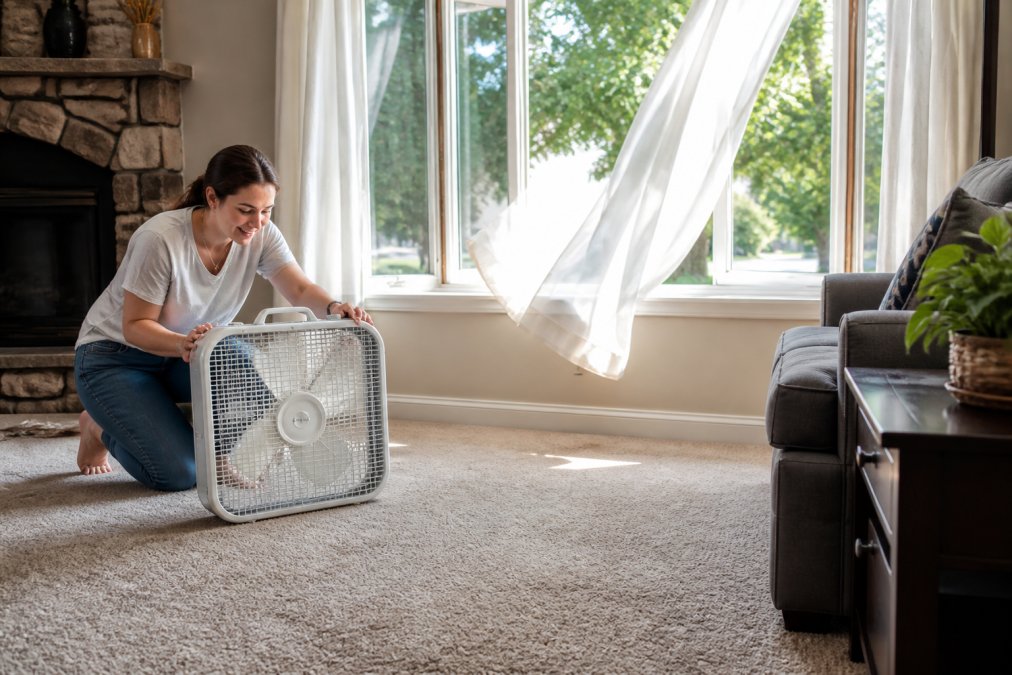
Accelerating carpet drying requires attacking moisture from multiple angles simultaneously. The most effective strategy is to combine airflow, dehumidification, and heat. Start by opening windows and doors to create cross-ventilation, then position fans to blow directly across the carpet surface.
Here is a practical sequence to follow after any carpet cleaning:
- Turn on ceiling fans and your HVAC system to circulate air throughout the home
- Place box fans or portable fans at floor level, angled slightly downward toward the carpet
- Run a dehumidifier in the room to pull moisture from the air
- Raise the thermostat a few degrees to warm the room and increase evaporation
- Lift furniture onto foil blocks or plastic caps so air can reach the carpet underneath
- Blot any remaining wet spots with clean, white towels using firm pressure
A common mistake is relying on a single fan. Multiple fans positioned around the room create turbulent airflow that strips moisture from the carpet pile far faster than one fan blowing in one direction.
For carpets cleaned with hot water extraction, perform a “towel test” after 4 to 6 hours. Press a clean white paper towel firmly onto the carpet. If it comes up damp or discolored, the carpet is not ready for foot traffic.
Walking on Wet Carpet After Cleaning: Safety and Timing
The general rule is to wait until the carpet is completely dry, which for standard hot water extraction means 6 to 12 hours. Walking on a damp carpet compresses the fibers while they are in their most vulnerable, water-swollen state. For nylon and polyester, this can cause a permanent flattening of the twist in the yarn, leading to matting that no amount of vacuuming will reverse. For wool, the risk is more severe: the scales on the wool fiber open when wet, making them prone to irreversible tangling and felting under foot traffic.
Beyond the visible damage, there is a less obvious but more critical risk: wicking. When you step on a damp carpet, your weight pushes moisture deeper into the padding and backing. As the surface dries, that trapped moisture can wick back up to the surface, carrying dissolved soil and cleaning residue with it. This is a leading cause of rapid re-soiling after a professional cleaning.
For essential access, clean, dry socks are acceptable for a quick crossing, but they still transfer body oils to the carpet. Cardboard or plastic walk-off mats are better, as they distribute weight and prevent direct fiber contact. Children and pets should be kept off entirely. A pet’s claws can snag and pull the carpet loops, and pet paws carry oils and bacteria that will be ground into the damp fibers.
Furniture placement is a common source of post-cleaning damage. Placing a heavy sofa or table leg directly on damp carpet creates a pressure point that traps moisture, leading to discoloration and a musty odor in the padding. Use plastic furniture coasters or aluminum foil balls under each leg to lift the furniture and allow air to circulate. For large, immovable pieces, ask your cleaning technician to use a low-moisture method for that area or to place air movers underneath.
A carpet that feels dry on the surface may still be damp in the padding. The ‘towel test’ only checks the surface. If you have heavy furniture to move back, wait a full 24 hours, regardless of the surface feel, to prevent moisture from being trapped in the pad.
Even clean-looking bare feet carry skin cells and bacteria. When you walk on a damp carpet, you are introducing a food source and microbes into a warm, moist environment, accelerating the growth of bacteria and dust mites that trigger allergies and asthma. For sensitive households, the ‘safe to walk’ threshold should be based on when the backing and padding are confirmed dry, which often requires a moisture meter. If you don’t have one, wait the full 12 hours for steam cleaning, or switch to a low-moisture method. preventing mold growth.
The Benefits of Low-Water Carpet Cleaning for Faster Drying
Low-water carpet cleaning offers a clear advantage when drying time matters: it uses up to 80% less water than traditional steam cleaning. This method relies on specialized machines that agitate cleaning solution into the carpet fibers, then extract it without deep saturation. The result is a clean carpet that dries in 1 to 4 hours rather than overnight.
For households with children, pets, or busy schedules, the benefits of low-water carpet cleaning extend beyond convenience. Less moisture means less risk of mold and mildew growth in the padding and subfloor. It also means no dirt-attracting residue is left behind, because the low-moisture solutions are designed to crystallize and be vacuumed away.
At PowerPro Carpet Cleaning, our low-water method is a core part of how we serve families across New Jersey. Our trained technicians use organic, green-certified solutions that are safe for children and pets, and our process typically has your carpets dry within hours, not days.
Health Risks of Improper Drying: Mold and Mildew Prevention
Carpet that stays damp for more than 24 hours creates ideal conditions for mold and mildew growth (the EPA). Mold spores are present in every home, but they need moisture to germinate and spread. A saturated carpet with poor airflow provides exactly the environment mold needs to take hold.
The health consequences are serious. Mold exposure can trigger allergic reactions, asthma attacks, and respiratory irritation, particularly in children, the elderly, and people with compromised immune systems. A musty odor in the days following a cleaning is often the first sign that mold is developing in the carpet padding.
Prevention starts with proper drying. Ensure good airflow during and after cleaning, and address any damp spots immediately. If your carpet remains wet after 24 hours, contact a professional to assess whether the padding needs replacement. In severe cases, such as water damage from flooding, prompt extraction and professional drying equipment are essential to prevent structural damage to your subfloor.
For health-conscious families, the choice of cleaning method matters. Low-water cleaning minimizes the moisture that supports mold growth, making it a safer option for homes with allergy sufferers or young children.
Post-Cleaning Maintenance Checklist
The first 24 hours after a cleaning are the most critical for the long-term health of your carpet. While the carpet is drying, it is in a vulnerable state, and your actions during this window have a disproportionate impact on how long the clean look lasts.
The First 4 Hours: The No-Go Zone
- Do not walk on the carpet. This is the period of highest moisture content. Any traffic risks fiber crush and wicking.
- Maintain maximum airflow. Keep fans running and windows open. Consistent airflow is the single biggest factor in preventing the 24-hour dampness that leads to mold.
- Do not replace furniture. Placing weight on the saturated padding will squeeze water into the subfloor, which can cause wood rot or adhesive failure.
The 4 to 12 Hour Window: The Drying Phase
- Perform the ‘white towel’ test. Press a clean, white paper towel firmly onto the carpet in a high-traffic area. If it comes up damp or shows any discoloration, the carpet is not ready. Repeat in a corner and near walls, as these areas dry slowest.
- Blot, do not rub, any spots. If you see a stain wicking to the surface, blot it with a clean, dry, white cloth. Rubbing will spread the residue and push it deeper.
- Check the padding. If you have a floor register or a small gap near a wall, feel the backing of the carpet. If it feels cool or damp, the pad is still wet.
The 12 to 24 Hour Window: The Recovery Phase
- Vacuum gently. Once the surface is dry, vacuum with the beater bar turned off to lift the pile without pulling on the fibers.
- Replace furniture with protection. Use plastic coasters or foil, and lift heavy pieces rather than sliding them.
- Apply a carpet protector (optional). If you had a protector applied, this is when it cures. Keep the room well-ventilated for the next 24 hours.
Beyond the First Day: The Long-Term Routine
The post-cleaning window sets the stage, but the long-term routine determines carpet lifespan. A common mistake is waiting until carpet looks dirty before cleaning it. By the time soil is visible, it has already worked its way deep into the fibers, acting as an abrasive that cuts the pile. Here is the routine that extends the life of your carpet:
- Vacuum high-traffic areas twice per week. This removes the grit that causes fiber abrasion. Use a vacuum with a HEPA filter to capture allergens, not just surface dirt.
- Use doormats at every entrance. A good doormat traps up to 80% of the dirt before it reaches the carpet. Place a mat both outside and inside the door.
- Implement a ‘no shoes’ policy. This is the most effective way to reduce soil and moisture. If it is not practical, use a dedicated pair of indoor slippers.
- Address spills with a specific technique. Blot with a clean, white cloth, working from the edge of the spill inward to prevent spreading. Use a solution of white vinegar and water for most organic stains, but always test in an inconspicuous area first.
- Schedule professional cleaning every 12 to 18 months. More frequent cleaning is needed with pets or heavy traffic. The method matters: low-moisture cleaning is gentler on the fibers and prevents the over-wetting that leads to rapid re-soiling.
A simple way to gauge if your carpet needs cleaning is the ‘white glove’ test. Run a white paper towel across the surface. If it comes up dark, it is time to schedule a professional cleaning. Waiting until you can see the dirt means the soil has already damaged the fiber’s luster.
Climate-Specific Drying Advice for Homeowners
Your local climate plays a major role in how long carpet takes to dry after cleaning. In humid regions, moisture in the air slows evaporation, extending drying times significantly. Homeowners in coastal areas or the southeastern states often find that carpets take longer to dry during summer months when relative humidity stays high.
In these conditions, a dehumidifier is essential. Run it continuously during and after cleaning, and use air conditioning to reduce humidity while circulating air. Avoid cleaning carpets on rainy days when outdoor humidity is at its peak.
Conversely, in dry climates, carpets dry quickly, sometimes within 4 to 6 hours after steam cleaning. The challenge there is preventing over-drying, which can make synthetic fibers brittle. In any climate, check the weather forecast before scheduling a cleaning.
For New Jersey homeowners, timing matters. Schedule cleanings in the morning so carpets have maximum daylight hours to dry, and plan to run dehumidifiers throughout the day.
When to Call a Professional for Slow-Drying Carpets
If your carpet remains damp beyond 24 hours after cleaning, call a professional immediately. This extended moisture indicates a problem, whether it is inadequate extraction, saturated padding, or an underlying issue like a leak or high humidity.
Signs that professional help is needed include a persistent musty odor, visible discoloration, or carpet that feels damp in isolated spots. A professional can use commercial-grade extraction equipment to remove trapped moisture and assess whether the padding or subfloor has been compromised.
Professional drying services use air movers and industrial dehumidifiers that far exceed what homeowners can rent. These tools can dry a saturated carpet in hours rather than days. At PowerPro Carpet Cleaning, our technicians are trained to Inspection Institution of Cleaning and Restoration standards, and we are available 24/7 for emergency situations involving water damage.
If your carpet is still wet after a full day, do not wait to see if it dries on its own. Prolonged moisture leads to mold, which is costly to remediate and hazardous to your health. Call a professional who can extract the water and dry the area properly.
Getting your carpet dry quickly comes down to choosing the right cleaning method, managing airflow and humidity, and knowing when to bring in help. The frustration of a living room that is off-limits for a full day is avoidable with a low-water approach. PowerPro Carpet Cleaning combines organic, green-certified solutions with a low-water process that dries in hours, not days. Call us at 848-347-3201 and get your carpets clean and dry the same day.
Frequently Asked Questions
How long should you stay off carpet after cleaning?
For hot water extraction (steam cleaning), plan to stay off the carpet for 6 to 12 hours. With low-water cleaning methods, you can often walk on the carpet within 1 to 2 hours. The exact time depends on carpet thickness, padding, humidity, and airflow. To be safe, wait until the carpet feels dry to the touch, and wear clean socks or slippers if you must walk on it earlier.
How can I make my carpet dry faster after cleaning it?
Open windows and doors to increase ventilation, turn on ceiling fans, and run a dehumidifier to pull moisture from the air. Set up portable fans aimed at the carpet surface for direct airflow. Avoid walking on the carpet while it dries to prevent crushing the fibers and trapping moisture. If you used a DIY cleaning machine, do an extra pass with the suction wand to extract more water.
Does humidity affect how long carpet takes to dry?
Yes, relative humidity is one of the biggest factors. On a humid day, moisture evaporates slowly, so carpet can take up to 24 hours to dry. In dry conditions with good airflow, drying may take only 4 to 6 hours. Running a dehumidifier or your HVAC system reduces humidity levels and speeds up evaporation, especially in basements or rooms with poor ventilation.
Is it safe to walk on damp carpet with socks?
Walking on damp carpet with clean, dry socks is generally safe once the carpet is no longer saturated. The risk is slipping or transferring dirt from your socks onto the damp fibers. Bare feet can transfer body oils that attract dirt. For the first few hours after cleaning, try to keep pets and children off the carpet entirely to prevent re-soiling and uneven drying.