Table of Contents
- The Real Cost of Professional Carpet Cleaning vs. What You Actually Get
- How Professional Carpet Cleaning Extends Carpet Lifespan
- DIY vs. Professional Carpet Cleaning: What’s the Difference?
- Carpet Cleaning for Indoor Air Quality and Health Benefits
- Deep Cleaning Methods: Steam Extraction and Hot Water Extraction Explained
- How Often to Clean Carpets for Maximum Protection
- Professional Carpet Cleaning and Warranty Protection
- The Long-Term ROI: Protecting Your Home Investment
- Conclusion
- Frequently Asked Questions
Last Updated: September 26, 2026
The Real Cost of Professional Carpet Cleaning vs. What You Actually Get
Understanding whether professional carpet cleaning worth cost requires knowing what you’re actually paying for. Most homeowners compare professional services to rental machines without realizing they’re measuring completely different outcomes. A rental machine won’t remove deep soil accumulation embedded in carpet fibers after months of foot traffic, pet accidents, and dust settling. Professional carpet cleaning worth cost becomes clear when you factor in what you’re protecting: your carpet investment, your home’s resale value, and your family’s health.
The difference between surface cleaning and deep cleaning isn’t just about appearance, it’s about extending your carpet’s lifespan by years and preventing fiber degradation when dirt and allergens build up inside the pile.
Professional-grade equipment uses hot water extraction or steam extraction at temperatures and pressures household machines cannot achieve. Rental machines extract roughly 40-50% of the water they spray into carpet, while professional equipment removes significantly more, reducing dry time from 24+ hours to just a few hours, the difference between carpet staying wet long enough for mold to develop versus drying quickly enough to prevent it.
How Professional Carpet Cleaning Extends Carpet Lifespan
Professional deep cleaning removes soil that accumulates deep within carpet fibers and backing. When dirt sits in carpet for months, it acts like sandpaper, grinding against fibers and causing silent fiber degradation. Professional cleaning extracts embedded soil before it causes permanent matting in high-traffic areas.
Most carpet manufacturer warranties require professional cleaning on a regular schedule. Skipping professional cleaning voids warranty protection. Following the manufacturer’s maintenance schedule, typically annual or bi-annual professional deep cleaning, protects your carpet investment.
Professional low-water extraction methods mean carpet dries faster, reducing the window where mold and mildew develop. Mold growth in damp carpet backing is a leading cause of premature carpet failure and indoor air quality problems.
DIY vs. Professional Carpet Cleaning: What’s the Difference?
DIY carpet cleaning with rental machines addresses surface dirt only. Equipment designed for light residential use has limited water pressure, inadequate suction, and no ability to control water temperature or apply the right cleaning chemistry for different fiber types.
Professional carpet cleaning targets the entire carpet depth. Technicians identify fiber type, assess soil type, and select the appropriate cleaning method. They spot problem areas, old stains, pet urine saturation, and mold growth, addressing them with targeted treatments consumer products cannot match.
Professional technicians understand carpet fiber chemistry and soil removal, identifying when stains require enzymatic versus oxidation-based treatment. They adjust extraction rates to prevent over-wetting damage.
DIY methods leave carpet damp for 12-24 hours, creating mold and mildew conditions. Professional equipment dries carpet in 2-4 hours, allowing same-day use and preventing mold growth.
Carpet Cleaning for Indoor Air Quality and Health Benefits
Carpet acts as a filter, trapping allergens, dust, and pet dander. Over time, this filter becomes saturated with contaminants vacuuming cannot remove. Professional extraction is a health investment, not just cosmetic.
What accumulates in carpet fibers:
Dust mites produce roughly 20 fecal pellets per day; a gram of carpet dust can contain up to 10,000 dust mites. Pet dander and mold spores similarly embed in carpet pile and backing, particularly where moisture lingers after DIY cleaning.
Household vacuums remove particles from only the top 1/8 inch of carpet pile. Allergens in deeper pile and backing remain undisturbed, off-gassing into breathing air when foot traffic agitates the carpet.
How professional extraction removes allergens:
Professional hot water extraction injects heated water (typically 200°F or higher) mixed with cleaning solution into carpet pile and backing, then extracts it using suction power 5-10 times greater than household equipment. This physically dislodges dust mites, pet dander, and mold spores, removing them from your home entirely rather than redistributing them into the air.
Professional extraction removes allergens from carpet backing and subfloor, not just the surface. Dust mites and pet allergens in the backing layer are extracted with the moisture. DIY rental machines lack the suction power and water temperature to reach this depth, leaving the allergen reservoir intact.
Health outcomes for allergy and asthma sufferers:
Families with asthma or allergies report reduced nighttime coughing, fewer medication doses, and improved sleep after professional cleaning. Allergens reaccumulate within 3-6 months, so manufacturers recommend professional cleaning every 6-12 months for homes with allergy sufferers.
Cat allergen (Fel d 1) is particularly persistent; a single cat can affect non-allergic household members. Professional cleaning removes pet allergen more effectively than DIY methods. Regular professional cleaning every 3-6 months for homes with multiple pets maintains allergen levels at a lower baseline.
Chemical residue and indoor air quality:
Many commercial carpet cleaning products contain surfactants and solvents that remain in fibers after drying, releasing volatile organic compounds (VOCs) into indoor air. Professional services using certified green or organic cleaning solutions with plant-based surfactants and enzymatic cleaners avoid chemical residue.
Professional carpet cleaning removes allergens from the entire carpet depth, not just the surface, and when paired with green cleaning solutions, improves indoor air quality without introducing chemical residue. For families with allergies, asthma, or pets, regular professional cleaning is a health maintenance practice, not a luxury service.
Deep Cleaning Methods: Steam Extraction and Hot Water Extraction Explained
Professional carpet cleaning uses two primary methods: hot water extraction and steam extraction. Understanding when each is appropriate reveals why professional expertise commands a premium over DIY rental machines.
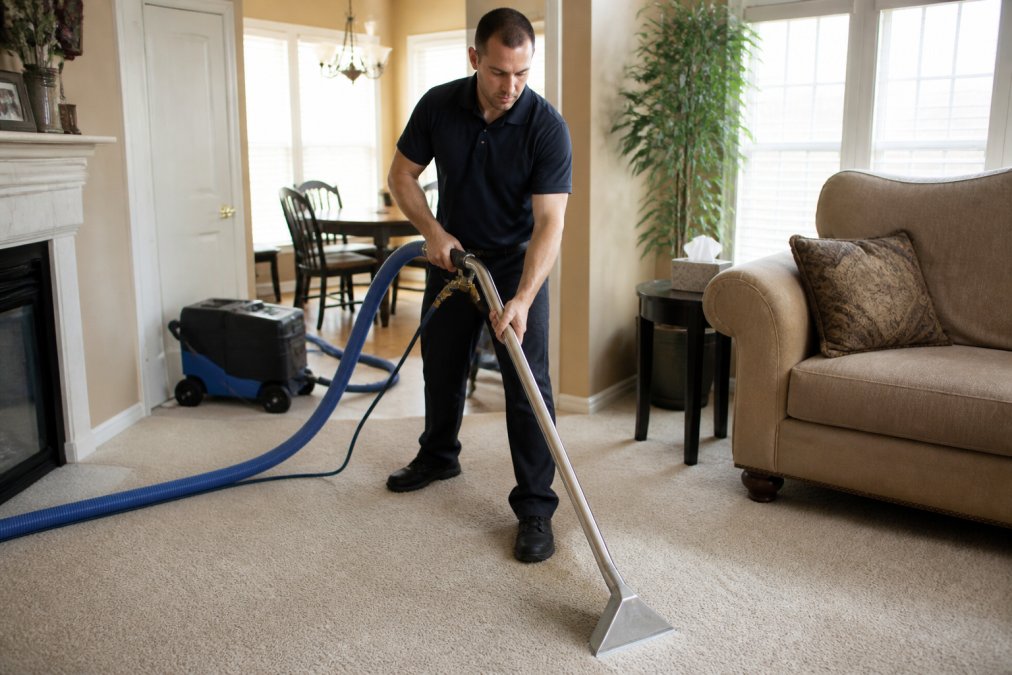
Hot water extraction (HWE): The industry standard for most household soils
Hot water extraction applies heated water (typically 200°F-220°F) mixed with cleaning solution into carpet pile and backing, then extracts it using powerful suction. Heat breaks down soil bonds, chemical action lifts dirt and allergens, and suction removes contaminated water before it soaks into backing.
Hot water extraction is recommended by the Carpet and Rug Institute (CRI) and most manufacturers for routine maintenance. It is highly effective on common household soils and works well on most fiber types, though water temperature and chemistry must be adjusted based on fiber content.
Hot water extraction introduces more water than steam extraction. Incomplete extraction or over-wetting can leave moisture in backing and subfloor, creating mold conditions. Professional technicians control this through proper extraction technique, appropriate water-to-solution ratios, and equipment with suction power to remove 70-80% of introduced water.
Steam extraction: Lower moisture, faster drying, delicate fiber protection
Steam extraction uses dry steam (very hot vapor with minimal liquid water, typically 250°F-300°F) that penetrates fibers and loosens soil bonds through heat. Less water is introduced, so steam extraction dries faster, often within 2-3 hours versus 4-6 hours for hot water extraction.
Steam extraction is preferred for delicate fiber types (wool, silk blends, natural fibers) that can be damaged by prolonged moisture or certain chemicals. It is also better for situations requiring rapid drying: homes with mold sensitivity, humid basements, or when carpet must be ready for use within hours.
Steam extraction is less effective than hot water extraction on heavily soiled carpet or stubborn stains requiring chemical treatment. Protein-based stains (blood, urine) and tannin stains (coffee, wine) require enzymatic or oxidation-based chemistry. Professional technicians know when steam extraction is sufficient and when hot water extraction with targeted treatment is necessary.
Fiber-type decision logic: Why professionals match method to carpet
This is where professional expertise creates value that DIY rental machines cannot match. Different carpet fibers respond differently to heat, moisture, and cleaning chemistry:
- Nylon carpet (the most common residential fiber) tolerates both hot water and steam extraction well. It is durable and responds well to chemical cleaning. Hot water extraction is typically the default for nylon.
- Polyester carpet is sensitive to heat above 212°F and can melt or become permanently damaged if exposed to water hotter than this. Professional technicians using hot water extraction on polyester reduce water temperature to 180°F-200°F and adjust extraction technique accordingly. Steam extraction at standard temperatures can damage polyester.
- Wool carpet is delicate and requires lower water temperatures (160°F-180°F) and careful extraction to avoid felting (permanent matting caused by moisture and agitation). Wool often benefits from steam extraction or dry cleaning methods rather than traditional hot water extraction.
- Wool blends and natural fibers require similar care. Professional technicians identify fiber content before selecting a cleaning method; DIY renters typically do not.
Using the wrong method on the wrong fiber type causes permanent damage: color loss, fiber melting, felting, or permanent staining. This risk is why carpet manufacturers specify professional cleaning in their warranty language, they know that improper cleaning method selection causes more damage than no cleaning at all.
Soil-type matching: Why professionals adjust chemistry and method
Professional technicians assess soil type and select cleaning chemistry accordingly:
- Protein-based soils (pet accidents, food spills, blood) require enzymatic cleaning solutions that break down protein molecules. These soils respond poorly to standard surfactant-based cleaners and require the enzyme to work for 12-24 hours after application, making them unsuitable for DIY rental cleaning where you apply and extract immediately.
- Tannin-based soils (coffee, tea, wine, plant matter) require oxidation-based cleaning chemistry. Standard surfactants lift the soil particles but leave the tannin stain. Professional technicians apply oxidizing agents that break down the tannin molecule itself, removing the stain rather than just the soil.
- Oil-based soils (cooking grease, cosmetics, automotive fluids) require solvent-based or specialized surfactants. Water-based cleaning solutions alone are ineffective on oil-based soils.
DIY rental machines come with one or two generic cleaning solutions. Professional services maintain multiple cleaning chemistries and select the appropriate one based on soil assessment. This matching of chemistry to soil type is invisible to the homeowner but is the difference between a stain that lifts completely and a stain that returns within weeks.
Equipment differences: Why professional suction and pressure matter
Professional extraction equipment differs from rental machines in three critical ways:
Suction power: Professional equipment generates 200+ inches of water lift (the measurement of suction strength). Rental machines typically generate 80-120 inches of water lift. This difference means professional equipment removes 70-80% of the water introduced into carpet, while rental equipment removes 40-50%. The remaining moisture in rental-cleaned carpet is why mold and mildew odors develop within days.
Water pressure: Professional equipment applies 300-500 PSI (pounds per square inch) of pressure. Rental machines apply 100-200 PSI. Higher pressure dislodges soil more effectively from deep within the carpet pile and backing.
Temperature consistency: Professional equipment maintains water temperature throughout the cleaning process. Rental machines often cool as they operate, reducing cleaning effectiveness as the job progresses. Temperature drop also means later sections of carpet receive cooler water, which is less effective at breaking down soil bonds.
These equipment differences compound: a professional system with high suction, high pressure, and consistent temperature removes soil more completely, dries faster, and leaves less residue. A rental machine with lower specs leaves more moisture, more residue, and more soil behind, which is why DIY-cleaned carpet often looks clean for a few weeks, then appears dirty again as residue attracts new soil.
Professional technicians often perform a pre-cleaning assessment, testing a small area with different cleaning methods to determine which approach will be most effective for that specific carpet and soil type. This diagnostic step is impossible with a rental machine and is one reason professional cleaning produces better results.
How Often to Clean Carpets for Maximum Protection
How often to clean carpets depends on household traffic, pets, and your carpet manufacturer’s recommendations. Most manufacturers specify professional cleaning annually for normal household traffic, and more frequently (every 6 months) for homes with pets or high traffic. Maintaining this rigorous schedule helps preserve the integrity of your flooring fibers, much like how a consistent approach to professional house cleaning protects the overall hygiene and longevity of your entire living space.
In practice, most households benefit from professional cleaning twice per year. This schedule prevents soil accumulation from reaching the point where fiber degradation accelerates. Between professional cleanings, regular vacuuming (2-3 times weekly in high-traffic areas) maintains surface cleanliness and removes particles before they settle deeper into the pile.
Homes with pets need more frequent professional cleaning because pet accidents introduce both organic matter and urine salts that accumulate in carpet backing. Urine odors that return after cleaning usually indicate the urine reached the backing and subfloor, requiring extraction from below the carpet surface, something only professional equipment can accomplish.
High-traffic commercial spaces or busy households with children might need quarterly professional cleaning to prevent visible matting and soil lines. The investment in frequent professional cleaning actually saves money by extending carpet life and preventing premature replacement.
Delaying professional cleaning past the point where soil has saturated the backing makes the problem exponentially harder to solve. Once urine or other contaminants reach the subfloor, professional cleaning may not fully resolve the odor, and replacement may become necessary.
Professional Carpet Cleaning and Warranty Protection
Your carpet manufacturer’s warranty is only valid if you follow the manufacturer’s specified maintenance schedule, and that schedule almost always includes professional carpet cleaning. This is not a suggestion, it’s a warranty requirement.
If your carpet develops problems (premature wear, staining, color loss) and you cannot demonstrate professional cleaning on the schedule specified by the manufacturer, the warranty claim will be denied. The cost of professional carpet cleaning worth the investment becomes obvious when you realize skipping it voids your warranty protection on a thousands-of-dollar carpet investment.
Manufacturers specify professional cleaning requirements because they understand that carpet longevity depends on regular deep cleaning. The warranty language protects both the manufacturer and the homeowner: manufacturers know carpets will last their intended lifespan if properly maintained, and homeowners know their investment is protected as long as they follow the maintenance schedule.
The Long-Term ROI: Protecting Your Home Investment
When you’re preparing for a move or selling your property, carpet condition directly affects your home’s value and buyer perception. Professional carpet cleaning before showing or selling is one of the highest-ROI home improvements you can make. Clean carpet makes the entire home feel cleaner and newer, even if nothing else has changed.
Buyers notice carpet condition immediately. Stained, matted, or odorous carpet signals deferred maintenance throughout the home, even if everything else is in perfect condition. Professional deep cleaning removes stains, restores pile texture, and eliminates odors that suggest pet accidents or water damage. The cost of professional cleaning is recovered many times over in buyer perception and final sale price.
For homeowners staying in their homes, the long-term ROI of regular professional cleaning is equally clear: extending carpet life by 5+ years means delaying a $5,000-$10,000+ replacement project. Professional cleaning costs a fraction of replacement, and the math is straightforward. Regular professional carpet cleaning worth the cost because it’s the cheapest way to protect your largest flooring investment.
| Maintenance Approach | Carpet Lifespan | Cost Over 10 Years | Replacement Cost |
|---|---|---|---|
| Vacuuming only | 5-7 years | Minimal | Full replacement needed |
| Vacuuming + DIY cleaning | 6-8 years | Low | Replacement within 10 years |
| Vacuuming + professional cleaning 1x/year | 10-12 years | Moderate | No replacement needed |
| Vacuuming + professional cleaning 2x/year | 12+ years | Moderate | No replacement needed |
Health benefits also have long-term value. Families with allergies or asthma who maintain professional cleaning schedules report fewer respiratory issues and reduced medication needs. While this benefit is harder to quantify in dollars, the quality-of-life improvement for families struggling with indoor air quality is significant.
Professional carpet cleaning extends carpet life by 5+ years, maintains warranty protection, improves indoor air quality, and increases home resale value, making it one of the highest-ROI home maintenance investments you can make.
Conclusion
Professional carpet cleaning is worth the cost because it protects your largest flooring investment, maintains your carpet warranty, improves your family’s health, and increases your home’s resale value. The comparison between professional cleaning and DIY methods isn’t really about cost, it’s about what you’re trying to achieve.
If you want surface cleanliness, DIY methods work. If you want to extend your carpet’s life, protect your warranty, remove deep allergen accumulation, and prevent mold growth, professional cleaning is the only option that delivers.
Frequently Asked Questions
Is professional carpet cleaning worth the cost?
Yes, professional carpet cleaning is worth the investment when you consider long-term carpet lifespan, health benefits, and resale value. Professional-grade equipment removes deep soil accumulation and allergens that rental machines cannot reach. Most homeowners see their carpets last 8-10 years longer with regular professional cleaning compared to DIY methods alone. The cost-benefit analysis heavily favors professional cleaning, especially for homes with pets, children, or high-traffic areas.
How often should you have carpets professionally cleaned?
Most carpet manufacturers recommend professional cleaning every 12-18 months for residential homes. Homes with pets, children, or high-traffic areas benefit from cleaning every 6-12 months. Spot treatment between professional cleanings extends the time between deep cleanings. Regular maintenance prevents soil accumulation and fiber degradation, which protects your warranty and keeps carpets looking newer longer. Following the manufacturer’s maintenance schedule is essential for preserving your carpet investment.
Does professional carpet cleaning remove allergens?
Professional carpet cleaning significantly reduces allergens, dust mites, pet dander, and other contaminants trapped in carpet fibers. Hot water extraction and steam cleaning kill allergens more effectively than DIY methods. Indoor air quality improves noticeably after professional cleaning, which is especially beneficial for families with allergies or asthma. Professional-grade equipment and techniques remove 95% of allergens from carpet pile, while rental machines typically remove only 40-50%. This health benefit alone justifies the cost for health-conscious families.
Can professional carpet cleaning remove old pet odors and stains?
Professional carpet cleaners can remove most pet odors and stubborn stains using specialized techniques like spot treatment and deodorizing. However, if urine has soaked deep into the carpet pad or subfloor, the odor may require additional treatment or pad replacement. Professional-grade equipment can extract moisture more thoroughly than rental machines, addressing the source of odors. Bonded and insured professionals assess whether stains are salvageable and recommend the best approach, whether that’s intensive cleaning or replacement.
When your carpet needs deep cleaning that removes soil from the backing, eliminates odors that return within weeks, and dries fast enough to prevent mold growth, PowerPro Carpet Cleaning delivers results DIY methods cannot match. Our organic, low-water extraction method cleans thoroughly while drying in hours instead of days. Call us at 848-347-3201 to schedule your professional cleaning and protect your home investment.