Table of Contents
- Why Mold Grows in Carpets After Cleaning
- How Long Does Carpet Take to Dry After Cleaning
- Best Carpet Drying Techniques to Stop Mold
- Using a Dehumidifier for Carpet Drying
- Inspect Carpet Padding and Subfloor for Hidden Moisture
- Signs of Mold Under Carpet to Watch For
- Preventative Maintenance and Post-Cleaning Care
- When to Call Professional Mold Remediation
- Frequently Asked Questions
Last Updated: September 21, 2026
Why Mold Grows in Carpets After Cleaning
Mold thrives in damp environments. Carpet cleaning introduces moisture deep into fibers, padding, and subfloor. If that moisture lingers too long, mold spores germinate and spread rapidly.
The problem isn’t the cleaning itself, it’s what happens after. Most homeowners think their carpet is dry when the surface feels dry. But underneath, moisture can remain trapped for days. That’s where mold takes hold.
Mold spores exist everywhere in your home. They’re dormant until conditions are right: moisture, warmth, and time. A wet carpet is a perfect breeding ground. Relative humidity above 55% accelerates microbial growth. Temperatures between 68-86°F create ideal conditions for fungal colonies to establish.
The carpet fibers themselves dry quickly. But carpet padding and subfloor dry much slower. This is where mold actually develops. If you don’t address the moisture underneath, you’re setting up a mold problem, even if the carpet feels dry to walk on.
How Long Does Carpet Take to Dry After Cleaning
Drying time depends on several factors: cleaning method, carpet fiber type, thickness, airflow, humidity, and temperature. But the most overlooked variable is fiber composition, which dramatically affects how long moisture lingers.
Synthetic fiber carpets (polyester, nylon, polypropylene):
Synthetic fibers are hydrophobic, they resist water absorption. Moisture sits on the surface and in the backing rather than soaking into fibers themselves. This is an advantage for drying speed.
- Dry-steam or low-water extraction: 4-8 hours
- Hot-water extraction: 12-18 hours
- In optimal conditions (warm, dry, good airflow): as fast as 6-10 hours total
Synthetic carpets are forgiving. They dry relatively quickly if you use proper technique and equipment.
Natural fiber carpets (wool, jute, sisal, cotton):
Natural fibers are hygroscopic, they actively absorb and hold moisture. Water penetrates deep into the fiber structure. Drying takes significantly longer, and the risk of mold is higher because moisture remains trapped longer.
- Dry-steam extraction: 8-12 hours minimum
- Hot-water extraction: 24-48 hours or longer
- In humid conditions: can extend to 72+ hours
Wool carpet, in particular, can retain 30% of its weight in water after cleaning. This makes it especially vulnerable to mold if drying is incomplete. Jute and sisal are even more absorbent and require extra caution.
Professional low-water methods dry fastest overall. Dry-steam extraction removes more water upfront, leaving less moisture behind. Most carpets (especially synthetics) dry within 4-8 hours using this approach. Traditional hot-water extraction saturates fibers and padding more heavily, extending drying to 12-24 hours or more in humid conditions.
Factors that speed up drying:
- Higher temperature (warm air evaporates moisture faster; aim for 70-75°F)
- Lower humidity (dry air pulls moisture from carpet; below 50% is ideal)
- Strong airflow (fans and ventilation move moisture out of fibers and padding)
- Thinner carpet or lower pile (less fiber mass and water retention)
- Synthetic fibers over natural fibers (hydrophobic vs. hygroscopic)
- Equipment that extracts more water during cleaning (less residual moisture to dry)
Factors that slow drying:
- Cold weather (moisture evaporates slowly below 65°F; natural fibers especially slow down)
- High humidity (humid air cannot absorb additional moisture; above 55% is problematic)
- Thick carpet, plush pile, or dense backing (holds more water)
- Poor ventilation (moisture stays trapped indoors)
- Wet subfloor or padding (acts as a moisture reservoir, re-wetting the carpet from below)
- Natural fiber composition (wool, jute absorb and retain water longer)
The critical insight: Surface drying is not complete drying. Your carpet might feel dry within hours, especially synthetic fibers. But the padding beneath, and especially the backing and subfloor, can stay damp for days. With natural fiber carpets, even the fibers themselves may retain moisture. That’s when mold risk peaks. Never assume your carpet is truly dry based on how it feels underfoot. Check the padding and subfloor before declaring the drying process complete.
Best Carpet Drying Techniques to Stop Mold
Preventing mold requires aggressive moisture removal. Don’t rely on time alone. Use active drying techniques.
Maximize Air Circulation
Air movement is your first defense against mold growth.
Open all windows and doors immediately after cleaning. Create cross-ventilation by opening windows on opposite sides of the room. This pulls fresh, drier air through the space and pushes humid air out.
Position fans strategically:
- Place box fans in windows to blow air out (not in)
- Use pedestal or tower fans to direct airflow across the carpet
- Position fans to create circular air patterns in the room
- Run fans continuously until carpet is completely dry
Industrial fans are more powerful than household fans. If you have access to one, use it. The increased airflow dramatically speeds evaporation. PowerPro Carpet Cleaning uses commercial-grade equipment that moves air much faster than standard household fans.
Don’t just turn on the ceiling fan. Ceiling fans circulate air within the room but don’t remove moisture from the space. You need air leaving the home.
Control Moisture and Humidity Levels
Humidity control is critical to prevent mold in carpets after cleaning.
Check your home’s relative humidity with a hygrometer (a cheap device available at any hardware store). Aim to keep it below 50%. Anything above 55% creates conditions where mold thrives.
Lower humidity by:
- Running air conditioning (AC removes moisture while cooling)
- Opening windows to let dry outdoor air in
- Using a dehumidifier (see next section)
- Avoiding activities that add moisture (hot showers, cooking, laundry)
If it’s humid outside, close windows and rely on AC or dehumidifiers. If it’s dry outside, open windows to exchange indoor humid air for outdoor dry air.
Temperature matters too. Warmer air holds more moisture. Keep your home at 70-75°F during the drying period. Avoid extreme cold, which slows evaporation.
Using a Dehumidifier for Carpet Drying
A dehumidifier actively removes moisture from the air. It’s one of the most effective tools to prevent mold in carpets after cleaning. But dehumidifier selection and operation are only half the equation. Equally important, and rarely discussed, is preventing your cleaning equipment itself from introducing mold spores back into the carpet.
How dehumidifiers work:
They pull humid air across cold coils. Moisture condenses on the coils and drips into a tank or drain. Dry air is released back into the room. This cycle repeats until humidity drops. The result: a measurable reduction in relative humidity, which slows and stops mold germination.
Choosing the right size:
Dehumidifier capacity is measured in pints per day (how much water it removes). For a carpet drying situation:
- Small room (under 300 sq ft): 30-50 pint capacity
- Medium room (300-500 sq ft): 50-70 pint capacity
- Large room (500+ sq ft): 70+ pint capacity
Undersizing won’t work. A weak dehumidifier can’t keep up with the moisture your carpet is releasing. You need enough capacity to noticeably lower humidity within 2-4 hours. If humidity hasn’t dropped by at least 10-15% after 4 hours of operation, your dehumidifier is undersized.
Placement and operation:
- Position the dehumidifier in the center of the room for even moisture capture
- Keep doors closed to contain humidity (don’t let humid air escape the room before the dehumidifier captures it)
- Empty the tank frequently or run a drain hose outside to prevent overflow
- Run continuously until humidity drops below 50% and stays there
- Monitor humidity with a hygrometer to track progress; check every 2-3 hours
Combine a dehumidifier with fans. Fans move air so moisture reaches the dehumidifier. Dehumidifiers remove that moisture from the air. Together, they’re far more effective than either alone. Position fans to push air toward the dehumidifier intake.
The overlooked risk: cleaning equipment as a mold vector
Most homeowners and even some professionals don’t realize that the carpet cleaning machine itself can harbor mold spores and reintroduce them during cleaning. This is a critical oversight.
Why cleaning equipment matters:
Carpet cleaning machines, especially the water tanks, hoses, and brush heads, create a warm, moist environment. If not properly maintained between uses, mold spores and bacteria colonize these components. When you run the machine, it sprays contaminated water back onto your carpet. You’ve just introduced the very problem you’re trying to prevent. Maintaining clean equipment is a fundamental step in a broader strategy to prevent water damage throughout the rest of your home.
How to maintain your cleaning equipment:
- Empty water tanks immediately after use; don’t let water sit overnight
- Rinse all hoses, brush heads, and nozzles with clean water after each use
- Run clean water through the system for 30-60 seconds to flush residual moisture
- Leave tanks and hoses open to air-dry completely (at least 24 hours) before storing
- Store equipment in a dry, well-ventilated space, not a damp basement or garage
- If you notice a musty odor from the machine, run a cleaning solution (1 part white vinegar to 3 parts water) through the system to kill spores
- Replace filters and seals annually or if you notice reduced suction or water flow
- For professional-grade equipment, follow manufacturer maintenance schedules; many recommend deep cleaning every 6-12 months
If you’re renting a carpet cleaning machine from a hardware or equipment rental store, inspect it before use. Ask when it was last serviced. If the tanks smell musty or show visible residue, request a different machine. Rental equipment that isn’t properly maintained between customers is a common source of mold recontamination.
The prevention chain:
Proper drying (fans + dehumidifier) + humidity control + clean equipment = no mold. Skip any one step, and you’ve left the door open for fungal growth. The dehumidifier removes moisture from the air, but if your cleaning machine introduced spores, you’re fighting an uphill battle. Start with clean equipment, dry aggressively, and maintain humidity below 50%.
Inspect Carpet Padding and Subfloor for Hidden Moisture
This is where most homeowners fail. They see dry carpet and assume the job is done. But moisture trapped in padding and subfloor is invisible, and dangerous.
Why padding is the problem:
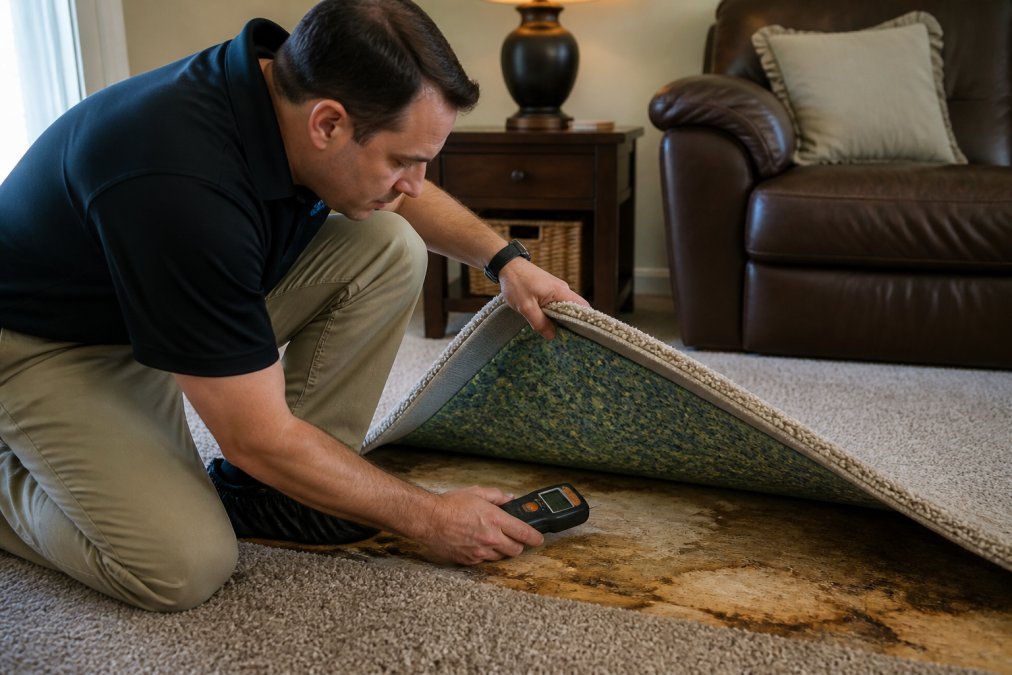
Carpet padding absorbs and holds water like a sponge. It dries much slower than carpet fibers. If padding stays damp for more than 24-48 hours, mold begins growing inside it. Once mold colonizes padding, it’s nearly impossible to remove without replacing the padding.
How to check for moisture:
Lift a corner of the carpet carefully. Feel the padding underneath. Is it cool or damp? Does it feel spongy? If yes, there’s still significant moisture.
Use a moisture meter if you have one. These inexpensive devices measure moisture content in materials. Readings above 20% indicate risk. Readings above 30% mean mold is likely already developing.
Press your hand on the subfloor (the base under the padding). Does it feel wet or cold? Cold indicates moisture. Wet means water is still present.
What to do if padding is wet:
- Increase airflow immediately (open windows, run fans)
- Place a dehumidifier in the room
- Lift carpet edges to allow air to reach padding from underneath
- Pull back carpet in corners and along walls to expose padding to air
- If padding stays wet for more than 48 hours, consider replacing it
Replacement is expensive but necessary. Wet padding that dries slowly becomes a mold factory. Once mold establishes in padding, it spreads to carpet fibers and can migrate to the subfloor. At that point, the problem is much larger than wet padding.
Signs of Mold Under Carpet to Watch For
Mold under carpet is often invisible until it’s severe. Watch for these warning signs.
Musty odor: This is usually the first sign. A damp, earthy smell means microbial growth is happening. Don’t ignore it. Act immediately.
Visible discoloration: Dark spots or patches on carpet or padding indicate mold colonies. Black or green spots are especially concerning.
Carpet feels damp: Even days after cleaning, if the carpet still feels cool or slightly wet, moisture is trapped underneath.
Carpet won’t dry: If your carpet feels damp after 48 hours, something is wrong. Normal drying should be complete by then.
Health symptoms: Increased allergies, coughing, or respiratory irritation after cleaning can signal mold spore exposure. Mold spores trigger allergic reactions in sensitive individuals (the CDC).
Soft or spongy carpet: Mold weakens carpet fibers and padding. If the carpet feels soft or squishy underfoot, structural damage is occurring.
Visible mold on padding: If you lift the carpet and see obvious mold growth on the padding, you need professional remediation immediately.
The moment you notice any of these signs, stop waiting and take action. Mold spreads fast. Early intervention prevents expensive replacement.
Preventative Maintenance and Post-Cleaning Care
Smart habits prevent mold problems before they start.
Immediately after cleaning:
- Open all windows and doors
- Turn on fans and AC
- Place a dehumidifier in the room
- Keep foot traffic off the carpet until completely dry
- Don’t close doors to the room (air needs to circulate out)
During the drying period:
- Check humidity every few hours with a hygrometer
- Monitor carpet and padding for dampness
- Keep fans and dehumidifiers running continuously
- Avoid adding moisture (limit showers, cooking, laundry)
Ongoing maintenance:
- Vacuum regularly to remove dust and debris (mold feeds on organic matter)
- Address spills immediately, don’t let moisture sit
- Maintain humidity below 50% year-round
- Ensure good ventilation in your home
- Check for leaks under sinks and around windows
- Use area rugs in high-moisture areas like bathrooms
Best practice for cleaning frequency:
Professional cleaning every 12-18 months keeps carpet fresh. More frequent cleaning (every 6 months) is needed in high-traffic homes or homes with pets. But only clean when necessary, excessive moisture from frequent cleaning increases mold risk.
Choose the right cleaning method:
Low-water methods like dry-steam extraction dry faster and leave less residual moisture. They’re superior to traditional hot-water extraction if mold prevention is your priority. PowerPro Carpet Cleaning uses low-water methods specifically because they dry within hours, not days, which helps eliminate the mold window.
When to Call Professional Mold Remediation
Some situations require professional help. Don’t try to fix severe mold yourself.
Call a professional if:
- You see visible mold growth under carpet or on padding
- The musty odor persists for more than 3-4 days
- Carpet doesn’t dry within 48-72 hours despite aggressive drying efforts
- You have health symptoms (respiratory issues, allergies) after cleaning
- Mold appears on the subfloor or walls
- The affected area is larger than a few square feet
- Your carpet was exposed to contaminated water (sewage, floodwater)
What professionals do:
Mold remediation specialists have industrial equipment and expertise. They can:
- Remove contaminated padding and replace it
- Treat subfloor with antifungal solutions
- Use HEPA-vacuum systems to remove mold spores
- Apply moisture barriers to prevent future growth
- Test air quality to ensure spores are gone
Professional remediation is expensive but necessary when mold establishes. Prevention through proper drying is far cheaper than remediation.
Wet carpet after cleaning doesn’t have to lead to mold. The solution is straightforward: remove moisture quickly and completely. Use fans, dehumidifiers, and humidity control. Inspect padding and subfloor. Act at the first sign of a musty odor.
PowerPro Carpet Cleaning uses low-water extraction methods that dry carpets in hours, not days, eliminating the mold window entirely. Our trained technicians follow Inspection Institution of Cleaning and Restoration standards to ensure complete drying and help prevent mold growth. For carpet cleaning that protects your home and your health, call us at 848-347-3201 for a consultation.
Frequently Asked Questions
How long until mold grows on wet carpet?
Mold spores can begin colonizing within 24-48 hours of moisture exposure if conditions support growth. Relative humidity above 55% and temperatures between 68-86°F create ideal conditions for fungal development. This is why rapid drying after cleaning is critical. The faster you remove moisture, the shorter the window for mold spores to establish. Most mold growth becomes visible within 3-7 days if carpet remains damp and humidity stays uncontrolled.
Can carpet with mold be saved?
Early-stage mold in carpet can sometimes be salvaged with professional remediation. If mold is limited to surface fibers and hasn’t penetrated deep into the padding or subfloor, specialized antifungal treatments and thorough drying may restore the carpet. However, if mold has colonized the carpet backing, padding, or subfloor, replacement is often necessary. Professional inspection using moisture meters and visual assessment determines whether restoration is feasible or if removal is the safer option for air quality and health.
What can I put on carpet to prevent mold after a deep clean?
After deep cleaning, focus on drying rather than applying products. Use industrial fans to increase airflow circulation, run a dehumidifier to lower relative humidity below 50%, and ensure proper ventilation. Some professionals apply antifungal treatments to carpet fibers as a preventative measure, but these work best on dry carpet. The key is removing moisture within hours of cleaning, not masking the problem with sprays. Proper drying prevents mold better than any topical treatment applied to wet or damp carpet.
What are the signs of mold growth under carpet padding?
Signs of mold under carpet padding include a musty odor, visible discoloration on the carpet backing when lifted, soft or spongy padding, and increased allergy symptoms or respiratory issues indoors. A moisture meter reading above 20% in the padding indicates excess moisture. If you notice these warning signs, lift the carpet edge in a small area to inspect the padding directly. Mold colonies under padding reduce air quality and can spread to the subfloor if left untreated, making early detection essential for preventing costly damage.