Table of Contents
- Why Do Carpets Stay Wet for Days After Cleaning?
- Excess Water Left in Carpet Fibers and Padding
- How Long Does Carpet Take to Dry After Cleaning?
- How to Dry Carpet Faster After Cleaning
- How to Use Fans to Dry Carpet
- Carpet Still Wet After Professional Cleaning? A Timed Troubleshooting Plan
- How to Check for Moisture Beneath Carpet Without Causing Damage
- When Wet Carpet Becomes a Health Risk
- Questions to Ask Before You Book a Carpet Cleaning Service
- Frequently Asked Questions
Last Updated: October 5, 2026
Why Do Carpets Stay Wet for Days After Cleaning?
If your carpet still feels damp a day or two after a cleaning, you are not imagining it. People often ask why do carpets stay wet for days after cleaning, and the answer is that too much water goes down and too little gets pulled back out, and the room has no airflow or ventilation to finish the job. At PowerPro Carpet Cleaning, we have handled this exact complaint since 1989, and the cause is almost always one of a handful of fixable problems.
Here is the short version: water left in the fibers, water trapped in the pad underneath, and a closed-up room with no air moving. Fix those three things and most carpets dry on a normal schedule.
Below, we break down each cause, give you drying times by method, and walk through a timed plan for carpets that are still wet after 12, 24, or 48 hours.
The Difference Between Damp Carpet and Wet Padding
Damp carpet and wet padding are two different problems, and they need two different responses. Damp carpet means the surface fibers feel cool or slightly moist to the touch. Wet padding means the cushion layer under the carpet is soaked, which you usually cannot feel from the top.
That distinction matters because surface dampness often dries on its own within hours. Soaked padding can stay wet for days and start to smell musty, because air cannot reach it.
A quick test: press a dry paper towel firmly into the carpet and stand on it for ten seconds. If the towel comes up damp, the surface is still wet. If the carpet feels dry on top but spongy or squishy underfoot, the pad is the problem.
Surface dampness is a drying problem. Wet padding is a moisture-trapping problem. Treat them differently or you will keep chasing the same wet spot.
Excess Water Left in Carpet Fibers and Padding
Too much water left behind is the number one reason carpets stay damp. A cleaner can lay down a perfect cleaning solution, but if the water extraction step is weak, that moisture sits in the carpet fibers and soaks into the pad.
Several things drive this:
- Insufficient water extraction. The vacuum recovery step did not pull enough water back out of the carpet.
- Too much water used. Some cleaning methods flood the carpet, and the machine cannot recover it all.
- A worn or clogged machine. Dull vacuum shoes or a full tank reduce how much water gets lifted.
- Slow passes. Rushing the wand across the carpet leaves water behind.
A good rule of thumb: a properly extracted carpet should feel damp, not soggy. If you can press it and see water rise, the extraction failed.
The cleaning method itself matters too. Carpet shampooing and older hot-water extraction tend to leave more moisture behind than low-water and dry-steam methods. That is one reason we built our service around low-water cleaning, which lets carpets dry within hours instead of days.
How Long Does Carpet Take to Dry After Cleaning?
Most carpets take 6 to 12 hours to dry after a professional cleaning, but the realistic range stretches from 2 to 4 hours at the fast end to 24 to 48 hours at the slow end. The exact number is not a single estimate, it is the product of your cleaning method, your carpet and pad construction, and the conditions in the room. Understanding how those three interact is the difference between a carpet that dries overnight and one that stays damp for days.
Here is what moves that number up or down:
| Factor | Dries Faster | Dries Slower |
|---|---|---|
| Cleaning method | Low-water, dry-steam | Shampoo, heavy water extraction |
| Carpet fiber | Synthetic (polyester, nylon), low pile | Wool, thick plush pile |
| Padding | Thin, breathable, open-cell | Thick, dense, memory foam |
| Airflow | Fans and open windows | Still air, closed room |
| Humidity | Low relative humidity | Above 60% relative humidity |
| Temperature | Warm room (75-80°F) | Cold room (below 65°F) |
Two conditions matter more than most people expect. First, relative humidity: when indoor air is already holding a lot of moisture, it cannot absorb much more from your carpet. Second, air movement: still air lets moisture sit right where it landed. A warm room with a fan and a dehumidifier can cut drying time in half compared to a cool, closed room with no air movement.
Drying Time by Cleaning Method
Different cleaning methods leave different amounts of water behind, so they dry on different clocks. Here is a realistic range for each, along with the mechanism that explains the difference:
- Low-water cleaning: 2 to 4 hours. Uses minimal moisture and strong extraction; the carpet is barely damp when the technician finishes.
- Dry-steam cleaning: 4 to 6 hours. Low moisture, fast recovery; the heat helps evaporation but the water volume is small.
- Hot-water extraction (steam cleaning): 6 to 12 hours. Effective at deep soil removal but water-heavy; the pad absorbs moisture that the wand cannot reach.
- Carpet shampooing: 12 to 24 hours. Leaves the most moisture and residue behind; the shampoo itself can hold water in the fibers.
The pattern is simple: the less water that goes in, the less has to come out. If fast drying matters to you, ask about the method before you book.
Drying Time by Carpet Type and Conditions
Method is only half the story. The carpet and pad you have, plus the room conditions, determine how fast that water leaves.
- Synthetic low-pile carpet (nylon, polyester, olefin): 4 to 8 hours under good airflow. The fibers are non-absorbent, so most moisture sits on the surface and evaporates quickly.
- Wool or thick plush pile: 12 to 24 hours or more. Wool absorbs water into the fiber itself, and thick pile traps moisture near the backing.
- Memory foam or dense rebond pad: 24 to 48 hours. These pads hold water like a sponge and release it slowly; air cannot easily reach the bottom layer.
- High humidity (above 60% RH): Add 4 to 12 hours to any estimate. The air is already saturated, so evaporation slows dramatically.
- Low airflow (no fans, closed windows): Add 6 to 24 hours. Moisture has nowhere to go.
A common pattern is that a carpet cleaned on a humid day in a closed room with a dense pad will still be damp at 48 hours, while the same carpet cleaned with a low-water method on a dry day with fans running will be dry in 3 hours. The method sets the starting point; the conditions set the clock. Understanding these environmental variables is essential for preventing the long-term saturation that necessitates professional water damage restoration.
Ask your cleaner how much water their method uses and how they recover it. A company that can explain its extraction process clearly usually leaves less moisture behind.
If your carpet is still wet after the expected window for your method and conditions, move to the timed troubleshooting plan below. Waiting longer than 48 hours without checking for trapped moisture risks mold and pad damage.
How to Dry Carpet Faster After Cleaning
You can cut drying time significantly with a few simple steps. The goal is to move air across the carpet and pull moisture out of the room.
Start with these:
- Open windows and doors to bring in drier air, if the outdoor humidity is low.
- Run ceiling fans and box fans to keep air moving across the carpet.
- Use a dehumidifier to pull moisture out of the air.
- Turn up the heat slightly, since warm air holds more moisture.
- Blot any obvious wet spots with clean, dry towels.
- Keep foot traffic off the carpet until it is dry.
If the outdoor air is humid, skip the open windows. You will just add moisture back into the room. In that case, rely on fans and a dehumidifier instead.
One more thing: do not walk on wet carpet in socks or bare feet if you can avoid it. It presses moisture deeper into the pad.
How to Use Fans to Dry Carpet
Fans are the single most effective tool for drying carpet faster, and where you place them matters as much as how many you use. The goal is to keep air moving across the whole surface, not just one spot.
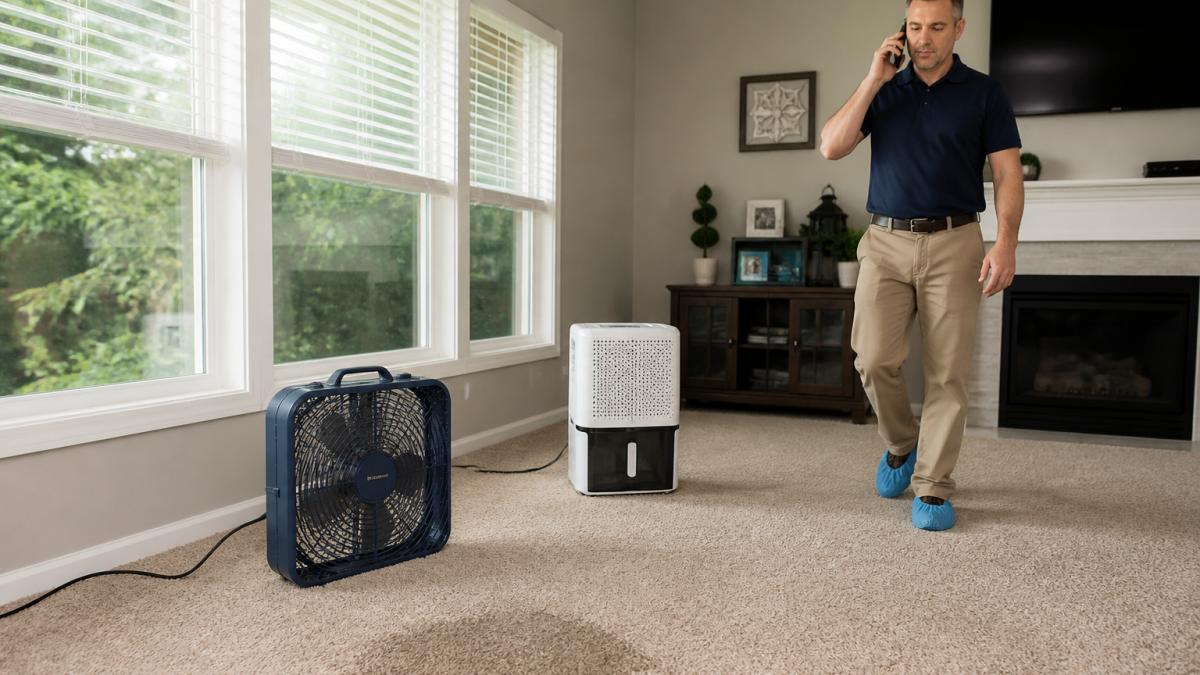
A box fan aimed flat across the carpet pushes air over the fibers and helps moisture evaporate. A dehumidifier nearby then pulls that moisture out of the air so the room does not just get damp again.
Where to Place Fans for Maximum Airflow
Place fans so air flows across the carpet, not straight down into it. Here is how to set up a room for fast drying:
- Point box fans at a low angle so air skims across the carpet surface.
- Put one fan near an open window or door to push moist air out.
- Set a dehumidifier in the center of the room, away from walls.
- Keep closet and bedroom doors open so air can circulate.
- Run fans for several hours, not just a few minutes.
If you have a ceiling fan, run it on low to keep air moving without blowing dust around. For larger rooms or soaked padding, two or three fans plus a dehumidifier work far better than one.
Do not seal up the room and run a fan alone. Without ventilation or a dehumidifier, you are just moving moist air in circles, and the carpet stays damp.
Carpet Still Wet After Professional Cleaning? A Timed Troubleshooting Plan
If your carpet is still wet after professional cleaning, the fix depends on how much time has passed. Use this timed plan to figure out what is going on and what to do next.
After 12 hours:
- Check airflow. Are fans and windows actually moving air?
- Feel for cold, damp spots. Cold spots often mean trapped moisture.
- Run a dehumidifier if you have not already.
After 24 hours:
- Do the paper towel test to see if the surface or the pad is the problem.
- Add more fans and keep them running.
- If one area is much wetter than the rest, that spot likely got extra water.
After 48 hours:
- Treat it as a padding problem, not a surface problem.
- Call the cleaning company and ask them to check moisture levels.
- Watch for a musty smell, which signals moisture is still trapped.
If a carpet is still wet after 48 hours, do not just wait it out. Trapped moisture under the carpet can lead to mold and mildew, and that is a much bigger problem than a damp floor.
How to Check for Moisture Beneath Carpet Without Causing Damage
You can check for moisture under the carpet without pulling up the whole floor. The key is to work from the least invasive test to the most invasive, and to stop before you damage the backing, pad, or tack strip. Here is a safe, step-by-step workflow.
Step 1: The Surface Tests (No Lifting)
Start with tests that require no tools and no lifting:
- The paper towel test. Press a dry paper towel firmly into the carpet and stand on it for ten seconds. If the towel comes up damp, the surface is still wet. If it stays dry but the carpet feels spongy, the pad is the problem.
- The press test. Press down firmly with your hand or knee. If water rises or the carpet feels squishy, the pad is likely saturated.
- The smell test. A musty or damp odor points to moisture trapped underneath, especially near baseboards and under furniture.
- The touch test. Cold, clammy spots often hold more moisture than warm, dry ones. Compare a suspect area to a known-dry area.
Step 2: The Edge Check (Minimal Lifting)
If the surface tests suggest trapped moisture, check the edges. This is where moisture hides and where you can inspect without damaging the field of the carpet.
- Lift at a seam or edge. Gently lift a corner or seam where the carpet meets the wall or a transition strip. Do not pull up the middle of the room.
- Look at the backing. A dark, damp backing or visible moisture on the underside means the pad is wet.
- Check the tack strip. If the tack strip is wet or rusted, moisture has been sitting there long enough to cause damage.
- Feel the pad. Touch the pad directly. If it is damp to the touch, it needs to be dried or replaced.
If you lift a corner, do it carefully and only if you plan to have the carpet re-stretched. Pulling up carpet in the middle of a room can damage the backing and the pad.
Step 3: The Moisture Meter Check (Professional Tool)
A moisture meter gives you a real number instead of a guess. A technician can use a pin-type or pinless meter to read moisture levels through the carpet and pad without lifting anything.
- Pin-type meters penetrate the carpet and pad to read moisture content at depth.
- Pinless meters read through the surface and are useful for a quick scan of a large area.
If your cleaner does not use a moisture meter, that is a sign they are not checking how wet the pad actually is. Ask them to show you the reading before they leave.
Step 4: When to Call a Professional
Call a qualified professional if:
- The pad is wet to the touch after 24 hours.
- You see or smell mold, or the carpet has dark staining.
- The tack strip is wet or rusted.
- The carpet has been wet for more than 48 hours.
- You have lifted a corner and cannot get it back down cleanly.
A professional can dry the pad in place with specialized equipment or, if the pad is too damaged, replace it. Removing moisture early is far cheaper and easier than dealing with mold later.
A moisture meter gives you a real number instead of a guess. If your cleaner does not use one, that is a sign they are not checking how wet the pad actually is.
If you are in Monmouth County or central New Jersey and your carpet is still wet after 48 hours, our team can check moisture levels and recommend the right next step.
When Wet Carpet Becomes a Health Risk
Wet carpet becomes a health risk when moisture sits long enough for mold and mildew to grow. Mold needs moisture and time, and a carpet that stays damp for days gives it both.
Watch for these warning signs:
- A musty or damp odor that will not go away
- Dark spots or staining on the carpet or backing
- Allergies or breathing issues that seem worse at home
- Visible mold along baseboards or under furniture
People with allergies, asthma, young children, and older adults are more sensitive to mold spores and damp-air problems. If anyone in your home fits that group, treat a persistently wet carpet as urgent, not minor.
The fix is to dry it fast and, if the pad is soaked, have it checked or replaced. Removing moisture early is far cheaper and easier than dealing with mold later.
Questions to Ask Before You Book a Carpet Cleaning Service
The right questions before you book will save you a wet-carpet headache later. Ask these before you schedule service:
- What cleaning method do you use, and how much water does it leave behind?
- How do you extract the water, and how much do you recover?
- How long should my carpet take to dry with your method?
- Do you check moisture levels before you leave?
- What do you do if the carpet is still wet after 24 hours?
- Are your technicians trained to industry cleaning and restoration standards?
A company that can answer these clearly is a company that thinks about drying, not just cleaning. At PowerPro Carpet Cleaning, our technicians are trained to Inspection Institution of Cleaning and Restoration standards, and our low-water method is built around faster drying and a healthier home.
If you are dealing with a carpet that will not dry, or you want a cleaning that dries within hours instead of days, our team can help. We serve homeowners and businesses across Monmouth County and central New Jersey, and we are available 24/7 for emergency calls at 848 347 3201.
A carpet that stays wet for days is more than an inconvenience. It can mean soaked padding, rising humidity, and a mold problem waiting to happen. PowerPro Carpet Cleaning uses organic, low-water, and dry-steam methods that pull more moisture out and leave less behind, so your carpet dries within hours and your home stays healthier. With trained technicians, a 100% satisfaction guarantee, and service across Monmouth County and central New Jersey, we make fast, thorough drying the standard, not the exception. Get started with PowerPro Carpet Cleaning and walk on dry carpet sooner.
Frequently Asked Questions
Why is my carpet still wet days after cleaning?
Carpet stays wet for days when too much water went in and not enough came out. The most common causes are insufficient water extraction, a thick or dense carpet pad that holds moisture, poor airflow in the room, and high indoor humidity above 60%. If the padding underneath is saturated, surface drying alone will not fix it. A moisture check at the backing and pad level tells you whether you are dealing with surface dampness or trapped water.
How long should carpet take to dry after professional cleaning?
With a low-water or dry-steam method and good airflow, most carpet dries in 2 to 4 hours. Standard hot water extraction typically takes 6 to 12 hours. Thick plush carpet, a dense pad, closed windows, and humidity above 60% can stretch drying to 24 to 48 hours. If carpet is still wet after 48 hours, the padding is likely saturated and needs professional attention to prevent mold and mildew.
Can too much water make carpet take longer to dry?
Yes. When a cleaning method uses more water than the extraction equipment can recover, the excess soaks through the backing into the pad. Carpet padding acts like a sponge and releases moisture slowly, which is why a carpet can feel dry on top while the pad stays wet for days. Ask any cleaner what water recovery rate their equipment achieves before you book.
Should I turn on the heat or air conditioning to dry carpet?
Either works, as long as air is moving. Run the HVAC fan continuously and set the thermostat to a comfortable temperature rather than blasting heat, which can cause the carpet surface to dry too fast while moisture stays trapped below. Pair the HVAC fan with a dehumidifier and box fans aimed across the carpet surface. Keep indoor relative humidity below 60% for the fastest results.