Table of Contents
- Why Cheap Carpet Cleaning Backfires: The Residue Problem
- How Detergent Residue and Sticky Soap Cause Rapid Resoiling
- Carpet Wicking Causes: Why Stains Reappear After Cleaning
- Carpet Cleaning Residue Removal: How to Fix a Sticky Carpet
- Carpet Cleaning Drying Time: Why Over-Wetting Makes Things Worse
- Carpet Fiber Types and pH Balance: What Cheap Cleaners Get Wrong
- How Professional Cleaning Prevents Rapid Resoiling
- Preventing Rapid Resoiling: Maintenance Tips for Homeowners
- Conclusion: Choosing the Right Cleaning Method for Lasting Results
- Frequently Asked Questions
Last Updated: September 14, 2026
Why Cheap Carpet Cleaning Backfires: The Residue Problem
Your carpet looked great for about a week. Then the traffic lanes turned gray again, faster than before you had it cleaned. If you’re wondering why carpets get dirty faster after cheap cleaning, the answer usually comes down to one thing: leftover soap. This guide from PowerPro Carpet Cleaning explains what’s happening at the fiber level and how to correct it.
Cheap cleaning often means a quick pass with a heavily soaped solution and almost no rinse. The detergent stays behind. That residue acts like a magnet for soil, and your carpet re-soils within days instead of months.
The problem isn’t dirt you can see. It’s chemistry you can’t.
Skipping the rinse step to save time is the single most common cause of rapid resoiling. The detergent doesn’t evaporate. It dries into a sticky film that grabs every particle your family tracks in.
How Detergent Residue and Sticky Soap Cause Rapid Resoiling
Detergent residue is the film of soap and surfactant left in carpet fibers when a cleaner doesn’t rinse properly. That film stays tacky after drying, so it traps loose soil the moment anyone walks across the carpet.
Here’s the sequence most homeowners never see:
- The cleaner applies a soap-heavy shampoo.
- The wand passes once, lifting some dirt but leaving solution behind.
- The carpet dries, and the soap film cures into a sticky layer.
- Every footstep presses dust, pollen, and grit into that layer.
- The carpet looks dirtier in two weeks than it did before cleaning.
The Carpet and Rug Institute’s cleaning standards treat complete residue removal as a core measure of cleaning quality, not an optional finishing step.
The Role of Surfactants and Soil Suspension
Surfactants are the cleaning agents that loosen soil from carpet fibers and hold it in suspension so an extractor can pull it away. They’re essential to the process. They’re also the reason rinsing matters so much.
A surfactant works by lowering the surface tension of water, letting it penetrate the fiber and lift grime. But once that soil is suspended, it has to leave the building. If the extraction step is weak or rushed, the surfactant and the soil it’s holding both stay in the carpet.
Good soil suspension without good extraction is just relocation. The dirt moves from deep in the pile to the surface, where it reattaches to the sticky residue.
Carpet Wicking Causes: Why Stains Reappear After Cleaning
Carpet wicking causes stains to reappear because moisture pulls dissolved soil from deep in the backing up to the surface as the carpet dries. The stain didn’t come back. It never left; it just migrated upward.
Wicking happens when a cleaner over-wets the carpet and leaves too much moisture in the pad and backing. As that moisture evaporates, it carries soil and old spill residue with it to the tips of the pile. You see a brown ring or a ghost of the original spot two days later.
The fix is controlled moisture and thorough extraction. A low-water method that flushes and immediately pulls water back out limits how much wicking can occur. Cheap cleaning tends to flood the carpet and walk away, which is exactly the condition that triggers wick-back.
If a stain reappears within 48 hours of cleaning, it’s almost always wicking, not a new spill. Blot it with a clean white towel and call a cleaner who can do a proper sub-surface flush rather than another surface pass.
Carpet Cleaning Residue Removal: How to Fix a Sticky Carpet
Carpet cleaning residue removal means flushing the detergent out of the fibers with clean water and a neutralizing agent, then extracting it completely. You can do a basic version yourself, but deep residue needs professional extraction. This is the rescue guide for anyone who already had a cheap cleaning and is now watching the carpet re-soil faster than before.
First, Confirm It’s Residue (Not Something Else)
Run a quick test before you start flushing:
- The feel test. Walk across the carpet in clean socks. If it feels tacky, stiff, or slightly crunchy, residue is likely.
- The white-towel test. Dampen a clean white towel with plain warm water, press it into a traffic lane for 10 seconds, and rub gently. If the towel picks up a soapy or gray film, that’s residue coming up.
- The re-soil timeline. If the carpet looked clean for a few days and then grayed out within one to two weeks, that’s the classic residue pattern. A carpet with no residue typically holds its appearance for weeks to months.
If the towel comes up clean and the carpet still re-soils, the problem may be wicking from the backing or a deep stain, not surface residue.
The Neutralizing Rinse: Order of Operations Matters
Most DIY guides tell you to “use vinegar.” The chemistry is more specific than that. Alkaline soap residue needs an acidic rinse to neutralize it, and the rinse only works if it reaches the residue and is then extracted. Skipping the extraction step just moves the problem around.
Here’s the sequence that actually works:
- Vacuum thoroughly first. Slow passes, two directions, overlapping. Loose soil left on top will re-bond to the residue and defeat the rinse.
- Mix a neutralizing rinse. A diluted white vinegar solution (roughly one part white vinegar to several parts warm water) cuts alkaline soap film. Test on a hidden corner first, wool and some dyed carpets can be sensitive to acid.
- Apply lightly. Dampen, don’t soak. Over-wetting drives residue deeper into the pad and makes wicking worse.
- Dwell, don’t scrub. Give the rinse 30 to 60 seconds to react with the alkaline film. Scrubbing distorts the pile and pushes residue deeper.
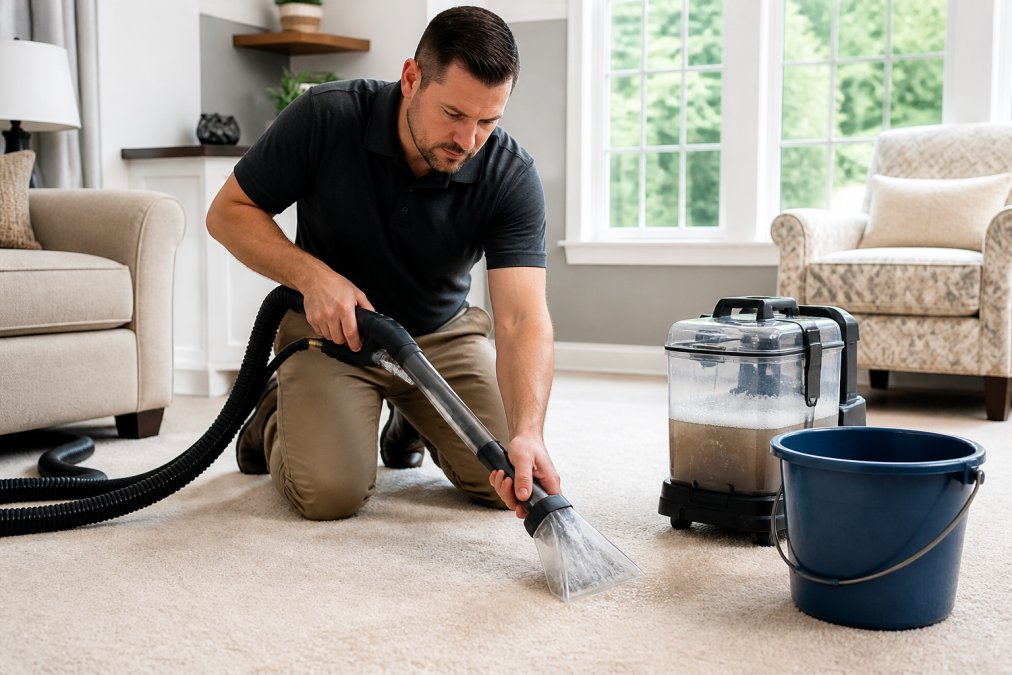
- Extract immediately. Use a wet vacuum with slow, overlapping passes until the water runs clear. Cloudy or foamy water means residue is still coming out, keep going.
- Repeat with plain water. The goal is clear extraction, not more product. A second pass with plain warm water flushes what the vinegar loosened.
- Dry fast. Fans and open windows. A carpet that stays damp for a day invites mold and rapid resoiling.
Foamy water in the extractor tank is the tell. If the tank looks like soap suds, there’s still surfactant in the carpet. Rinse and extract again until the water is clear and flat.
When DIY Isn’t Enough
If the carpet still feels sticky after two full rinse-and-extract cycles, the residue has soaked into the backing and pad. Homeowner extractors can’t reach that depth, they pull from the surface, not from below the pile. At that point, a professional sub-surface flush is the only way to remove the residue without replacing the carpet.
Signs it’s time to call a professional:
- The carpet re-soils within days even after your best DIY rinse.
- The tacky feel returns within a week.
- Brown rings or wicking appear at the base of the pile after drying.
- The carpet has been cheap-cleaned multiple times and the residue has compounded.
A proper sub-surface flush uses controlled water volume and high-suction extraction to push clean water through the pile and backing, then pull it back out with the suspended residue. Done correctly, it removes the film instead of redistributing it.
Preventing the Cycle From Restarting
Once the residue is gone, keep it gone:
- Skip soap-heavy spot sprays. They add the same residue you just removed.
- Vacuum frequently. High-traffic areas need several passes a week, not one quick run.
- Use walk-off mats. Most tracked-in soil enters in the first few feet of a doorway.
- Blot spots, don’t scrub. Scrubbing pushes soil deeper and distorts the pile.
- Choose a cleaner who rinses. Ask directly whether the process includes a neutralizing rinse and complete extraction. If the answer is vague, that’s your answer.
Carpet Cleaning Drying Time: Why Over-Wetting Makes Things Worse
Carpet cleaning drying time matters more than most homeowners realize. A carpet that stays wet for 24 hours or more can develop mold, mildew, and odor, and the lingering moisture keeps soil bonding to the fibers (the EPA).
Cheap cleaning usually over-wets because the equipment has weak suction and the technician compensates by using more water. More water means longer drying time, and longer drying time means more time for wicking, mildew, and resoiling.
Fast drying depends on three things: less water used, stronger extraction, and good air circulation afterward. A low-water method paired with high-suction extraction can cut drying time from a full day to a few hours (iicrc.org). That’s the difference between a carpet that stays clean and one that’s damp and dirty again by the weekend.
Carpet Fiber Types and pH Balance: What Cheap Cleaners Get Wrong
Carpet fiber types and pH balance determine which cleaner is safe to use, and cheap cleaning often ignores both. The wrong pH can damage fibers or leave a residue that never rinses clean. Most articles stop at the word “residue.” The real mechanism is chemistry: a high-alkaline cleaner that isn’t neutralized leaves the fiber surface at an elevated pH, and that charged surface behaves like a magnet for airborne soil.
Why pH Imbalance Attracts Dirt (The Part Most Guides Skip)
Carpet cleaners are formulated on the pH scale, where 7 is neutral. Most general-purpose shampoos run alkaline, often in the 9 to 11 range, because alkalinity saponifies oily soil and lifts it quickly. That’s fine during cleaning. The problem is what happens after.
When an alkaline film dries in the pile, two things occur:
- The fiber surface stays chemically active. A high-pH film holds a slight negative charge that attracts the positively charged particles in household dust, pollen, and tracked-in grit.
- The film stays hygroscopic. Many soap and surfactant residues pull moisture from the air, so the carpet feels slightly damp or tacky even when it looks dry. Damp + tacky = soil magnet.
A neutralizing rinse, typically an acidic rinse agent or a diluted acid like white vinegar, brings the fiber back toward neutral pH. Once the surface is balanced, the static and hygroscopic pull drops, and the carpet stops grabbing every particle that lands on it.
“pH balanced” on a bottle doesn’t mean the residue is neutralized. A cleaner can be pH balanced for the fiber during the wash and still leave an alkaline film if it isn’t rinsed out. Rinsing is what removes the film; the formula only decides how aggressive it is.
Fiber-by-Fiber: How Cheap Cleaners Behave on Each Type
| Fiber Type | Common Use | pH Sensitivity | Cheap Cleaner Risk |
|---|---|---|---|
| Nylon | High-traffic areas | Tolerates most cleaners | Residue buildup; re-soiling in traffic lanes |
| Polyester | Budget carpet | Sensitive to high pH | Dulling, stiffness, matting at pivot points |
| Olefin (polypropylene) | Basements, outdoors | Resists water-based soil | Oil-based soil clings; residue hard to rinse |
| Wool | Premium rooms | Damaged by alkaline cleaners | Fiber damage, browning, cellulosic burn |
| Triexta (PTT) | Newer residential | Generally tolerant | Residue film if extraction is weak |
A few practical notes on each:
- Nylon is the most forgiving, which is why cheap cleaners get away with it, until the residue accumulates. Nylon’s resilience hides the problem for a few cleanings, then traffic lanes gray out fast.
- Polyester dulls visibly under repeated high-pH exposure. The fiber loses luster before it loses structure, so the first sign is a flat, chalky look rather than a stain.
- Olefin repels water-based soil well, which is exactly why soap residue is so stubborn on it, the same water-repelling surface resists the rinse water that would carry the residue away.
- Wool is the highest-stakes fiber. Alkaline cleaners can cause browning (a cellulosic reaction in the fiber) and, in severe cases, chemical burn that permanently alters the pile. Wool needs a neutral to slightly acidic cleaner and a thorough rinse.
- Triexta behaves more like nylon but still relies on complete extraction to avoid a sticky film.
Most cheap operations use one generic shampoo on every carpet. That’s the shortcut that costs you a clean carpet, and on wool or polyester, it can cost you the carpet itself.
How to Tell Residue From Re-Staining
Before you assume your carpet is just dirty again, check which problem you actually have:
- Residue: uniform graying in traffic lanes, a tacky or stiff feel, dull appearance across the whole room, and a carpet that re-soils within one to two weeks of every cleaning.
- Re-staining: a defined spot or ring that returns in the same place, often within 24 to 48 hours, and usually tied to a specific spill or pet accident.
- Wicking: a brown or dark ring at the base of the pile that reappears after drying, indicating soil pulled up from the backing.
If the whole room looks dingy and feels slightly sticky, it’s residue. If one spot keeps coming back, it’s wicking or a deep stain. The fix is different for each, and treating one as the other wastes time and money.
How Professional Cleaning Prevents Rapid Resoiling
Professional cleaning prevents rapid resoiling by removing the residue instead of adding to it. The equipment, the rinse step, and the chemistry all work together to leave fibers clean and residue-free.
At PowerPro Carpet Cleaning, we use organic, green-certified solutions and a low-water, dry-steam method that flushes soil out and extracts it in the same pass. Because less water goes in, less stays behind, and carpets dry within hours rather than a full day. Our technicians are trained to Inspection Institution of Cleaning and Restoration standards.
That’s the practical difference between a cheap clean and a lasting one. No sticky film, no wick-back, no re-soiling in a week.
Preventing Rapid Resoiling: Maintenance Tips for Homeowners
Preventing rapid resoiling comes down to keeping soil and moisture under control between professional cleanings. Small habits make the biggest difference.
- Vacuum frequently. High-traffic areas need several passes a week, not one quick run.
- Use walk-off mats. Most tracked-in soil enters in the first few feet of a doorway.
- Blot spots, don’t scrub. Scrubbing pushes soil deeper and distorts the pile.
- Skip soap-heavy spot sprays. They add the same residue you’re trying to remove.
- Control dust. Dust settles into carpet and becomes grit underfoot.
- Keep air circulating. Good airflow speeds drying and reduces static attraction of soil.
The single best predictor of how long a carpet stays clean is how much residue was left behind. Residue-free cleaning plus regular vacuuming beats any quick-fix product.
Conclusion: Choosing the Right Cleaning Method for Lasting Results
The reason carpets get dirty faster after cheap cleaning is simple: leftover soap and trapped moisture. Fix the residue, control the drying time, and match the chemistry to the fiber, and your carpet stays clean for months instead of days.
If your carpet re-soils within weeks of every cleaning, it’s time for a method that flushes and extracts instead of smearing soap around. PowerPro Carpet Cleaning has served homeowners since 1989 with organic, low-water cleaning that dries fast and leaves no dirt-attracting residue behind. We handle carpets, area rugs, tile, grout, and air ducts, and we are available 24/7 for emergency calls.
Get started with PowerPro Carpet Cleaning and get a deeper clean that actually lasts. Call us at 848 347 3201.
Frequently Asked Questions
Why is my carpet dirtier after cleaning?
Cheap carpet cleaning often leaves behind detergent residue that acts like a magnet for dirt. When the cleaning solution isn’t fully rinsed, sticky surfactants remain in the carpet pile, causing rapid resoiling. Additionally, over-wetting can lead to wick-back, where deep stains rise to the surface. Professional low-water methods with proper rinsing prevent this.
What is carpet wicking and why does it happen?
Carpet wicking is when stains that were thought to be removed reappear after cleaning. It happens because cleaning solutions soak into the carpet backing and padding, dissolving old spills. As the carpet dries, moisture carries the dissolved stains back to the surface. Proper drying and extraction techniques are essential to prevent wicking.
How long should I wait before walking on my carpet after a professional cleaning?
Drying time depends on the method. Low-water cleaning, like the dry-steam process, allows carpets to dry within hours, often 2-4. Traditional steam cleaning can take 12-24 hours. To speed drying, increase air circulation with fans and keep pets and children off the carpet until it’s completely dry to avoid re-soiling and potential mildew growth.
Does shampooing a carpet ruin the carpet?
Shampooing itself doesn’t ruin carpet, but improper use of cheap shampoos can. Many contain harsh chemicals or leave sticky residue that attracts dirt. Over-wetting can also damage the backing and cause mold. Professional cleaners use pH-balanced solutions and proper extraction to clean without leaving residue, preserving carpet fibers and preventing rapid resoiling.