Table of Contents
- Why Commercial Carpet Cleaning Matters for Small Business Offices
- Benefits of Professional Carpet Cleaning for Offices
- Commercial Carpet Cleaning Frequency: How Often Is Enough?
- Truck-Mounted vs. Portable Extraction: Which Fits Your Building?
- Dry-Steam Carpet Cleaning Advantages for Occupied Offices
- How to Choose a Commercial Carpet Cleaner
- DIY Maintenance Between Professional Visits
- What Commercial Carpet Cleaning Costs Small Businesses
- Conclusion
- Frequently Asked Questions
Last Updated: September 20, 2026
Why Commercial Carpet Cleaning Matters for Small Business Offices
Commercial carpet cleaning is the scheduled, professional removal of embedded soil, allergens, and stains from business flooring using commercial-grade equipment and pH-balanced solutions. For small offices, it protects both the asset underfoot and the people walking on it every day.
At PowerPro Carpet Cleaning, we’ve watched small offices in Monmouth County and across central New Jersey put off carpet care for years, then face replacement bills that dwarf what maintenance would have cost.
The EPA’s indoor air quality guidance notes that indoor pollutant levels can run higher than outdoor levels, and carpet acts as a reservoir for those particles until it’s properly extracted. That’s the case for treating floor care as part of office hygiene, not a cosmetic afterthought.
Below, we’ll break down what professional cleaning actually delivers, how often to schedule it, and how to vet a vendor without getting burned.
Benefits of Professional Carpet Cleaning for Offices
Professional cleaning does two jobs at once: it restores appearance and it extends the life of the carpet. Consumer-grade vacuums lift surface soil; they don’t touch the grit that settles at the base of the pile.
Indoor Air Quality and Allergen Reduction
Hot water extraction flushes out the fine particulate that recirculates through an HVAC system all day. For offices with staff who have allergies or asthma, that reduction in allergen load matters more than the visual difference. A CDC overview of indoor environmental quality points to regular cleaning as a core control for indoor triggers.
Carpet Longevity and Fiber Protection
Soil is abrasive. Ground into the backing, it saws away at fibers from below, which is why traffic lanes wear out long before the rest of the floor. Scheduled soil extraction and a protective treatment after cleaning slow that process and keep fiber integrity intact.
Commercial Carpet Cleaning Frequency: How Often Is Enough?
Most small offices need professional commercial carpet cleaning every 6 to 12 months, with high-traffic areas and entry zones cleaned more often. The right interval depends on foot traffic, weather, and whether food or pets are present.
Here’s a zone-based schedule office managers can actually run:
| Zone | Example Areas | Cleaning Frequency |
|---|---|---|
| High-traffic | Entrances, reception, hallways | Every 3-4 months |
| Moderate | Private offices, conference rooms | Every 6 months |
| Low-traffic | Storage, back offices | Every 12 months |
| Special | Break rooms, pet-friendly areas | Every 2-3 months |
A Simple Zone-Based Schedule for Office Managers
Walk your space once a quarter and map it into the four zones above. If a zone looks dull or holds odor after vacuuming, it moves up a tier. This approach keeps traffic lane cleaning targeted instead of paying to deep clean rooms nobody uses.
Preventative Maintenance: The Part Most Guides Skip
Frequency isn’t just a calendar question, it’s a soil-load question. The goal of preventative maintenance is to keep soil from reaching the backing, where it abrades fibers from below. Three habits do most of the work:
- Entry matting. Ten to fifteen feet of walk-off matting at every entrance removes the majority of tracked-in soil before it hits the carpet. Shake mats weekly and deep clean them quarterly.
- Daily vacuuming with the right machine. A commercial-grade vacuum with a HEPA filter removes far more soil per pass than a residential upright, and it keeps what it captures from blowing back into the room.
- Immediate spill response. Blot, don’t rub. Rubbing drives stain into the backing and spreads it sideways.
Inspection Triggers That Tell You to Move Up a Tier
Don’t wait for the calendar. Walk the space monthly and look for these signals:
- Matted traffic lanes that stay flat after vacuuming.
- Graying or dulling in entry zones that no longer responds to vacuuming.
- Odor that returns within a day or two of cleaning.
- Visible soil at the base of the pile when you part the fibers.
- Sticky or crunchy feel underfoot in break rooms and reception.
Any one of these means the zone moves up a tier. Two or more means the whole floor should be reassessed.
Check the carpet at the entry mat line. If the fiber there is matted flat while the rest of the office looks fine, your cleaning frequency is fine but your entry matting is too short. Add 10 to 15 feet of walk-off matting and the soil load drops before it ever reaches the carpet.
Seasonal Adjustments
Frequency isn’t static across the year. Winter brings road salt, sand, and moisture that drive soil deep into the pile. Spring brings pollen. Both seasons justify moving entry zones and reception up a tier. Summer and fall are usually the best windows for the deeper, whole-floor cleaning, when foot traffic is lighter and drying is faster.
Treat frequency as a starting point, not a rule. The offices that get the longest life out of their carpet are the ones that inspect monthly, adjust by zone, and clean before soil reaches the backing, not after the floor looks bad.
Truck-Mounted vs. Portable Extraction: Which Fits Your Building?
A truck-mounted system delivers hotter water and stronger vacuum from a unit parked outside, while a portable extractor is a self-contained machine wheeled into the building. Both work; the choice comes down to building access and drying tolerance.
Truck-mounted units win on soil extraction and drying speed because heat and lift stay high over long hose runs. Portables win where there’s no parking access, upper floors with no hose route, or after-hours constraints. Ask any vendor which they’ll bring before you book.
Dry-Steam Carpet Cleaning Advantages for Occupied Offices
Dry-steam, or low-water, cleaning uses far less moisture than traditional steam cleaning, so carpets dry within hours instead of a full day. That’s the difference between closing a wing of your office and simply working around the technician.
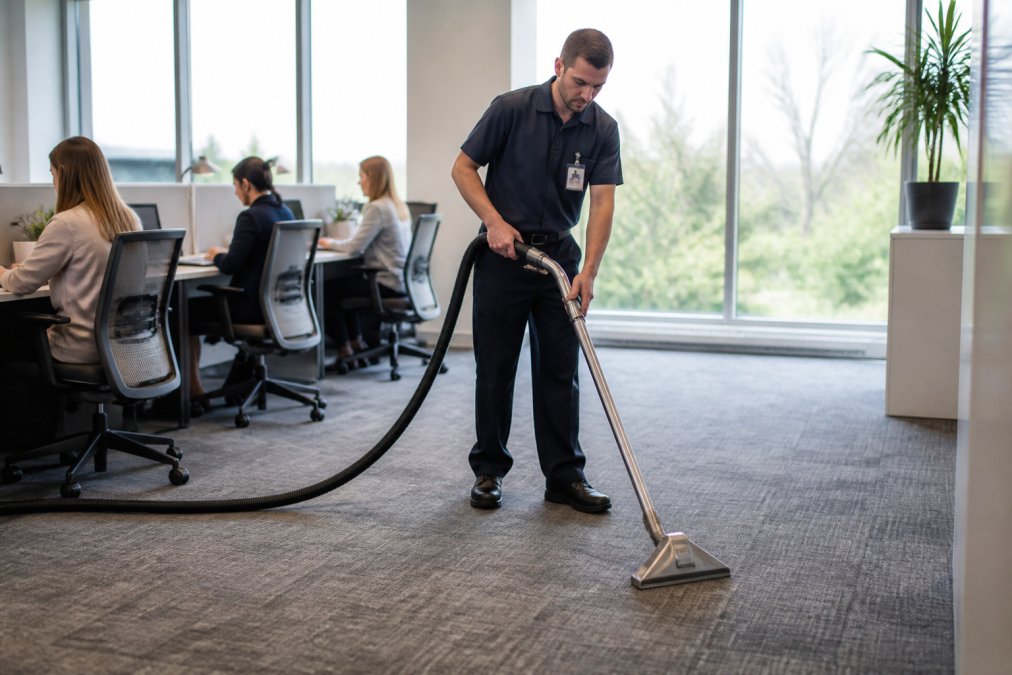
Minimizing disruption during these essential maintenance tasks requires a reliable service provider, making the process of vetting cleaning companies a critical step in maintaining a professional and hygienic workspace.
For occupied offices, fast drying isn’t a convenience, it’s a safety and liability question. Wet carpet invites slips, mildew, and that damp smell that lingers for days. Low-water methods paired with pH-balanced solutions leave no dirt-attracting residue, which is why the carpet stays clean longer between visits.
The biggest mistake offices make is booking a wet-extraction clean the day before a client visit or event. Even with fast drying, give the carpet 24 hours of buffer. Rushing it means furniture gets set back on damp fiber and you get rust rings and crushed pile.
How to Choose a Commercial Carpet Cleaner
The right vendor proves three things before you sign: they carry insurance, they know their equipment, and they can explain their process in plain terms. Price alone tells you nothing about what happens to your floor.
Ask every candidate these questions:
- Are you insured and can you provide a certificate of insurance?
- Which method will you use, and how long until the carpet is dry?
- Do you use pH-balanced or green-certified solutions?
- Will you pre-treat spots and traffic lanes, or just run a wand?
- What’s your process for a stain that doesn’t come out on the first pass?
Insurance, Liability, and Vendor Vetting
A legitimate commercial cleaner carries general liability and workers’ compensation coverage. Ask for the certificate directly, and confirm the coverage is current. If a crew member damages furniture or slips on your property, that insurance is what stands between the incident and your business.
Vet the vendor, not the quote. A certificate of insurance, a clear method, and a written scope of work protect you far more than a low bid from a crew that can’t answer basic questions.
DIY Maintenance Between Professional Visits
Between professional cleanings, a disciplined in-house routine keeps soil from reaching the backing. None of it replaces extraction, but it stretches the interval and protects the investment.
- Vacuum high-traffic areas daily with a commercial-grade machine, not a household upright.
- Place walk-off mats at every entrance and shake them out weekly.
- Blot spills immediately with a clean white cloth; never rub, which drives stain deeper.
- Keep a spot treatment kit on hand for coffee, ink, and food.
- Move furniture slightly each quarter to prevent permanent pile compression.
- Log every stain and its location so the next cleaning crew knows where to focus.
What most guides miss is the vacuum itself. A commercial-grade vacuum with a HEPA filter removes far more soil per pass than a residential unit, and it keeps what it captures from blowing back into the room. Upgrade the vacuum before you upgrade anything else.
What Commercial Carpet Cleaning Costs Small Businesses
Pricing for commercial carpet cleaning depends on square footage, carpet condition, method, and how many zones need attention. There’s no single number that fits every office, and any vendor quoting a flat rate sight-unseen is guessing.
For a small business, the honest math is cost per square foot against the cost of replacement. A floor care program that cleans on schedule typically costs a fraction of re-carpeting a suite every few years, and it avoids the disruption of a full replacement. Ask for a written quote that lists the method, the zones covered, and the drying time.
The Cost-Per-Square-Foot vs. Replacement Math
Most small business owners don’t need a sales pitch, they need a way to justify the line item. The clearest frame is cost per square foot of cleaning against cost per square foot of replacement, spread across the years the carpet actually lasts.
- Cleaning cost per square foot is driven by method, soil level, and how much pre-treatment the traffic lanes need. A lightly soiled open office with a low-water method sits at the low end; a heavily soiled suite with food service and no entry matting sits at the high end.
- Replacement cost per square foot includes the carpet itself, adhesive and installation labor, furniture moving, and the downtime while a wing is closed. That last item is the one owners forget, and it’s often the largest hidden cost.
- The break-even point is the year the cleaning program’s cumulative cost crosses the replacement cost. For most small offices, scheduled cleaning stays below that line for years, while deferred cleaning pushes replacement forward by several years.
A Simple ROI Frame You Can Run Yourself
You don’t need a spreadsheet to make the call. Answer four questions:
- What is the square footage of carpeted space in the office?
- What did the last replacement cost, and how many years ago was it?
- How many years did that carpet last before it looked unacceptable?
- What would it cost to replace it again today, including downtime?
If the answer to question 3 is shorter than the manufacturer’s expected lifespan, the gap is often deferred maintenance.
Frame the decision as cost per square foot per year, not cost per visit. A cleaning program can help extend the carpet’s life and may cost less per year than the replacement it postpones, and it avoids the disruption of a full re-carpet.
What Drives the Quote Up or Down
- Method: low-water and dry-steam methods use less solution and dry faster, which can reduce labor time on occupied floors.
- Soil level: heavily soiled traffic lanes need pre-treatment and possibly a second pass.
- Access: upper floors with no hose route or tight after-hours windows add labor.
- Furniture: moving desks, cubicle panels, and filing cabinets is labor, and it’s often quoted separately.
- Frequency: a recurring schedule usually costs less per visit than one-off emergency cleans.
Be wary of a quote that’s dramatically lower than the others. It may indicate a less thorough service. You may find the carpet looks worse sooner.
Where to Look for the Real Number
Ask three vendors for a written quote that lists square footage, method, number of passes, pre-treatment, drying time, and furniture handling. Compare them line by line, not on the bottom number. The quote that explains its process is almost always the one that holds up on the floor.
Conclusion
The challenge for most small offices isn’t finding someone to clean the carpet, it’s building a floor care program that holds up over years instead of months. PowerPro Carpet Cleaning has handled commercial and residential carpet, upholstery, tile, grout, and air duct cleaning since 1989, using organic, green-certified solutions and low-water methods that let carpets dry within hours. Our technicians are trained to Inspection Institution of Cleaning and Restoration standards, and we’re available around the clock for emergencies.
Get started with PowerPro Carpet Cleaning and put your office on a maintenance schedule that protects both your carpet and the people who work on it. Call 848-347-3201.
Frequently Asked Questions
How often should small business offices schedule commercial carpet cleaning?
Most small offices do well with professional deep cleaning every 6 to 12 months, plus quarterly spot treatment in high-traffic areas like reception and hallways. Offices with 20 or more employees, pets on site, or daily foot traffic should lean toward the 6-month end. A written commercial carpet cleaning frequency schedule based on zones keeps carpet longevity predictable and prevents soil from grinding into fibers.
What are the benefits of professional carpet cleaning for offices?
Professional cleaning pulls out embedded soil, allergens, and bacteria that routine vacuuming leaves behind. That supports indoor air quality, reduces allergy complaints, and protects carpet fiber integrity so the floor lasts longer. It also improves appearance for clients walking through the space. For small businesses, the practical payoff is fewer premature carpet replacements and a workspace that looks maintained without daily effort from staff.
Is dry-steam carpet cleaning safe for an office that stays open?
Yes. Dry-steam and low-water methods use far less moisture than traditional steam cleaning, so carpets dry within hours rather than a full day. That means employees can return to the space quickly, and there is less risk of mold or mildew from trapped dampness. Ask the provider about their drying time and whether they use pH-balanced solutions, since those details matter for fiber protection and occupant comfort.
How do I choose a commercial carpet cleaner for my small business?
Look for a company with commercial-grade equipment, technicians trained to industry standards, and proof of insurance and liability coverage. Ask how they handle high-traffic areas, stain removal, and traffic lane cleaning, and request a written floor care program rather than a one-time quote. Confirm drying times, cleaning solutions used, and whether they can also handle upholstery, tile, or air ducts in the same visit.