Table of Contents
- What Low Moisture Carpet Cleaning Actually Does
- How Long Does Carpet Take to Dry After Cleaning
- Allergen and Dust Mite Removal Without Harsh Chemicals
- Low Moisture vs Steam Cleaning: Key Differences
- Prevention of Mold, Mildew, and Odor Problems
- Eco-Friendly Carpet Cleaning Methods That Work
- Long-Term Carpet Fiber Health and Longevity
- Commercial vs Residential Applications
- Stain Removal and Residue-Free Results
- Frequently Asked Questions
Last Updated: September 27, 2026
What Low Moisture Carpet Cleaning Actually Does
Low moisture carpet cleaning is a professional cleaning method that uses minimal water and specialized equipment to remove dirt, allergens, and stains from carpet fibers while allowing the carpet to dry in just a few hours. Unlike traditional steam cleaning, which saturates carpet with hot water, low moisture methods apply concentrated cleaning solutions that encapsulate soil particles, making them easier to vacuum away.
The core principle is efficiency: minimal liquid does the work of larger volumes, delivering faster drying, lower mold risk, and reduced stress on carpet backing and fibers.
The process involves pre-treatment, agitation to loosen soil, and extraction using specialized equipment, leaving carpet genuinely clean and dry enough for immediate foot traffic, critical for busy households and commercial spaces.
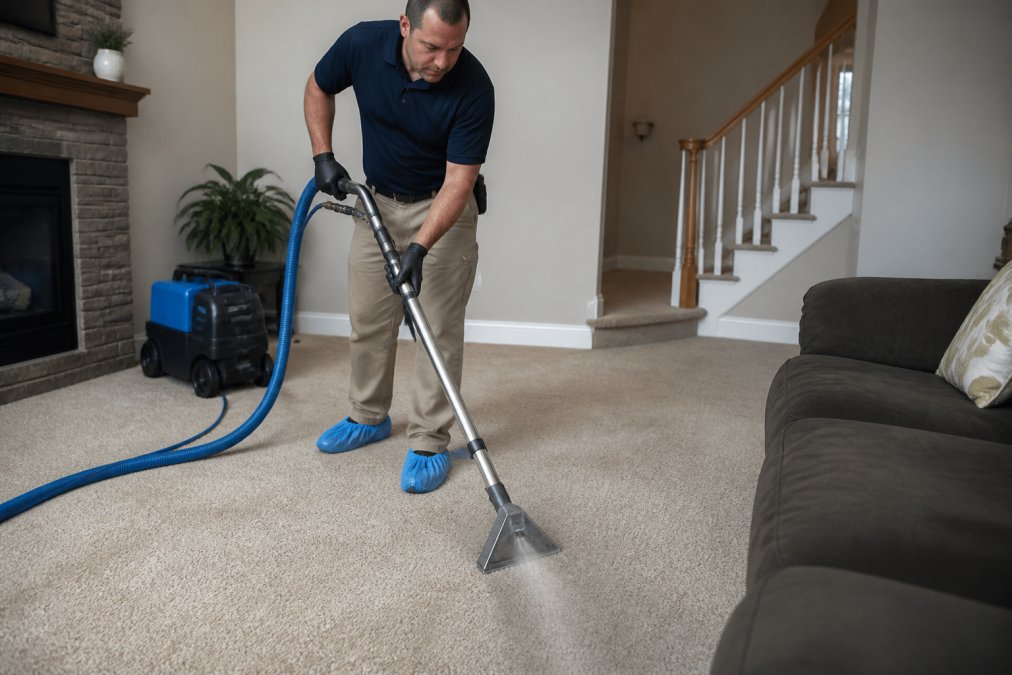
“Low moisture” doesn’t mean less effective; cleaning power comes from chemistry and agitation, not water volume. VLM technology suspends soil particles for complete removal rather than pushing them around.
The real advantage emerges after the cleaning is done. Because the carpet dries so quickly, you avoid the window where mold and mildew risk peaks, usually 24-48 hours after traditional cleaning.
How Long Does Carpet Take to Dry After Cleaning
With low moisture carpet cleaning, most residential carpets dry within 2-4 hours, with some areas taking up to 6 hours depending on humidity, air circulation, and carpet thickness.
Hot water extraction requires 12-24 hours of drying time. Families with children or pets and businesses needing operational continuity benefit directly from low moisture’s faster drying.
Variables That Control Drying Time
Drying time depends on several specific factors that you can actually control:
Ambient Humidity: Relative humidity above 60% significantly slows evaporation, extending drying toward 6 hours. Dry climates or low humidity (below 40%) achieve 2-3 hour drying. Basements and naturally humid spaces require longer drying times.
Air Circulation: Running ceiling fans, opening windows, and using portable fans accelerates evaporation by 1-2 hours. Stagnant air slows drying; professionals recommend continuous fan use until carpet is dry to the touch.
Carpet Pile Height and Density: Low-pile, tightly woven carpets dry in 2-3 hours; thick plush varieties take 4-6 hours. Synthetic backings release moisture faster than natural jute or felt.
Water Extraction Efficiency: Professional-grade systems extract more water during cleaning, leaving less to evaporate. Consumer-grade equipment may extend drying by 30 minutes to an hour.
Temperature: Warmer air promotes faster evaporation; cold temperatures slow it noticeably, making winter cleaning take longer than summer even with identical humidity.
Practical Steps to Optimize Drying
You can influence drying time by managing these variables:
- Turn off humidifiers and avoid running showers or baths in the cleaned area until the carpet is completely dry
- Open windows and doors to increase air circulation, unless outdoor humidity is very high
- Run ceiling fans on high and position portable fans to direct air across the carpet surface
- Increase indoor temperature slightly if possible; even a 5-10 degree increase helps
- Avoid walking on the carpet excessively until it’s dry; foot traffic can redeposit soil and slow evaporation
- If cleaning a basement or naturally damp space, consider running a dehumidifier alongside fans to lower ambient humidity
One critical mistake is turning up humidity while the carpet is drying. Using a humidifier or running a shower in the same room slows evaporation and increases mold risk significantly. Keep humidity low and air moving until the carpet is completely dry to the touch.
How to Know When Your Carpet Is Truly Dry
Press your hand firmly on the carpet for 5 seconds. If it feels damp or cool, moisture remains. The carpet should feel warm and dry to the touch. Check multiple spots; edges and corners dry last. Most residential carpets are safe for normal use within 4-6 hours.
Allergen and Dust Mite Removal Without Harsh Chemicals
Low moisture cleaning combined with green-certified solutions removes non-living allergens very effectively without the chemical residue that traditional methods leave behind.
Allergens like dust mites, pet dander, and pollen settle deep in carpet fibers beyond regular vacuuming reach. Professional agitation lifts these particles for extraction; encapsulation chemistry traps them, preventing re-suspension into the air.
Dust mites thrive in damp environments. Quick drying creates hostile conditions for these pests, especially important for families with asthma or allergies.
Green-certified solutions break down soil without leaving sticky residue that attracts new dirt and dust, keeping carpet cleaner longer and supporting better indoor air quality.
Low Moisture vs Steam Cleaning: Key Differences
Low Moisture Carpet Cleaning:
- Uses minimal water (typically 10-20% moisture content)
- Dries in 2-6 hours
- Lower risk of mold and mildew
- Minimal stress on carpet backing
- Better for delicate or antique carpets
- Ideal for high-traffic commercial spaces
Hot Water Extraction (Steam Cleaning):
- Uses heated water at high pressure
- Requires 12-24 hours drying time
- Higher risk of over-wetting and residue
- Can damage sensitive carpet types
- Excellent for heavy, deep-set stains
- Better for occasional, deep cleaning
Choose based on your needs: low moisture for quick turnaround, steam cleaning for deeply embedded stains. Many professional services offer both options depending on carpet requirements.
Over-wetting with steam cleaning can cause wicking, where moisture pulls dirt back up from the carpet backing as it dries, creating resoiling. Low moisture methods virtually eliminate this problem.
| Method | Drying Time | Water Usage | Best For | Risk of Mold |
|---|---|---|---|---|
| Low Moisture | 2-6 hours | Minimal | Residential, commercial, quick turnaround | Very low |
| Hot Water Extraction | 12-24 hours | High | Heavy stains, deep cleaning | Moderate to high |
| Bonnet Cleaning | 1-2 hours | Minimal | Surface maintenance only | Very low |
| Encapsulation | 2-4 hours | Minimal | Maintenance, high-traffic areas | Very low |
For most residential situations, low moisture methods provide the best balance of cleaning power, drying speed, and carpet safety. Steam cleaning becomes necessary only when dealing with severe, set-in stains.
Prevention of Mold, Mildew, and Odor Problems
Mold and mildew are health concerns that develop when carpets stay damp too long. Low moisture carpet cleaning eliminates the wet environment where these microorganisms thrive.
Mold spores become dangerous only when carpet moisture stays elevated for extended periods. Traditional methods leaving carpets wet 24+ hours create ideal mold conditions; low moisture methods dry in hours, keeping the environment hostile to mold.
Odor problems stem from moisture trapped in carpet backing or padding where bacteria and fungi produce musty smells. Quick moisture removal prevents these conditions, especially important in humid climates or basements.
Pet urine soaks deep into carpet fibers and backing. Low moisture methods with targeted pre-treatment address odor at the source by reaching deep into fibers while avoiding over-wetting that traps moisture and perpetuates smell.
Eco-Friendly Carpet Cleaning Methods That Work
Environmental responsibility doesn’t require sacrificing cleaning power. Low moisture methods are inherently more sustainable than traditional approaches, and when combined with green-certified solutions, they become a genuinely eco-friendly option.
The environmental benefits start with water conservation. Low moisture cleaning uses a fraction of the water that steam cleaning requires. In a region where water resources matter, this difference adds up quickly. A single professional cleaning using traditional methods might use 50+ gallons of water; low moisture methods use 10-15 gallons or less.
Green-certified cleaning solutions break down naturally without persisting in the environment. They don’t contain harsh chemicals that leach into groundwater or remain as residue in your home. PowerPro Carpet Cleaning uses organic, green-certified cleaning solutions.
The reduced drying time also means lower energy consumption. No need to run air conditioning longer or use fans for extended periods to dry the carpet. This translates to smaller carbon footprint per cleaning job.
Sustainable carpet cleaning also means extending carpet life. By avoiding over-wetting and chemical residue, low moisture methods preserve carpet fibers and backing, meaning carpets last longer before replacement becomes necessary. Keeping carpets in service longer is one of the most practical environmental benefits.
If environmental impact matters to your household, ask cleaning companies specifically about their water usage, chemical certifications, and drying times. These three factors determine the true sustainability of their methods.
Long-Term Carpet Fiber Health and Longevity
How you clean your carpet directly affects how long it lasts. Low moisture methods preserve carpet fiber integrity in ways that traditional cleaning cannot match.
Carpet fibers are surprisingly delicate. Excessive water and aggressive agitation can damage the structural integrity of the fibers themselves. Over time, repeated over-wetting weakens fibers, causing them to fray, mat down, and lose their appearance. This is why carpets cleaned with traditional methods often look worn faster than they should.
Low moisture cleaning applies just enough water and agitation to clean effectively without stressing fibers. The result is carpet that maintains its appearance and resilience longer. Fibers stay upright, colors remain vibrant, and the carpet resists matting in high-traffic areas.
Carpet backing, the foundation that holds fibers in place, suffers significantly from over-wetting. Prolonged moisture exposure weakens the backing, leading to delamination where the backing separates from the fibers. This is irreversible damage that requires carpet replacement. Low moisture methods protect the backing by keeping moisture exposure minimal.
Chemical residue also affects long-term fiber health. Soap and detergent residue left behind by traditional cleaning attracts dirt, causing rapid resoiling. The carpet looks dirty again quickly, so homeowners clean more frequently. Each cleaning stresses the fibers further. Low moisture methods using residue-free solutions break this cycle, the carpet stays cleaner longer, requiring less frequent cleaning overall.
Commercial vs Residential Applications
Low moisture carpet cleaning works effectively in both settings, but the priorities differ between commercial and residential spaces.
Residential Benefits:
Homeowners need cleaning that minimizes disruption and protects family health. Low moisture methods deliver on both fronts. Fast drying means kids and pets can use the space again quickly. Organic solutions mean no chemical exposure concerns. The allergen removal benefits families with asthma and allergies. For most residential situations, low moisture is the ideal choice.
Commercial Benefits:
Businesses can’t afford downtime. A retail store, office, or restaurant can’t close for 24 hours while carpet dries. Low moisture cleaning allows businesses to continue operations while the carpet dries underneath. The minimal moisture also means lower mold risk in commercial HVAC systems, which affects air quality across the entire building.
High-traffic commercial areas benefit from low moisture maintenance cleaning. Regular light cleaning with low moisture methods prevents heavy soil buildup and extends the time between deep cleans. This approach is more cost-effective over time than waiting until carpet is heavily soiled and requires intensive cleaning.
PowerPro Carpet Cleaning serves both residential and commercial clients because the method adapts to different needs. Residential clients prioritize health and convenience. Commercial clients prioritize operational continuity and cost efficiency. Low moisture methods address all these priorities.
The equipment differs slightly between settings. Commercial-grade machines handle larger areas and higher soil loads. Residential equipment is scaled for typical home spaces. But the underlying principle remains the same: minimal water, maximum cleaning power, fast results.
Stain Removal and Residue-Free Results
Stain removal and residue management are two separate challenges that low moisture cleaning addresses through different mechanisms. Understanding what each method does, and doesn’t do, helps set realistic expectations.
How Low Moisture Cleaning Tackles Different Stain Types
Not all stains respond equally to low moisture methods. Success depends on stain chemistry and how long the stain has been present.
Stains Low Moisture Handles Exceptionally Well:
Water-soluble stains (coffee, tea, juice, wine, pet urine) respond very well to low moisture cleaning. These stains dissolve readily in the cleaning solution applied during pre-treatment. The encapsulation chemistry suspends the stain particles, and extraction removes them completely. Fresh stains, those less than 24 hours old, are removed almost completely with a single professional treatment.
Protein-based stains (blood, egg, dairy) also respond well because the cleaning solutions are formulated to break down protein bonds. Pre-treatment followed by agitation and extraction typically removes these stains entirely, even when they’re a few days old.
Stains That Present Greater Challenges:
Oil-based and grease stains (cooking oil, butter, cosmetics) require specialized solutions because they don’t dissolve in water. Low moisture cleaning can reduce these stains significantly, but complete removal sometimes requires multiple treatments or specialized solvents. A single pass may lighten a grease stain by 70-80%, but stubborn residue sometimes remains.
Dye-based stains (ink, marker, food coloring) are the most difficult category. Once dye molecules bond to carpet fibers, they’re extremely hard to remove without damaging the fiber itself. Low moisture methods can lighten dye stains but rarely eliminate them completely. Permanent markers and ballpoint pen ink are essentially impossible to remove without professional dye-stripping, which risks fiber damage.
Set-in stains, those that have been in the carpet for weeks or months, require extended pre-treatment time (30 minutes to several hours) to allow the cleaning solution to break down the stain chemically. Even with extended treatment, very old stains may not respond fully. The longer a stain sits, the more it bonds to the fiber, making removal progressively harder.
Why Residue Accumulates With Traditional Methods
Traditional hot water extraction leaves behind soap and detergent residue because the method uses high volumes of water and detergent but doesn’t extract all of it. Here’s the mechanism:
Excess Detergent Application: Traditional methods apply more detergent than is strictly necessary to ensure cleaning power. This is a safety margin, more soap means more certainty of cleaning.
Incomplete Extraction: Even with powerful extraction, some detergent solution remains trapped in the carpet fibers and backing. The high water volume means more total detergent is present, and extraction can’t remove 100% of it.
Residue Reactivation: As the carpet dries, remaining detergent residue can reactivate when moisture from humidity or foot traffic rehydrates it. This residue becomes sticky, attracting dirt and dust particles from the air and from foot traffic.
Rapid Resoiling: Within 2-4 weeks, the carpet looks dirty again in traffic patterns because the sticky residue is actively attracting soil. Homeowners perceive the carpet as “getting dirty fast,” when actually the residue is the problem.
This cycle encourages more frequent cleaning, which stresses carpet fibers with each cleaning cycle and accelerates wear.
How Low Moisture Prevents Residue Buildup
Low moisture cleaning eliminates residue through a fundamentally different approach:
Minimal Detergent Application: Low moisture methods use concentrated cleaning solutions applied in small quantities. Less total detergent means less residue to extract.
Complete Extraction: Because less liquid is present overall, extraction removes a higher percentage of the cleaning solution. The carpet is left with minimal residue.
Encapsulation Chemistry: Many low moisture solutions use encapsulation polymers that crystallize as they dry. These polymers trap soil particles and then become brittle, allowing them to be vacuumed away. They don’t remain sticky or attract new dirt.
Residue-Free Results: When the carpet dries, there’s minimal detergent residue left behind. The carpet stays noticeably cleaner for 4-8 weeks or longer because there’s no sticky residue attracting new soil.
The Practical Difference Over Time
The residue effect becomes obvious in a side-by-side comparison:
- Week 1: Both methods leave the carpet visibly clean.
- Week 3: Carpet cleaned with traditional methods shows visible dirt reappearing in traffic patterns. Carpet cleaned with low moisture methods remains noticeably clean.
- Week 6: Traditional-method carpet requires cleaning again. Low moisture carpet is still acceptably clean.
- Week 12: Over a year, the low moisture carpet requires 3-4 professional cleanings. The traditional-method carpet requires 6-8 cleanings.
This difference translates directly to cost savings and reduced wear on carpet fibers from frequent cleaning.
If you have a stain that’s more than a week old or appears to be oil-based, discuss realistic expectations with your cleaning technician before treatment. Some stains can be lightened significantly but not removed completely without risking fiber damage.
Frequently Asked Questions
How does low moisture carpet cleaning compare to traditional wet cleaning in terms of drying time?
Low moisture carpet cleaning typically dries within 2-4 hours, compared to 24-48 hours for traditional hot water extraction. This faster drying time means less disruption to your daily routine and reduced risk of mold or mildew growth. The encapsulation process used in low moisture methods suspends soil particles that are then vacuumed away, requiring far less water saturation than steam cleaning methods.
Can low moisture cleaning methods actually remove deep-seated allergens and dust mites?
Yes. Low moisture methods use specialized cleaning solutions and agitation to lift allergens, dust mites, and their residue from carpet fibers without over-wetting. The combination of mechanical agitation and polymer-based encapsulation traps non-living allergens and suspends them for removal. However, for maximum allergen reduction, regular maintenance cleaning every 3-6 months is more effective than occasional deep cleaning alone.
What makes eco-friendly low moisture cleaning safer for families and pets?
Eco-friendly low moisture methods eliminate harsh chemical residues left behind by traditional detergents. Instead of soap-based solutions, they use plant-derived or water-based agents that break down naturally. This means no toxic fumes, no sticky residue that attracts dirt, and no chemical irritants for children or pets to contact. Your carpet dries faster and stays cleaner longer without the health risks of conventional cleaners.
Is low moisture cleaning effective for old pet urine stains and odors?
Low moisture methods work best on fresh to moderate stains and odors. For old, set-in urine damage, professional assessment is necessary, some stains may require targeted enzyme treatments or spot extraction before general cleaning. The encapsulation process and minimal water use help prevent odor reactivation, but severely damaged areas may need specialized treatment beyond standard low moisture cleaning.