Table of Contents
- What Actually Drives Carpet Cleaning Pricing in 2026
- Average Carpet Cleaning Cost per Room: What Changes the Number
- Professional Carpet Cleaning Methods Comparison: Which One Fits Your Budget
- Residential vs. Commercial Pricing Models
- Hidden Fees Checklist: What to Ask Before You Book
- How Often Should Carpets Be Professionally Cleaned?
- Eco-Friendly and Green Cleaning Surcharges
- Subscription and Maintenance Plan Pricing
- DIY vs. Professional Carpet Cleaning: Cost-Benefit Analysis
- How to Read a Professional Carpet Cleaning Estimate
- Frequently Asked Questions
Last Updated: October 1, 2026
What Actually Drives Carpet Cleaning Pricing in 2026
Carpet cleaning pricing factors to consider in 2026 come down to a short list: square footage, fiber type, soil level, method, and access. Get those five right and most quotes stop feeling random. This guide from PowerPro Carpet Cleaning breaks down each one, plus the fees most homeowners never see coming.
The industry has shifted. Low-water and organic methods now compete directly with traditional steam extraction, and that choice alone can move your final bill more than the size of the room. Below, we’ll show you exactly how to read an estimate line by line, spot padded charges, and decide when professional cleaning is worth it versus renting a machine.
Carpet cleaning pricing is not a single rate. It’s a stack of variables, and the two that move the number most are soil level and the method you choose.
Square Footage, Room Count, and Minimum Charges
Most companies quote either by the room or by the square foot, and the two rarely produce the same total. A “room” is often defined as up to a certain size, so a large open living area can count as two rooms. Ask which model the quote uses before you compare anything.
Minimum charges exist because small jobs still require a full setup, chemical mix, and equipment run. A single hallway or a staircase often hits that floor regardless of actual size. If your job is small, ask whether combining it with another service lowers the effective rate.
Carpet Fiber Type and Soil Level
Fiber type changes both the chemistry and the time required. Synthetic fibers such as nylon and polyester tolerate most cleaning agents well. Natural fibers like wool need gentler solutions and slower drying, which adds labor.
Soil level is the bigger swing factor. Light traffic-lane soil is a routine job. Pet urine, red wine, and years of ground-in dirt require pre-treatment, dwell time, and sometimes repeat passes. That extra labor is the single most common reason a final invoice exceeds the original quote.
Average Carpet Cleaning Cost per Room: What Changes the Number
There is no universal per-room figure, and any company that quotes one without seeing your carpet is guessing. What you can compare is how each variable pushes the number up or down.
| Pricing Factor | Effect on Cost | Why It Matters |
|---|---|---|
| Square footage | Direct increase | Larger area means more solution, water, and time |
| Room count vs. open plan | Varies | Open areas may count as multiple “rooms” |
| Soil level | Moderate to high | Heavy soil needs pre-treatment and repeat passes |
| Fiber type | Low to moderate | Natural fibers require gentler, slower methods |
| Stain severity | High | Pet odor and dye stains need specialty treatment |
| Furniture moving | Low | Some companies charge, some include it |
| Access and stairs | Low to moderate | Upper floors and tight spaces add labor |
| Add-on protectors | Optional | Applied after cleaning, priced separately |
A practical way to compare quotes is to ask each company to price the same three rooms, then list what’s included. The lowest headline number often excludes pre-treatment, furniture moving, or spot treatment, which reappear as add-ons later.
Professional Carpet Cleaning Methods Comparison: Which One Fits Your Budget
Method choice is where budgets diverge most, because each method carries different labor, drying time, and equipment costs. The right pick depends on your fiber, your timeline, and how fast you need the room back.
Steam Extraction vs. Dry Cleaning vs. Encapsulation
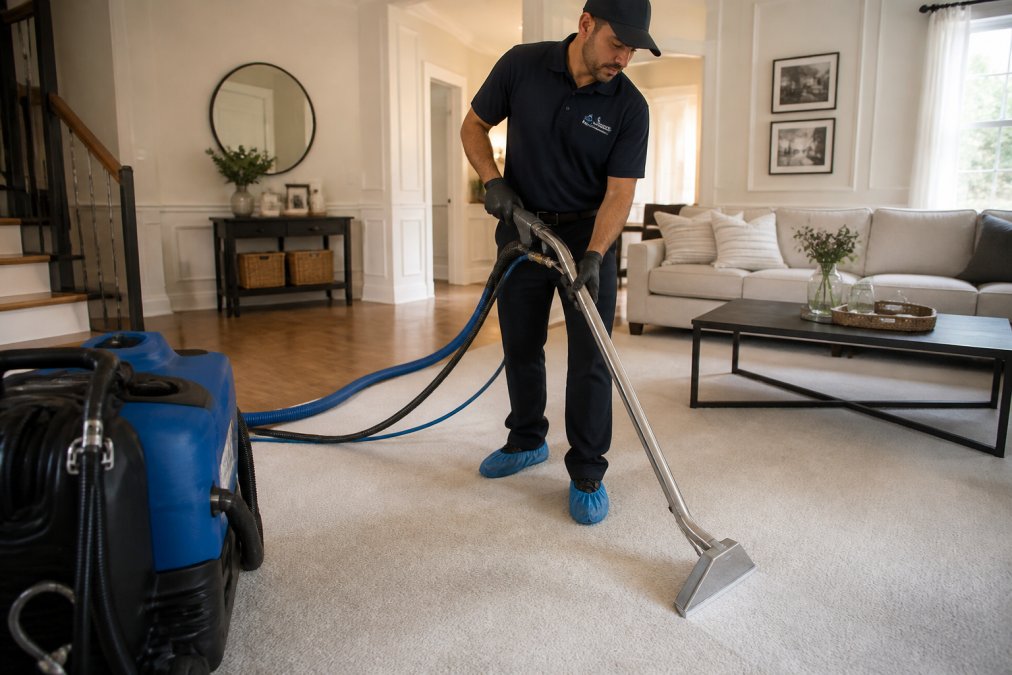
Hot water extraction, often called steam cleaning, injects heated water and solution, then vacuums it back out. It reaches deep into the backing and is the standard for heavily soiled carpet. Drying takes longer unless the technician uses a low-water variation.
Dry cleaning uses minimal moisture and compound-based agitation. Carpets are walkable almost immediately, which suits offices and commercial spaces. It lifts surface soil well but reaches less deep.
Encapsulation applies a polymer that crystallizes around soil particles so they vacuum away later. It’s fast, low-moisture, and popular for commercial maintenance schedules.
Ask what your drying time actually is, not what the brochure says. Low-water methods can bring carpets back to walkable condition in hours, while a standard steam pass can leave backing damp well into the next day. If kids or pets are in the house, that difference decides the schedule.
Residential vs. Commercial Pricing Models
Homes and businesses are priced on different logic, and understanding that logic is the difference between accepting a quote and negotiating one.
Residential work is quoted per job. The variables are visible ones: pet accidents, furniture, staircases, closets, and how long the carpet has gone since its last cleaning. A technician walks the space, counts rooms or measures square footage, notes soil level, and builds a one-time number. Because the job is a single visit, the company has to recover setup, chemical, and travel costs in that one invoice.
Commercial work is usually priced on a recurring maintenance contract, where the per-visit rate drops as frequency rises. That structure exists because commercial spaces prioritize predictable budgets over one-time deep cleans, and because recurring routes let a company amortize travel and setup across many stops. A restaurant with weekly traffic-lane cleaning needs a different plan than a homeowner cleaning twice a year.
How Frequency Tiers Actually Work
Most commercial pricing is built on tiers. A monthly plan costs more per visit than a quarterly plan, which costs more than a semi-annual plan, but the annual total usually runs the other direction, because more frequent visits mean lighter soil per visit and less labor each time. The company is trading a higher per-visit rate for a lower cost-per-square-foot-per-year.
Ask a commercial provider to quote the same square footage at three frequencies. The pattern you’ll see is the real pricing model, not the headline rate.
Production Rate: The Number Behind the Number
Commercial quotes are often built from a production rate, how many square feet a technician can clean per hour given the method, the soil level, and the furniture density. Open office carpet with light soil moves fast. A restaurant dining room with grease tracking and chair legs everywhere moves slowly. Two spaces of identical size can carry very different labor hours, and that difference is what separates a competitive bid from an unrealistic one.
After-Hours and Access Surcharges
Commercial work frequently happens outside business hours, and that scheduling carries a premium. Overnight crews, weekend windows, badge access, freight elevator scheduling, and building-management sign-offs all add coordination cost. A quote that ignores these will not survive the first invoice. Ask explicitly whether the rate assumes business-hours access.
What This Means for a Homeowner
If you run a business out of your home, or you own a rental property, ask for a maintenance schedule rather than a one-off quote. The recurring rate is almost always lower per visit, and the schedule prevents the deep-restoration pricing that comes with neglected carpet. For a single-family home, a one-time quote is usually the right structure, but if you plan to clean twice a year anyway, ask whether a two-visit plan prices better than two separate bookings.
Residential pricing recovers cost in one visit. Commercial pricing spreads it across a route. The structure, not the square footage, is what makes one quote look cheaper than another.
Hidden Fees Checklist: What to Ask Before You Book
The fastest way to avoid a surprise invoice is to ask about every line item before the technician arrives. Use this checklist on the phone.
- Is there a service call fee or minimum charge?
- Is furniture moving included, and is there a weight or size limit?
- Are stairs, landings, and closets priced separately?
- Is pre-treatment for stains included or added per area?
- Is pet odor treatment priced per room or per incident?
- Are spot treatment and post-cleaning protector separate charges?
- Is there an after-hours or weekend surcharge?
- Does the quote include disposal of the extracted wastewater?
- Is there a cancellation or rescheduling fee?
- Will the final price change if the technician finds heavier soil?
The most common mistake is accepting a phone quote without confirming what triggers an upcharge. If pre-treatment and pet odor work are not written into the estimate, expect them to appear on the invoice after the job is done.
How Often Should Carpets Be Professionally Cleaned?
Most households should schedule professional cleaning every 12 to 18 months, and homes with pets, allergies, or heavy foot traffic should aim closer to every 6 to 12 months. Frequency is a pricing factor most people ignore, because waiting longer means heavier soil and a costlier visit.
The math is straightforward. A carpet cleaned on schedule needs routine soil removal. A carpet left for three years needs pre-treatment, multiple passes, and possibly stain-specific work, all of which raise the bill. Regular cleaning also protects the carpet itself, since abrasive soil grinds fibers down over time and shortens the carpet’s usable life.
For businesses, traffic-lane cleaning on a quarterly or monthly cycle keeps the carpet presentable and avoids the deep-restoration pricing that comes with neglect.
Eco-Friendly and Green Cleaning Surcharges
Green cleaning is one of the angles most pricing guides skip entirely. Some companies charge a premium for certified organic or low-toxicity solutions, while others include them at no extra cost. Whether the surcharge is justified depends on what your household actually needs.
Health-conscious families often prioritize allergen removal and residue-free cleaning, because standard detergents can leave behind a sticky film that attracts new dirt. If a company charges more for green solutions, ask what certification the product carries and whether the method still removes the same soil load. A green label should not mean a weaker clean.
Households with pets, young children, or allergy sufferers who want allergen and residue reduction without harsh chemical smell.
Subscription and Maintenance Plan Pricing
Recurring plans are the quietest way to lower your per-visit cost. Companies that offer maintenance subscriptions can schedule predictable work, which lets them reduce the rate per visit compared with one-off bookings. You commit to a frequency; they commit to a lower price.
Before signing, confirm three things: what happens if you skip a visit, whether the rate is locked for the plan term, and whether add-on services are discounted or full price. A plan only saves money if you would have booked those cleanings anyway.
DIY vs. Professional Carpet Cleaning: Cost-Benefit Analysis
Renting a machine looks cheaper until you account for what it doesn’t do. Rental units typically clean surface soil, and they leave more water in the carpet than professional low-water equipment, which means longer drying and a real risk of mold in humid conditions.
DIY also carries hidden costs: the rental itself, cleaning solution, your time, and the risk of over-wetting or setting a stain permanently. Professional cleaning brings technician training, commercial-grade extraction, and pre-treatment chemistry that a rental cannot match. For light maintenance between professional visits, spot cleaning at home is sensible. For deep soil, pet odor, or allergen removal, the professional route usually costs less once you count the redo.
How to Read a Professional Carpet Cleaning Estimate
A trustworthy estimate is itemized, not a single number. But “itemized” is not enough, you need to know which line items are standard, which are optional, and which are the ones companies use to make a low headline number look competitive.
The Anatomy of a Real Estimate
A complete estimate names the method (hot water extraction, low-water extraction, dry compound, or encapsulation), lists each area by room or by measured square footage, calls out pre-treatment separately, and prices any add-ons individually. If any of those four elements is missing, you are looking at a range, not a quote.
The line items that should appear on almost every professional estimate:
- Base cleaning, priced per room or per square foot, with the room definition stated (for example, “up to 200 sq ft”)
- Pre-treatment, traffic lanes, spots, or heavy-soil areas, priced per area or included
- Stain-specific treatment, pet odor, red wine, ink, or dye, usually priced per incident
- Furniture moving, stated with a weight or size limit, or listed as not included
- Stairs and landings, almost always separate from room pricing
- Post-cleaning protector, optional, applied after cleaning, priced per area
- Disposal or waste handling, rarely itemized, but worth asking about
How to Compare Two Quotes Apples-to-Apples
Pick three rooms in your home and ask every company to price those same three rooms. Then ask each one to state, in writing, whether pre-treatment, furniture moving, spot treatment, and stairs are included. The lowest headline number often excludes two or three of those, which reappear as add-ons after the technician arrives.
The comparison that matters is not the base rate. It is the total for the same scope, with the same inclusions, on the same day.
Red Flags That Signal a Quote to Question
Three patterns should make you slow down. First, a price given without asking about your carpet’s condition, fiber, or soil level, that number is a guess dressed as a quote. Second, no mention of method or drying time, which usually means the company plans to use whatever is fastest for them. Third, a verbal quote with nothing in writing, which leaves you with no recourse if the invoice changes.
A fourth, subtler flag: a quote that is dramatically lower than every other bid. In this trade, labor and chemistry set a floor. A number far below that floor usually means the scope is smaller than you think, or the technician plans to upcharge on site.
Questions to Ask Before You Sign
- What method will you use, and what is the expected drying time?
- Is pre-treatment included, or priced per area?
- Is furniture moving included, and is there a weight or size limit?
- Are stairs, landings, and closets priced separately?
- Is pet odor treatment priced per room or per incident?
- Will the final price change if the technician finds heavier soil, and if so, by how much?
- Is there a cancellation or rescheduling fee?
What a Written Estimate Protects You From
A written estimate is not just a price, it is a scope document. It tells you what the company has agreed to do, what it has agreed to exclude, and what the price will be if nothing unexpected is found. When a technician discovers heavier soil than the phone conversation suggested, a written estimate is what keeps the conversation about scope rather than about trust.
For homeowners in Monmouth County and across central New Jersey, where older housing stock and finished basements often mean carpet that has gone years between cleanings, the soil-level clause is the one to read most carefully. Ask the company to state, in writing, what happens if the carpet needs more passes than the estimate assumed.
Read the estimate for what it excludes, not what it includes. The exclusions are where the final invoice is decided.
Frequently Asked Questions
How do professionals calculate carpet cleaning costs?
Most companies start with square footage or room count, then adjust for carpet fiber type, soil level, and add-ons like stain removal or pet odor treatment. A service call fee or minimum charge applies to small jobs. Because every home is different, pricing depends on quantity, condition, and the specific services requested. Request an on-site or virtual estimate so the technician can measure accurately and note any pre-treatment needs before quoting.
Does the type of carpet fiber affect cleaning prices?
Yes. Synthetic fibers like nylon and polyester generally clean with standard hot water extraction, while natural fibers such as wool or silk may require gentler methods, lower moisture, and specialized solutions. Delicate or blended fibers can add labor time and product cost. Tell your provider the fiber content when you request a quote so the estimate reflects the right method and avoids damage.
Are there extra fees for stain removal or pet odor treatment?
Often, yes. Standard cleaning covers surface soil and light spots, but stubborn stains, urine saturation, and odor neutralization require pre-treatment, enzyme application, or sub-surface flushing. These are typically quoted as add-ons. Ask whether the estimate includes spot treatment, pet odor work, and carpet protector application, and get any add-on charges confirmed in writing before the crew arrives.
How often should carpets be professionally cleaned to manage long-term costs?
Most households benefit from professional cleaning every 12 to 18 months, while homes with pets, children, or allergy sufferers may need it every 6 to 12 months. Commercial spaces with heavy foot traffic often schedule quarterly maintenance. Regular cleaning prevents soil from bonding to fibers, which keeps future cleanings faster and less expensive. A maintenance plan can spread the cost across the year.
Carpet cleaning pricing in 2026 rewards homeowners who ask the right questions before booking, not the ones who chase the lowest headline number. PowerPro Carpet Cleaning gives you an itemized estimate, organic green-certified solutions, and a low-water process that leaves carpets walkable within hours. Get started with PowerPro Carpet Cleaning and get a quote built around your carpet, not a generic per-room guess.