Table of Contents
- Which Comes First: Air Ducts or Carpets?
- Signs Your Air Ducts and Carpets Need Cleaning
- Tools and Equipment for Cleaning Air Ducts and Carpets
- Step-by-Step: How to Clean Air Ducts and Carpets Yourself
- Is Professional Air Duct Cleaning Actually Necessary?
- Benefits of Professional Carpet Cleaning
- How Often to Clean Air Ducts and Carpets
- Common Mistakes and Safety Risks to Avoid
- Post-Cleaning Air Filtration and Maintenance Schedule
- Conclusion
- Frequently Asked Questions
Last Updated: September 16, 2026
Which Comes First: Air Ducts or Carpets?
Always clean the air ducts before the carpets. This is the single most important sequencing rule in the entire process, and it is the one most homeowners get backwards.
The reason is simple physics. Duct cleaning dislodges dust, debris, and loose particulate matter that has settled inside the ductwork. Some of that material inevitably escapes into the room during the process. If your carpets have already been deep cleaned, that fallout lands directly on freshly cleaned fibers and undoes hours of work.
Clean ducts first, then carpets. That order protects your investment and keeps contaminant removal moving in one direction: out of the system, not back into the room.
At PowerPro Carpet Cleaning, we handle both services. Our technicians follow the same order on every job: ducts, then carpets, then a final filtration check.
Signs Your Air Ducts and Carpets Need Cleaning
Two clear signals tell you it is time: visible dust streaking around supply and return vents, and carpets that release a musty odor when walked on. Either one on its own is reason enough to schedule service.
Watch for these specific indicators:
- Dark streaks or “dirty spots” around register covers and ceiling vents
- A puff of dust when the HVAC system kicks on
- Persistent musty or stale smells that do not clear with ventilation
- Visible mold or microbial growth near the air plenum or drain pan
- Allergy symptoms that worsen indoors during heating and cooling season
- Carpet that feels gritty or matted even after routine vacuuming
- Pet odors that return within days of cleaning
Dust redistribution is the telltale sign. When your HVAC system runs, it should move clean air. If it is moving dust instead, the ductwork is the source.
Tools and Equipment for Cleaning Air Ducts and Carpets
Matching the tool to the task separates a real deep clean from a surface wipe-down. Ductwork and carpet fibers fail in completely different ways, so they need different equipment.
Air Duct Cleaning Tools
A HEPA vacuum is the foundation. It captures fine particulate instead of blowing it back into the room. Pair it with:
- Rotary brush systems for mechanical brushing of duct walls
- Negative air pressure equipment to contain debris at the source
- Compressed air whips for loosening caked-on buildup
- Chemical sanitizing solutions for microbial growth and odor
- Register cover removal tools and drop cloths for surface protection
Carpet Cleaning Tools and Solutions
Carpet needs brush agitation, heat, and controlled moisture. The essentials:
- A commercial-grade extractor or steam unit
- Pre-spray and spot treatments for pet stains and dander
- A low-water or dry-steam method to limit drying time
- Grooming tools to lift pile after cleaning
A common mistake is using a shop vacuum on ductwork. Standard vacuums exhaust fine dust back into the air, which is the opposite of contaminant removal. Only a HEPA-rated unit belongs in a duct system.
Step-by-Step: How to Clean Air Ducts and Carpets Yourself
You can handle light maintenance yourself. Full duct cleaning and deep carpet extraction are a different scale of job, but the sequence below works for both DIY upkeep and understanding what a professional crew does. It also flags the points where DIY effort can damage the system, which most guides leave out.
Step 1: Prep the Room and Protect Surfaces
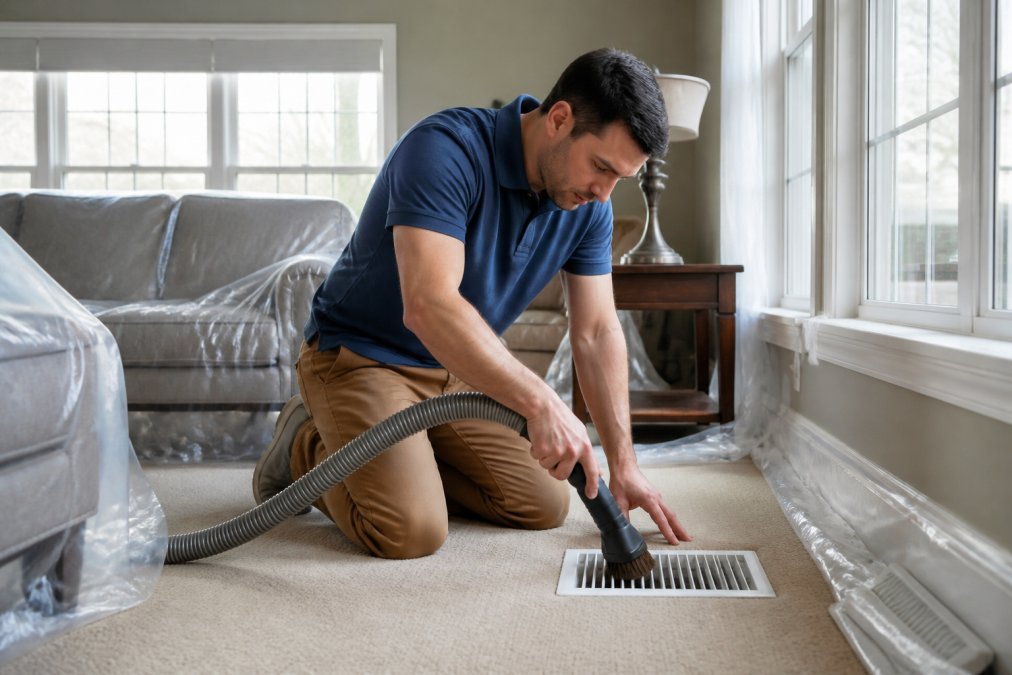
Turn off the HVAC system at the thermostat before you touch anything, and switch the breaker for the air handler if you can reach it safely. Seal supply and return vents you are not actively working on with plastic sheeting and painter’s tape. Move furniture, lay drop cloths, and remove register covers so you can reach into the duct openings. Photograph the register orientation before removal so you can reinstall the louvers the same way.
Step 2: Clean and Sanitize the Air Ducts
Work from the farthest vent toward the main trunk line. Use brush agitation to loosen buildup from the duct walls, then follow with a HEPA vacuum to capture what you have freed. Apply a sanitizing solution only after the debris is removed, never before. Check the blower motor and drain pan while you have access.
Where DIY goes wrong is at the mechanical components. Flexible duct runs are typically a thin foil-and-polyester sleeve over a wire helix. A rotary brush spun at high speed through flex duct can tear the inner liner, and a torn liner becomes a permanent dust trap that no amount of cleaning will fix. Rigid sheet-metal trunk lines tolerate brushing; flex branches usually do not. If your system is mostly flex, stop at the register boot and vacuum what you can reach rather than running a brush down the run.
The blower motor and evaporator coil are the other fragile points. Coil fins bend under almost no pressure, and a bent fin blocks airflow across that section of the coil permanently. A soft-bristle brush or a coil-specific cleaner applied from the access panel is the safe approach. Never spray liquid directly into the coil cabinet.
Aggressive brushing can also pop duct joints apart. A separated joint leaks conditioned air into a crawlspace or attic, raises static pressure, and forces the blower to run longer. If you hear a change in airflow after cleaning, have the duct system inspected before running it again.
Step 3: Deep Clean the Carpets
Pre-treat stains and high-traffic lanes, allow the dwell time printed on the product, then agitate the fibers with a groomer or brush. Extract with a low-water method so the carpet dries within hours rather than a full day. Finish by grooming the pile and running air movers or fans to speed drying.
Two mechanical details separate a real extraction from a surface pass. First, pass the wand slowly, in overlapping strokes, and use dry strokes (no spray) at the end of each lane to pull remaining moisture out of the pile. Second, keep the water temperature in the range the extractor manufacturer specifies; too hot can set certain stains and stress some synthetic backings, too cool leaves residue behind.
Step 4: Verify and Reset the System
Before you turn the HVAC back on, walk the house and confirm every register cover is seated, every plastic sheet is removed, and no tools are left inside a duct run. Replace the HVAC filter with a fresh one, then run the system on fan-only for 15 to 20 minutes to move any residual airborne particulate into the new filter rather than back through the rooms.
| Step | Task | Time Estimate | Key Tool |
|---|---|---|---|
| 1 | Prep room and protect surfaces | 20-30 min | Drop cloths, plastic sheeting |
| 2 | Clean and sanitize ducts | 1-2 hrs | HEPA vacuum, rotary brush (rigid duct only) |
| 3 | Deep clean carpets | 1-2 hrs | Extractor, pre-spray |
| 4 | Verify and reset system | 20-30 min | Fresh filter, fan-only run |
The order never changes: ducts, then carpets, then filtration. Skipping the final filter swap means the dust you just loosened gets pulled straight back through the return.
Is Professional Air Duct Cleaning Actually Necessary?
Professional air duct cleaning is necessary when you see visible contamination, smell persistent odors, or have household members with respiratory health concerns. For routine maintenance in a clean home, annual DIY upkeep may be enough.
The honest answer is that not every home needs a full professional service every year. What pushes a home from “optional” to “necessary” is evidence: mold growth, pest debris, recent renovation dust, or a documented spike in airborne allergens.
This is where equipment safety matters, and it is a gap most guides skip. Improper DIY duct cleaning can damage ductwork integrity, knock joints loose, and create leaks that raise static pressure and force your blower motor to work harder. A damaged duct system costs far more to repair than the cleaning would have.
If you are unsure whether your ducts cross that threshold, an inspection answers the question faster than guesswork.
Benefits of Professional Carpet Cleaning
The benefits of professional carpet cleaning go beyond appearance. Proper extraction removes dust mites, dander, and trapped allergens that routine vacuuming leaves behind, and it resets the fiber so the carpet wears more evenly.
Key advantages:
- Deeper clean that reaches the base of the pile, not just the surface
- Removal of germs, toxins, and allergens for a healthier living environment
- No dirt-attracting residue left behind when the method is done correctly
- Faster drying times that prevent mold and mildew growth
- Extended carpet lifespan by lifting embedded grit that abrades fibers
For pet owners, the difference is often the odor. Old urine deposits sit in the backing and pad, not the surface fibers. Surface cleaning never reaches them.
How Often to Clean Air Ducts and Carpets
The standard recommendation is to clean air ducts every 3 to 5 years and carpets every 12 to 18 months. Homes with pets, children, or allergy sufferers should shorten both intervals.
Adjust your home maintenance schedule based on these factors:
- Pets in the home: carpets every 6 to 12 months
- Allergy or asthma sufferers: ducts every 2 to 3 years
- Recent renovation or water damage: clean ducts immediately
- Heavy foot traffic or smoking indoors: carpets every 6 to 12 months
- New home purchase or move: clean both before moving in
Why the Two Schedules Should Be Synchronized, Not Separate
Most guides hand you two independent calendars. That is the mistake. Ducts and carpets sit on the same air loop: the HVAC system pulls air from the rooms, filters it, conditions it, and pushes it back through the supply registers. Every time the system runs, it moves whatever is loose in the carpet into the ductwork, and whatever is loose in the ductwork back onto the carpet. Cleaning them on unrelated schedules means one is always recontaminating the other.
The practical fix is to anchor both to a single trigger. Pick one event per year, such as the seasonal switch from heating to cooling, and use it to run the whole checklist. When you clean the ducts, clean the carpets within the same week, before the system runs hard again. When you clean the carpets, replace the HVAC filter the same day so the extraction releases are captured rather than recirculated.
The Integrated Schedule
| Task | Frequency | Why It Matters |
|---|---|---|
| Replace HVAC filter | Every 1-3 months | Protects filtration efficiency and keeps the loop clean |
| Vacuum high-traffic carpet | Weekly | Limits dust redistribution into the return |
| Inspect vents and registers | Monthly | Catches leaks and loose joints early |
| Professional duct cleaning | Every 3-5 years | Removes deep buildup the filter cannot catch |
| Professional carpet cleaning | Every 12-18 months | Resets fibers, removes allergens, cuts the dust load feeding the ducts |
| Duct + carpet deep clean together | Every 3-5 years | Eliminates cross-contamination between the two |
Sequencing the Two Services in One Visit
When both are due, book them back to back. Ducts first, carpets second, filter swap last. A single visit eliminates the window where a freshly cleaned carpet sits under a duct system that is about to shed debris, and it means the extraction moisture and the duct debris are handled in one drying-and-venting cycle instead of two.
If you can only do one this year, do the ducts. A dirty duct system will recontaminate a clean carpet within weeks, but a clean duct system will not undo a dirty carpet on its own. The duct side of the loop is the upstream source.
Mark the next due date for both services on the same calendar entry. Treating them as one maintenance event is what keeps the loop from resetting itself.
Consistency beats intensity. A home on a steady preventative maintenance cycle rarely faces the emergency deep clean that costs more and disrupts more.
Common Mistakes and Safety Risks to Avoid
The biggest risk is over-wetting. Too much moisture in carpet creates the exact conditions for mold and mildew growth, and it can seep into the pad and subfloor where it is far harder to dry.
Other mistakes to avoid:
- Cleaning carpets before ducts, which recontaminates clean fibers
- Using harsh chemicals that leave sticky residue and attract new dirt
- Skipping the blower motor and drain pan, common spots for microbial growth
- Running the HVAC system mid-clean and spreading debris through the house
- Ignoring ductwork integrity and loosening joints during aggressive brushing
Never pour liquid sanitizer directly into ductwork or saturate carpet backing. Excess moisture trapped in a duct or pad fuels mold growth within days, and remediation costs far more than the cleaning did.
Post-Cleaning Air Filtration and Maintenance Schedule
What you do after cleaning determines how long the results last. Upgrade to a high-efficiency filter, replace it on schedule, and keep the system sealed so contaminants stay out.
Post-cleaning air filtration is the step most homeowners skip entirely. After a deep clean, your system is at its cleanest point. A quality filter protects that baseline.
A simple integrated schedule keeps everything aligned:
| Task | Frequency | Why It Matters |
|---|---|---|
| Replace HVAC filter | Every 1-3 months | Protects filtration efficiency |
| Vacuum high-traffic carpet | Weekly | Limits dust redistribution |
| Inspect vents and registers | Monthly | Catches leaks early |
| Professional duct cleaning | Every 3-5 years | Removes deep buildup |
| Professional carpet cleaning | Every 12-18 months | Resets fibers, removes allergens |
This is the integrated home maintenance schedule that ties the whole system together. Ducts, carpets, and filtration are one connected loop, not three separate chores.
Conclusion
Keeping ducts and carpets clean in the right order is what separates a home that stays fresh from one that keeps recycling the same dust and allergens. Most homeowners get the sequence wrong and pay for it twice.
PowerPro Carpet Cleaning has been providing expert residential and commercial cleaning services since 1989, using organic, green-certified solutions and a low-water method that lets carpets dry within hours. Our technicians are trained to Inspection Institution of Cleaning and Restoration standards, and we are available 24/7 for emergencies across Monmouth County and central New Jersey.
Call us at 848 347 3201 to schedule duct and carpet cleaning in one appointment and get a healthier home without the guesswork.
Frequently Asked Questions
Is professional air duct cleaning actually necessary?
Not always. If you see visible dust blowing from vents, notice musty odors, or have had recent remodeling, professional cleaning can help. The EPA recommends cleaning when there is visible mold, vermin infestation, or clogged ducts. Otherwise, regular vacuuming and filter changes may be enough. For homes in Monmouth County and central New Jersey, a professional inspection can determine if cleaning is needed.
How often should you clean your carpets and air ducts?
Carpets should be deep cleaned every 12 to 18 months, or every 6 to 12 months in homes with pets or allergies. Air ducts typically need cleaning every 3 to 5 years, but more often if you have pets, smoke, or recent renovations. In Manalapan, Monroe, Eatontown, and Howell Township, seasonal pollen and humidity can shorten these intervals, so adjust based on visible dust and indoor air quality.
Can I clean my own air ducts effectively?
You can handle light maintenance, like vacuuming registers and changing filters. But without a HEPA vacuum and rotary brush, you will not reach deep into the ductwork. DIY methods can also damage ductwork if you use too much pressure. For thorough cleaning, especially in older homes in central New Jersey, professional equipment and training are safer and more effective.
What are the benefits of professional carpet and duct cleaning?
Professional cleaning removes deep-seated dirt, allergens, and pet dander that regular vacuuming leaves behind. It can improve indoor air quality, extend the life of your carpets, and reduce musty odors. For families in Monmouth County dealing with allergies or pets, professional cleaning also helps prevent mold growth and keeps your HVAC system running efficiently. Many companies, like PowerPro Carpet Cleaning, use organic solutions safe for kids and pets.